

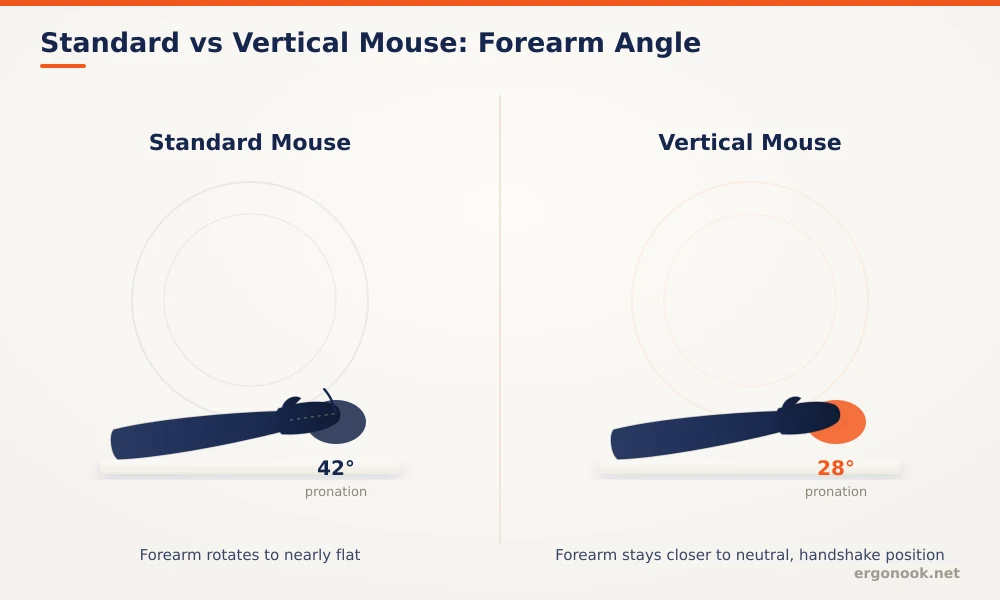
Do vertical mice help with wrist pain? For pain from forearm rotation, yes. A 2013 study found a vertical mouse cut forearm pronation from 42 to 28 degrees and lowered wrist extensor muscle activity, versus a standard mouse. It won’t help pain caused by a mouse that’s the wrong size or a desk set too high.
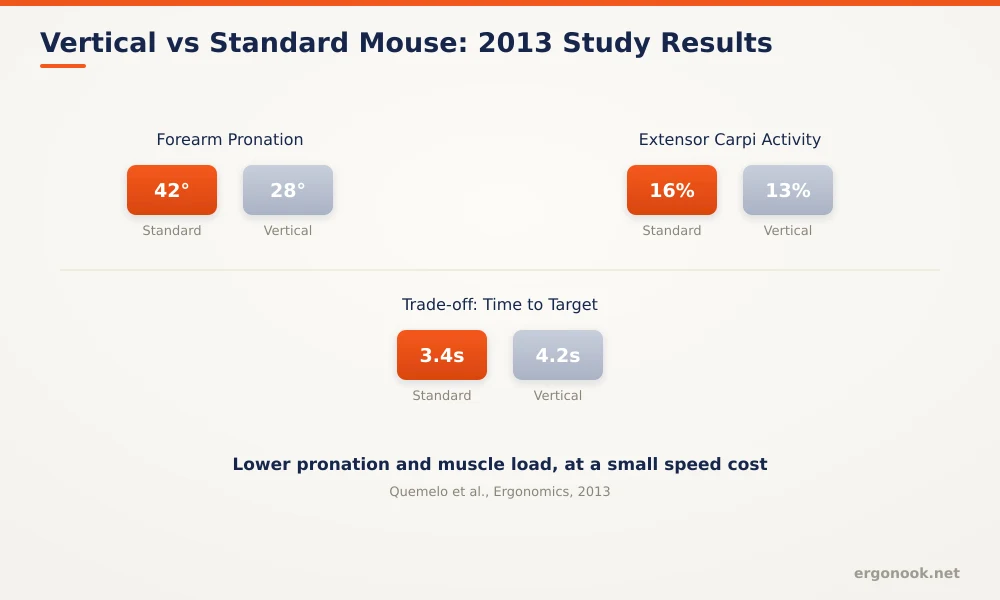
- A study in the journal Ergonomics found a vertical mouse reduced forearm pronation from 42 to 28 degrees and cut extensor carpi muscle activity from 16% to 13%, compared with a standard mouse.
- The same study found pointing was slower with the vertical mouse, 4.2 seconds to target versus 3.4 seconds, so accuracy takes an adjustment period.
- OSHA’s guidance recommends keeping the wrist in a straight, neutral posture while using a mouse, not bent up, down, or to the side.
- Vertical mice range from about $20 for budget models to $120 for premium ones. Price doesn’t guarantee the angle fits your hand size.
This article is for general educational purposes and is not medical advice. If you have persistent pain, numbness, or tingling, talk to a doctor or physical therapist before changing your equipment or routine. For general workplace ergonomics guidance, see resources from OSHA and NIOSH.
In this article:
- What a vertical mouse actually does
- What the research says about vertical mice and wrist pain
- Who vertical mice are worth it for
- Who should skip a vertical mouse
- How much does a good vertical mouse cost?
- Vertical mouse vs trackball and other alternatives
- Common mistakes that waste the money
- Frequently asked questions
What a Vertical Mouse Actually Does
A vertical mouse turns your hand into a handshake position instead of the flat, palm-down grip a standard mouse forces. That flat grip holds your forearm in a rotated position, called pronation, for hours at a time. It’s a position your arm can hold briefly without issue, but it accumulates strain over a full workday of repetition. A vertical mouse changes the grip angle anywhere from 45 to 90 degrees depending on the model, which keeps your forearm closer to its relaxed, neutral position, thumb pointing up rather than palm pointing down.
What the Research Says About Vertical Mice and Wrist Pain
A study published in the journal Ergonomics measured muscle activity and forearm movement in 16 subjects using a standard mouse and a vertical mouse. It found the vertical mouse reduced forearm pronation from 42 to 28 degrees and cut extensor carpi muscle activity from 16% to 13%, both statistically significant differences (Quemelo et al., Ergonomics, 2013). The same study found a real trade-off: pointing to a target took longer with the vertical mouse, 4.2 seconds versus 3.4 seconds, even though overall user satisfaction with the vertical mouse was good.
Separately, OSHA’s guidance for pointing devices recommends keeping the wrist in a straight, neutral posture while mousing, and notes that a mouse positioned too far to the side encourages exactly the kind of deviation a vertical grip helps avoid (OSHA). Neither source claims a vertical mouse eliminates wrist pain. Both point to the same mechanism: less forearm rotation and lower muscle load during the hours you’re actually gripping the mouse.
Who Vertical Mice Are Worth It For
A vertical mouse tends to help most if your discomfort is specifically from constant forearm rotation, the kind that shows up as a dull ache after long stretches of mousing. It’s also worth trying if you already have a diagnosed condition like carpal tunnel syndrome or tendinitis and your doctor has cleared equipment changes as one part of managing it, since a neutral grip is one tool among several rather than a replacement for treatment. Fine, precise work like photo editing usually isn’t the deciding factor either way, since most people keep a secondary mouse on hand for tasks that need it during the adjustment period. If that describes your situation, our picks for the best vertical mouse for wrist pain narrow the field to models worth trying.
Who Should Skip a Vertical Mouse
If the strain is coming from something else entirely, like a mouse that’s too small for your hand, a desk that’s too high forcing your shoulder up, or a chair armrest at the wrong height, a vertical mouse won’t fix it, since the underlying cause is still there and untouched. Left-handed users also have a much smaller selection to choose from, since most vertical mice are designed for right-handed use first, which can make finding a good fit harder regardless of how well the mechanism works. Anyone doing fast-paced gaming should also think twice: flat mice with higher precision tracking are still the norm for that use case, and the vertical angle’s speed trade-off matters more there than in general productivity work.
How Much Does a Good Vertical Mouse Cost?
Price tracks build quality and sensor precision more than the angle itself, since even budget models use the same basic handshake geometry.
| Tier | Price | What You Get |
|---|---|---|
| Budget | About $20 to $35 | Basic handshake angle, wired, fewer size options |
| Mid-range | About $40 to $70 | Wireless, adjustable DPI, better build quality |
| Premium | About $80 to $120 | Refined sensor precision, multiple device pairing, better long-session comfort |
Sizing and grip style matter as much as the angle. Vertical mice come in a range of angles and sizes, and the angle that helps one person can feel awkward for another depending on hand size and grip style, palm grip versus fingertip grip. A mouse that’s too large or too small for your hand undermines the ergonomic benefit regardless of how good the vertical angle is in theory, so checking a generous return window matters more here than with a standard mouse.
Vertical Mouse vs Trackball and Other Alternatives
A vertical mouse isn’t the only ergonomic option for reducing forearm strain. A trackball keeps your hand mostly stationary while a thumb or finger moves the ball, removing arm movement entirely rather than just changing the wrist angle, useful for anyone with limited desk space or shoulder strain from reaching. A contoured mouse, angled but not fully vertical, offers a smaller adjustment than a full vertical mouse, which can be a gentler starting point for someone unsure whether they’ll adapt to a steep angle. None of these is universally better. The right choice depends on which specific movement, rotation, reaching, or gripping, is contributing most to your discomfort. If keyboard position is also part of the picture, our guide on ergonomic keyboard vs regular keyboard covers the same trade-off for typing.
Common Mistakes That Waste the Money
- Giving up during the adjustment period. Accuracy and speed usually dip for the first one to two weeks. That’s normal and not a sign the mouse doesn’t fit you, it’s a sign your hand hasn’t adapted to the new angle yet.
- Buying the wrong size for your hand. A mouse that’s too large or too small undermines the angle’s benefit regardless of price, so check a return window before committing.
- Expecting it to fix a problem it can’t address. A desk that’s too high or a chair armrest at the wrong height will keep causing strain no matter which mouse you use.
- Skipping the backup mouse during the transition. Keeping the old mouse plugged in for tasks that need fine precision, like photo editing, makes the adjustment period less frustrating.
Frequently Asked Questions
How long does it take to get used to a vertical mouse?
Most people adjust within one to two weeks of regular use, though accuracy for precise tasks may take longer to fully recover.
Do vertical mice work for gaming?
They’re generally built for productivity use rather than fast-paced gaming, where flat mice with higher precision tracking are more common.
Is a vertical mouse better than an ergonomic regular-shaped mouse?
It depends on where your discomfort comes from. A vertical mouse specifically targets forearm rotation, while a contoured regular mouse mainly addresses hand shape and grip comfort.
Do vertical mice help with elbow pain too, not just wrist pain?
Some people find relief in the elbow and forearm as well, since reduced rotation lowers strain along the whole forearm, though the primary design intent targets the wrist and forearm specifically.
A vertical mouse helps most when forearm rotation is the actual source of your discomfort, backed by measurable reductions in pronation and muscle activity. It’s one tool among several, not a fix for a desk, chair, or mouse size that’s still working against you.





Write Your Review
No reviews yet. Be the first to share your experience!