

A footrest turns a big and tall chair into something closer to a recliner for short breaks, letting you extend your legs without getting up or reaching for a separate ottoman. The design varies more than shoppers expect: some footrests stay hidden until pulled out, others are permanently visible, and a handful pair the footrest with a kneading massage system built into the lumbar area. This guide to big and tall office chairs compares six chairs with a footrest, spanning 300 to 750 pounds in rated capacity.
Every footrest design here, hidden, pull-out, or integrated, along with the recline range it pairs with, is confirmed directly from that chair’s own product listing. Disclosure: this article contains Amazon affiliate links. If you buy through one, we may earn a commission at no extra cost to you, and that commission never influences which chairs make this list or how they are ranked.

Pros
- 750 pound rating covers users well beyond what most big and tall chairs accommodate.
- Lumbar airbag gives adjustable firmness control beyond a fixed foam pad.
- 90 to 155 degree recline range covers both upright work and a deep break position.
Cons
- This is a newer listing with a limited review history so far; check current buyer feedback before ordering.
- Larger frame takes up more floor space than the lower-capacity chairs in this roundup.
WINVO rates this chair to 750 pounds, among the highest capacities covered in this roundup, built with a wide seat and high back specifically for users at the top of the big and tall weight range.
A lumbar airbag provides adjustable lower back firmness, and the recline spans 90 to 155 degrees, covering both an upright working posture and a deep break position with the integrated footrest extended.
PU leather upholstery rounds out a chair aimed squarely at buyers who need capacity well beyond what standard big and tall chairs offer, though as a newer listing, current reviews are worth checking before ordering.
Weight capacity: 750 pounds.
Recline: 90 to 155 degrees.
Lumbar: airbag, adjustable.
Footrest: integrated.
Upholstery: PU leather.
This chair suits a buyer who needs a rating well above the standard big and tall range, along with both a footrest and deep recline.
Because it is a newer listing, check current buyer reviews before ordering rather than relying on early ratings alone.
Buyers comfortably under 500 pounds may not need this much capacity and could save with a lower-rated chair instead.

Pros
- 165 degree recline is deeper than most manual reclining chairs in this feature category.
- 23.6 inch seat width gives noticeably more hip and thigh room than a standard-width big and tall seat.
- Steel frame construction is built specifically for plus-size users rather than a standard frame stretched to fit.
Cons
- This is a newer listing with a limited review history so far; check current buyer feedback before ordering.
- No massage or heat functionality despite the deep recline.
StellaMia rates this chair to 400 pounds and builds it around a 23.6 inch extra-wide cushioned seat, sized specifically for plus-size users on a heavy-duty steel frame rather than a standard frame simply padded wider.
The recline reaches 165 degrees, deeper than most manual reclining chairs in this feature category, paired with a hidden footrest that extends for a near nap-ready position without staying visible the rest of the time.
High-density foam, adjustable armrests, and built-in lumbar support round out a chair aimed at both extended seat width and a genuinely deep recline in the same package.
Weight capacity: 400 pounds.
Seat width: 23.6 inches.
Recline: up to 165 degrees.
Footrest: hidden, pull-out.
Frame: heavy-duty steel.
This chair suits a buyer who wants both extra seat width and a deep 165 degree recline in one chair.
Because it is a newer listing, check current buyer reviews before ordering rather than relying on early ratings alone.
Buyers who want massage or heat functionality should compare it against the chairs elsewhere in this roundup that include those features.

Pros
- Strong, well-established review history among the picks in this roundup.
- Wide enough seat pan to sit cross-legged, a detail most executive-style chairs do not accommodate.
- Spring cushion construction adds durability compared with foam-only seats.
Cons
- 400 pound rating sits in the lower half of this roundup.
- No massage or airbag lumbar option, support is fixed in place.
EXCEBET rates this chair to 400 pounds and builds the seat around a spring cushion with high-density elastic sponge, sized generously enough to allow cross-legged sitting, a detail most executive-style big and tall chairs do not accommodate.
An integrated footrest pairs with lumbar support built directly into the high-back design rather than a separate adjustable or inflatable piece, backed by a strong, well-established review history relative to several of the newer listings in this feature category.
Deluxe, durable PU leather upholstery covers the frame, positioning this as a dependable, lower-maintenance option among the more feature-dense chairs elsewhere in this roundup.
Weight capacity: 400 pounds.
Cushion: spring, high-density elastic sponge.
Footrest: integrated.
Lumbar: built into high-back design.
Upholstery: PU leather.
This chair fits a buyer who wants a wide, cross-legged-friendly seat with a strong review history behind it.
Buyers who want adjustable or airbag lumbar firmness should compare it against the other lumbar designs elsewhere in this roundup.
Buyers above 400 pounds should choose a higher-capacity chair instead.

Pros
- Infinite-angle recline lock beats the three fixed preset angles common on most reclining chairs.
- Hidden footrest keeps a clean profile when not extended, unlike a permanently visible footrest bar.
- 20 spring packs add durability under sustained daily use compared with foam-only cushions.
Cons
- 300 pound rating is the lowest capacity among the picks in this roundup.
- Recline range tops out at 135 degrees, more limited than the deeper-reclining chairs elsewhere here.
Amseatec rates this chair to 300 pounds and builds the recline around infinite-position locking technology, holding at any angle between 90 and 135 degrees rather than only the three preset stops found on most reclining chairs.
A hidden footrest pulls out only when needed, keeping a cleaner profile the rest of the time compared with a permanently visible footrest bar, paired with 20 internal spring packs in the cushion for durability under sustained daily use.
High-back leather upholstery and adjustable lumbar support round out a chair backed by a strong, well-established review history relative to some of the newer listings in this feature category.
Weight capacity: 300 pounds.
Recline: infinite lock, 90 to 135 degrees.
Footrest: hidden, pull-out.
Cushion: 20 internal spring packs.
Lumbar: adjustable.
This chair fits a buyer who wants to lock the recline at a precise custom angle rather than settling for a few fixed positions.
Buyers above 300 pounds should choose one of the higher-capacity chairs elsewhere in this roundup.
The hidden footrest is worth prioritizing for anyone who prefers a cleaner look when the footrest is not in use.

Pros
- Kneading massage ball replicates a real circular massage motion rather than a simple flat vibration pad.
- Cushion thickness is meaningfully above the stated industry average for this category.
- Removable lumbar cushion lets you use the chair with or without the extra pad depending on preference.
Cons
- This is a newer listing with a limited review history so far; check current buyer feedback before ordering.
- Gaming-chair styling may not suit a strictly traditional executive office look.
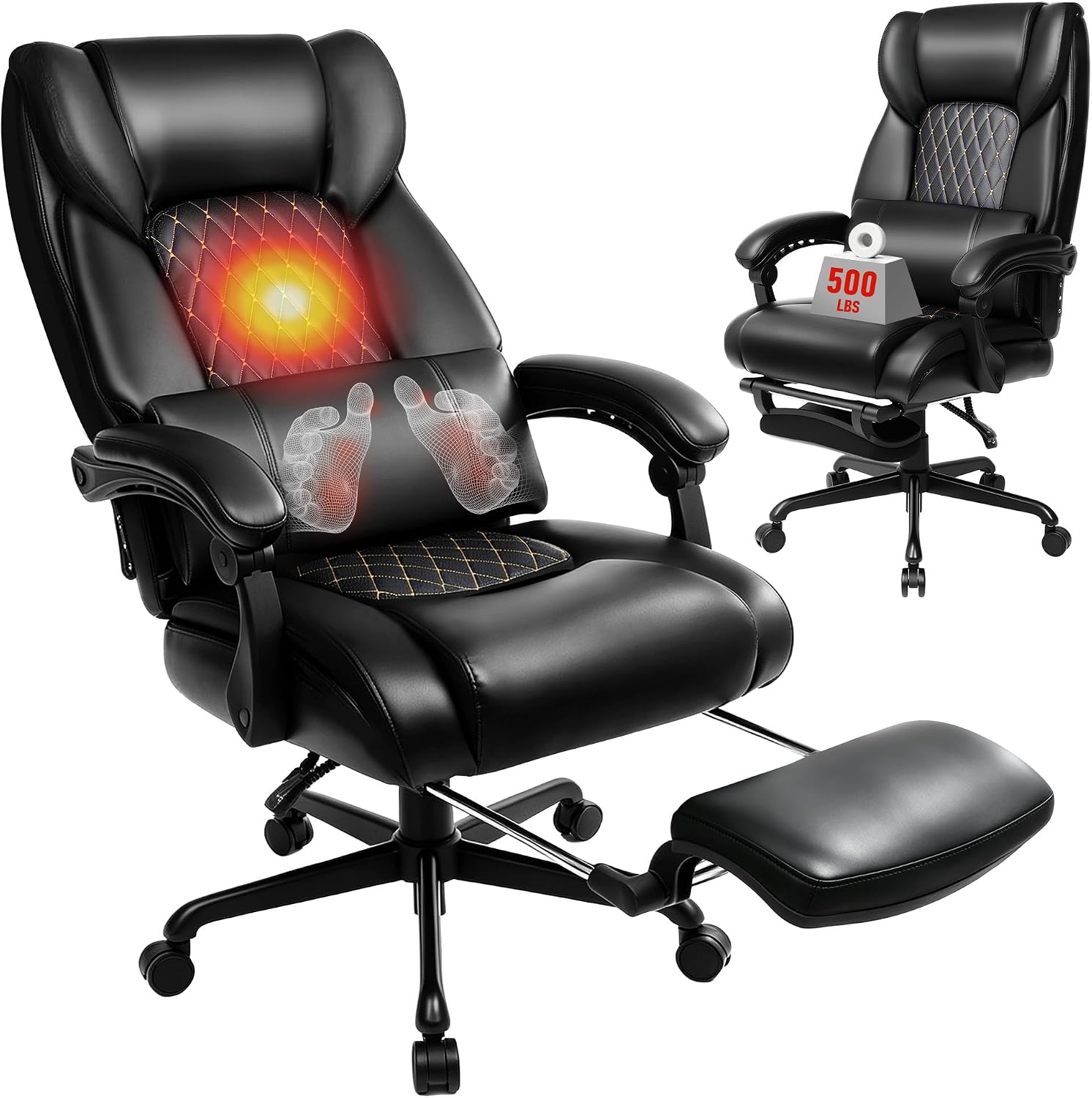
CHAIRKER rates this chair to 500 pounds and builds the seat around a 5.71 inch spring-packed high-density foam cushion, notably thicker than the 3.5 inch average the listing cites for this category, on a 21.65 inch wide seat pan.
The standout feature is a built-in dual-direction kneading massage ball at the lumbar position, designed to replicate a real circular thumb massage rather than a flat vibration pad, paired with a removable sponge-filled cushion for buyers who want the option to use the chair without it.
Padded linkage armrests and an integrated footrest round out a chair positioned around tactile comfort features more than raw weight capacity alone.
Weight capacity: 500 pounds.
Cushion: 5.71 inch spring-packed foam.
Seat width: 21.65 inches.
Massage: dual-direction kneading lumbar ball.
Footrest: integrated.
This chair fits a buyer who wants a genuine kneading massage motion rather than a simple flat vibration pad.
Because it is a newer listing, check current buyer reviews before ordering rather than relying on early ratings alone.
Buyers who want a strictly traditional executive look should compare it against the more conventional leather chairs elsewhere in this roundup.

Pros
- 7 inch cushion thickness is notably deeper than most competing chairs in this price range.
- 22 inch seat width gives more hip room than a standard-width executive chair.
- Premium upholstery gives it a more polished executive look than gaming-style alternatives.
Cons
- 400 pound rating sits in the lower half of this roundup.
- No recline angle beyond a standard tilt is specified, more limited than the deep-reclining chairs elsewhere here.
Efomao rates this chair to 400 pounds and builds the seat around a 7 inch thick cushion, deeper than most competing chairs in this price range, on a 22 inch wide seat pan aimed at reducing fatigue over long desk sessions.
An integrated footrest supports reclined breaks, while premium upholstery gives it a more polished, traditional executive look compared with the gaming-chair styling common elsewhere in this feature category.
Heavy-duty construction throughout rounds out a chair positioned around cushion depth and seat width as its primary selling points rather than a deep recline or massage functionality.
Weight capacity: 400 pounds.
Cushion: 7 inches thick.
Seat width: 22 inches.
Footrest: integrated.
Upholstery: premium.
This chair suits a buyer who prioritizes cushion depth and a traditional executive look over a deep recline or massage functionality.
Buyers above 400 pounds should choose a higher-capacity chair elsewhere in this roundup.
The 22 inch seat width is worth prioritizing for anyone who has found standard executive chairs too narrow.
Buying Guide
Hidden versus permanently visible footrests
A hidden footrest tucks away under or behind the seat until pulled out, keeping a cleaner look the rest of the time, which matters more in a shared living space where the chair is visible when not in use. A permanently visible footrest, often built as a fixed bar or extension near the base, stays in the same position at all times and typically requires no manual pulling or folding to access, at the cost of a bulkier resting profile even when not extended. Neither is objectively better; it comes down to whether visual profile or effortless access matters more to you. If you work in a shared office or a room that doubles as a guest space, the hidden design tends to look more intentional when not in use. For more on how footrest position interacts with overall seated posture during breaks, see our guide on what to look for in an ergonomic office chair.
A footrest without enough recline range still leaves you half-reclined
A footrest is most useful when paired with a recline deep enough to actually support your weight in a resting position; extending your legs while sitting mostly upright can feel awkward rather than restful. Look at the stated recline range alongside the footrest feature rather than treating them as independent specs. A chair that reclines to 155 or 165 degrees with a footrest functions closer to a genuine nap position, while a chair with only a light recline and a footrest may leave you feeling propped up rather than supported. As a rough guide, treat anything under 120 degrees as a leg-rest for upright sitting and anything past 145 degrees as a genuine break position.
Massage-integrated footrest chairs add a distinct comfort layer
A small number of footrest chairs pair the leg support with a kneading or vibration massage system at the lumbar position, aimed at the idea that a footrest break is already a rest moment, so adding massage extends that same idea to the lower back. If this combination appeals to you, check whether the massage motor is a simple flat vibration pad or a kneading design that replicates a circular motion, since the two feel noticeably different in practice. A kneading motor typically costs more to manufacture and shows up on fewer listings, so treat it as a genuine upgrade rather than an interchangeable label with basic vibration.
Seat width matters as much as the footrest itself for a comfortable break
A footrest lets you extend your legs, but a narrow seat pan can still leave your hips and thighs cramped during that same break. Several chairs in this roundup pair the footrest with an explicitly wider seat, in the 21 to 23.6 inch range, aimed at making the reclined position genuinely comfortable rather than just technically available. Measuring your own hip width against a listed seat width, rather than assuming any big and tall label automatically fits, is a quick way to avoid a cramped fit after the chair arrives. If persistent discomfort continues regardless of footrest or seat width, it is worth reading our breakdown of signs your office chair is bad for your back to rule out other contributing factors.
A footrest changes leg and hip position during a recline, but seat cushion construction affects comfort during the upright hours that make up most of a workday. If tailbone pressure is a bigger concern for you than recline comfort specifically, our seat cushion for tailbone pain guide covers that separately.
Final Thoughts
Buyers who want precise control over their reclined position should look at the Amseatec 300 Lb Capacity Chair with Infinite-Lock Footrest, whose infinite-lock recline holds at any angle between 90 and 135 degrees rather than only a few fixed stops, with a hidden footrest that stays out of sight until needed. Anyone who needs a higher weight rating along with a deep recline and footrest should consider the WINVO 750 Lb Capacity Chair with Lumbar Airbag and Footrest, which pairs a 750 pound capacity with a lumbar airbag and a 90 to 155 degree recline range. Between precise angle control at an entry-level capacity and maximum capacity with a deeper recline, the right choice comes down to which constraint matters more for your specific situation. Buyers who fall comfortably within both chairs weight ratings can also simply pick based on price and upholstery preference, since both cover the core footrest and recline functionality this roundup was built around.
FAQ
Is a built-in footrest better than a separate ottoman?
A built-in footrest is more convenient since it extends and retracts with the chair itself, without needing to position a separate piece of furniture at the right distance every time. A separate ottoman offers more flexibility in height and angle and can be used independently of the chair, which matters if you want leg support without reclining the backrest at all. The tradeoff is floor space: an ottoman takes up permanent room even when you are not using it, while a built-in footrest disappears when retracted.
Do footrests add significant weight or bulk to a big and tall chair?
A footrest mechanism adds some weight and, on hidden designs, some mechanical complexity compared with a chair that has none, but it is a relatively small addition compared with the overall frame and base weight of a big and tall chair. The bigger practical consideration is usually floor space when the footrest is extended, not the weight it adds to the chair itself. Measure how far the footrest extends from the base before buying if your desk sits close to a wall or another piece of furniture.
Can I retrofit a footrest onto a chair that does not have one?
Standalone footrests and ottomans can be used alongside any chair regardless of whether it has a built-in mechanism, and this is often the simplest option if you already own a chair you otherwise like. A built-in footrest stays properly aligned with the chair’s recline angle automatically, while a separate footrest requires manually repositioning it to match.
How often should I use the footrest and recline during a workday?
There is no fixed rule, but alternating between upright focused work and short reclined breaks throughout the day is generally more comfortable than staying in one position for hours at a stretch. Treat the footrest as a tool for deliberate short breaks rather than a permanent working posture, since prolonged reclining is not typically suited to active tasks like typing. A five to ten minute reclined break every couple of hours is a reasonable starting point to figure out what fits your own routine.




Write Your Review
No reviews yet. Be the first to share your experience!