

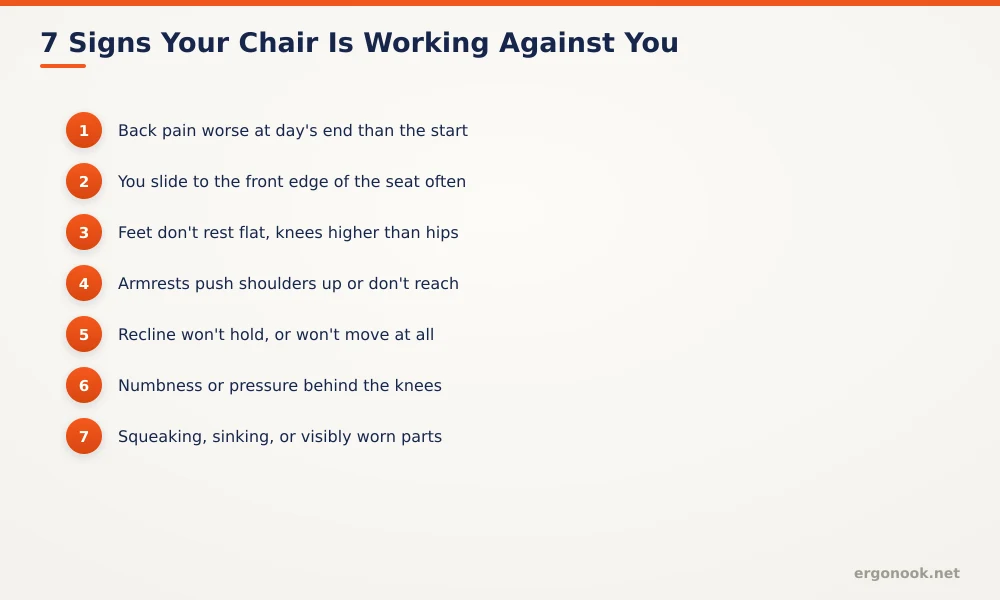
The clearest signs your office chair is bad for your back: pain that’s worse at the end of the day than the start, constantly sliding to the front edge of the seat, and feet that don’t rest flat with knees higher than your hips. Most of these trace back to a chair that’s either unadjusted or lacks the adjustment your body needs, not necessarily a chair that needs replacing.
- Back pain that builds through the workday and eases overnight often points to a chair or setup problem rather than a separate medical issue.
- Sitting at the front edge of the seat cuts off lumbar support entirely, one of the most common habits in chairs that otherwise have decent ergonomics built in.
- Numbness behind the knees usually means the seat is too deep for your leg length, not that the cushioning is too firm.
- Many of these signs are fixable with correct adjustment. Structural issues like sinking, squeaking, or broken recline mechanisms mean it’s time to replace the chair.
This article is for general educational purposes and is not medical advice. If you have persistent or worsening back pain, talk to a doctor or physical therapist before assuming your chair is the only cause.
In this article:
- 7 signs your office chair is bad for your back
- What to do if you spot these
- When it’s worth replacing vs fixing
- Frequently asked questions
7 Signs Your Office Chair Is Bad for Your Back
1. Pain That’s Worse at the End of the Day
Discomfort that builds steadily from morning to evening, then eases overnight, is the clearest pattern linking pain to your chair rather than a separate condition. It happens because a chair without proper lumbar support lets your lower back round into a posterior pelvic tilt, flattening its natural curve and pushing more load onto the discs and surrounding muscles over hours of sitting (Cleveland Clinic). Check whether your lumbar support actually meets the curve of your lower back before assuming the chair itself is the problem.
2. You’re Always Sliding to the Front Edge
Catching yourself perched at the front of the seat, rather than settled against the backrest, is one of the most common habits in chairs that otherwise have decent ergonomics built in. It happens because the seat depth is too long for your legs, forcing you forward to keep your knees from hitting the seat edge. Adjust the seat depth, or scoot back and check whether a lumbar cushion helps bridge the gap if the chair has no depth adjustment.
3. Feet Don’t Rest Flat, Knees Higher Than Hips
Mayo Clinic Health System’s posture guidance notes that your ears, shoulders, and hips should line up in a straight column when you sit, which is hard to maintain if your knees sit noticeably above your hip line (Mayo Clinic Health System). This usually means the seat is too high for your leg length. Lower the seat height, and add a footrest if your feet still don’t reach the floor comfortably once the height is otherwise correct.
4. Armrests Push Your Shoulders Up or Don’t Reach
Armrests set too high push your shoulders toward your ears for hours at a time, creating upper back and neck tension that often gets blamed on a separate cause entirely. Armrests set too low do nothing, leaving your shoulders to support your arms’ weight instead. If your chair’s armrests aren’t height-adjustable at all, removing them is sometimes better than leaving them at a fixed, wrong height.
5. The Recline Won’t Hold, or Won’t Move
A tilt tension that’s too loose lets the backrest feel unstable every time you lean back, so you unconsciously avoid reclining and stay locked in one static position instead. A mechanism that’s stuck and won’t recline at all has the same effect. Frequent small position changes matter for spinal health, so a chair that discourages movement, whichever direction the mechanism is failing, works against you either way.
6. Numbness or Pressure Behind the Knees
Pins-and-needles or numbness behind the knee points to a seat that’s too deep, pressing into the sensitive area behind the knee and restricting circulation. This is a seat depth problem, not a cushioning problem, so adding more padding usually doesn’t help and can make it worse by pushing you even closer to the seat edge.
7. Squeaking, Sinking, or Visibly Worn Parts
Unlike the first six signs, this one usually isn’t fixable with an adjustment. A gas cylinder that slowly sinks under weight, foam that’s visibly compressed and no longer springs back, or a frame that creaks under normal movement are signs of mechanical wear that adjustment can’t reverse.
What to Do If You Spot These
Work through your chair’s actual adjustments before assuming you need a new one. Seat height, seat depth, lumbar position, and armrest height solve the first four signs on this list in most cases, at no cost beyond a few minutes. If your current chair doesn’t have the adjustment range to fix the problem, even set correctly, that’s when it’s worth shopping. Our chairs for lower back pain roundup covers models scored specifically on lumbar adjustability and seat depth range, the two adjustments most of these signs trace back to.
When It’s Worth Replacing vs Fixing
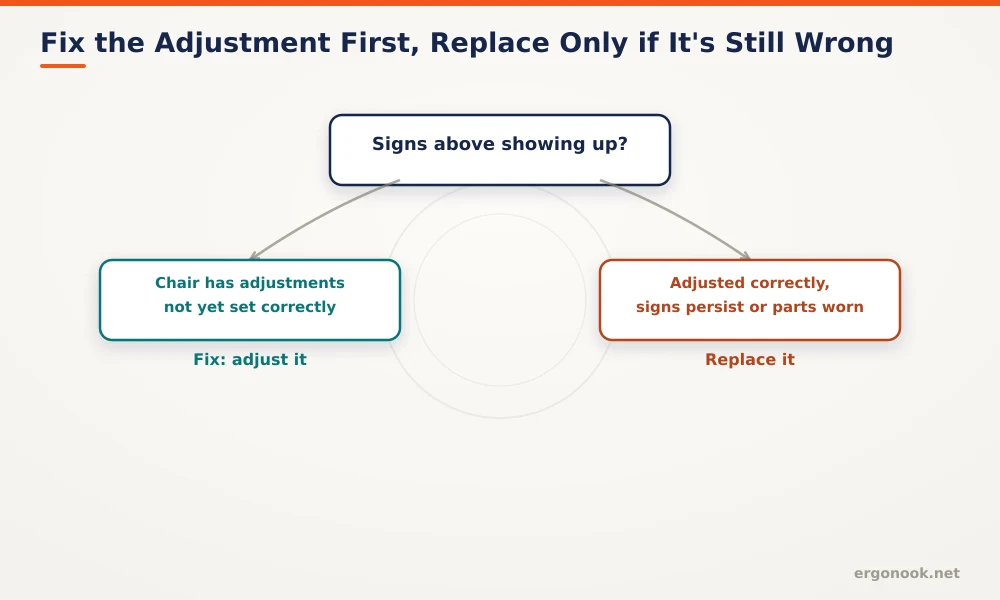
| Situation | Fix or Replace |
|---|---|
| Adjustable but currently set wrong | Fix: readjust seat height, depth, lumbar, and armrests |
| Correctly adjusted, signs persist | Replace, the chair likely lacks range for your body |
| Squeaking, sinking, or visible wear | Replace, mechanical wear isn’t fixable by adjustment |
| No adjustment options at all | Replace if any of the seven signs apply to you |
Frequently Asked Questions
Can a cushion fix a chair with these problems?
A lumbar or seat cushion can help temporarily with some of these signs, but it’s a workaround, not a substitute for a chair with the right adjustment range built in.
Is some discomfort normal when adjusting to a new chair?
A short adjustment period is common, but pain that persists or worsens after a week or two is worth addressing rather than waiting out.
How often should an office chair be replaced?
There’s no fixed timeline. Replace it when mechanical parts fail or when your body or needs change enough that the current adjustment range no longer fits, rather than on a set schedule.
Would switching to a standing desk fix these chair issues?
It reduces total sitting time but doesn’t fix a poorly adjusted chair for the time you do spend seated, so it’s a complement, not a substitute.
Most signs your office chair is bad for your back trace back to a fixable adjustment, not a chair that needs replacing outright. Work through seat height, depth, lumbar, and armrests first, and reserve replacement for mechanical wear or a chair that genuinely lacks the range your body needs.





Write Your Review
No reviews yet. Be the first to share your experience!