

Most big and tall office chairs lean toward the widest possible seat and footprint, which works against anyone shopping for a smaller home office where floor space around the desk is limited. The six chairs below take a different approach, pairing a genuine big and tall weight rating with a frame specifically built or marketed to take up less room, whether through a narrower profile, flip-up arms, or a fully folding design.
This is a narrower category than the executive or leather roundups elsewhere on this site, and capacity ratings here top out at 400 pounds rather than the 700 or 800 pound chairs found in those larger roundups. That reflects a genuine tradeoff: a smaller footprint generally means a smaller frame, which limits how high a manufacturer can push the weight rating. Every chair below was checked against products already used elsewhere on this site to avoid repeating the same listing under a different headline, and prices and ratings reflect Amazon listings checked at the time of research, which can shift over time. Disclosure: this article contains Amazon affiliate links. If you buy through one, we may earn a commission at no extra cost to you, and that commission never influences which chairs make this list or how they are ranked.

Pros
- 400 pound rating in a frame specifically marketed as space-saving rather than the widest possible footprint.
- Cloud cushion adds a distinct seat feel compared to standard foam.
- 5D flip armrests fold fully out of the way when floor space is tight.
- High review rating relative to price.
Cons
- Compact framing means less overall seat width than the widest big and tall chairs in other roundups on this site.
- Leather upholstery runs warmer than mesh over long sessions.
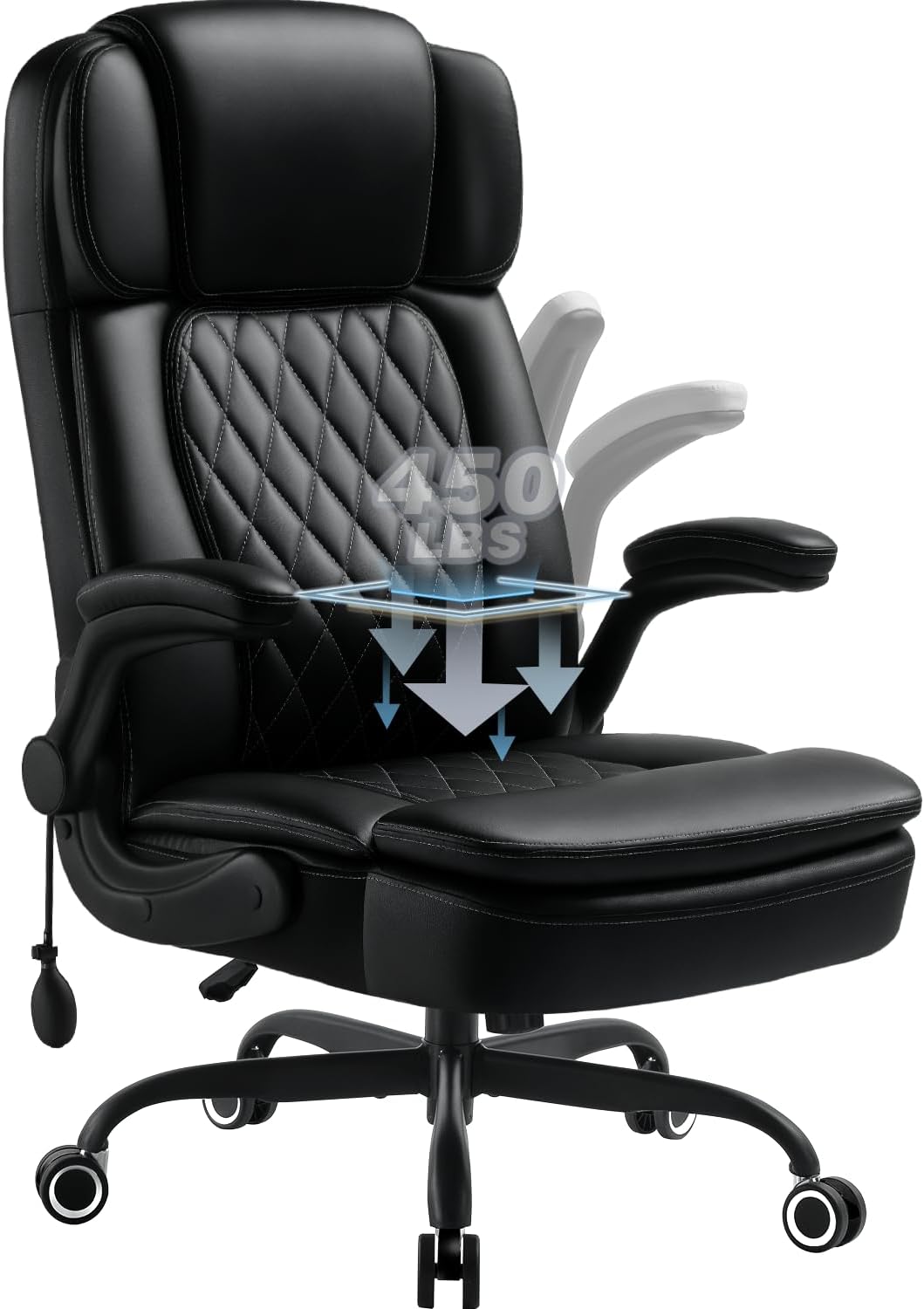
This chair is rated to 400 pounds and marketed specifically as space-saving, a distinct positioning from the wide-footprint chairs found in the other big and tall roundups on this site.
A cloud cushion seat gives a different feel than standard dense foam, and 5D flip armrests fold fully out of the way when floor space is tight, useful for a smaller home office where every inch around the desk counts. Ergonomic lumbar support rounds out the fit controls.
The combination of a genuine 400 pound rating with a compact frame is the core selling point here, rather than maximum width for its own sake.
Weight capacity: 400 pounds.
Design: space-saving frame.
Cushion: cloud cushion seat.
Armrests: 5D flip.
Lumbar: ergonomic support.
Best for buyers in a smaller home office who need genuine 400 pound capacity without the widest possible footprint.
The flip armrests are worth prioritizing if the chair needs to slide fully under a desk when not in use.
Compare against wider chairs in other roundups on this site if maximum seat width matters more than a compact footprint.

Pros
- Folding design is the most space-efficient option in this roundup when the chair is not in use.
- Footrest and lumbar support included despite the compact folding frame.
- 2D headrest and armrests give more adjustment than a basic folding chair typically offers.
- Useful for a home office that doubles as another room, where the chair needs to be put away.
Cons
- CFTVW8D7 does not publish a specific weight capacity for this listing, so heavier users should confirm current specs before ordering.
- Folding mechanisms add a moving part that a fixed frame does not have, worth checking hinge durability in current reviews.
This chair takes the space-saving concept furthest in this roundup by folding for storage or transport entirely, rather than just using a compact fixed frame like the other picks here.
Despite the folding design, it still includes a built-in footrest, 2D headrest, 2D armrests, and lumbar support, a fuller feature set than most folding chairs offer. This suits a home office that doubles as a guest room or shared space, where the chair needs to be put away rather than left out permanently.
The manufacturer does not publish a specific weight capacity for this listing, so heavier shoppers should check the current product page before ordering, and hinge durability under repeated folding is worth checking in current buyer reviews.
Weight capacity: not published by the manufacturer at time of review.
Design: folding, space-saving.
Extras: built-in footrest.
Headrest and armrests: 2D adjustable.
Lumbar: included support.
Best for buyers whose home office doubles as another room and who need the chair to fold away entirely rather than just sit compactly in place.
Since no weight capacity is published, confirm current specs on the listing before ordering if capacity is a firm requirement.
Check current reviews for hinge durability given the added folding mechanism.

Pros
- 400 pound rating with a specifically stated space-saving design philosophy from the manufacturer.
- 24 inch seat width is clearly published rather than left vague.
- Flip-up arms fold away to reduce footprint further when needed.
- Suitable for a conference room or home office where the chair needs to tuck away neatly.
Cons
- Lower review rating than several other picks in this roundup; read current buyer feedback before ordering.
- Higher price relative to some of the other 400 pound rated options here.
GYI rates this chair to 400 pounds and publishes a specific 24 inch seat width, giving a clearer picture of the actual footprint than listings that only claim "space-saving" without a number attached.
Flip-up arms fold away to reduce the footprint further when the chair is not actively in use, and the high back leather design and heavy duty base round out a chair built for both home office and conference room settings.
Review scores here run somewhat lower than several other picks in this roundup, worth checking current buyer feedback before ordering.
Weight capacity: 400 pounds.
Seat width: 24 inches.
Armrests: space-saving flip-up.
Design: high back leather.
Base: heavy duty.
A fit for buyers who want a specific, published seat width rather than vague space-saving marketing language.
Check current buyer feedback given the somewhat lower rating relative to other picks in this roundup.
Suits both home office and conference room settings where the chair needs to tuck away neatly.

Pros
- Highest review rating among the candidates checked for this roundup.
- Mesh construction breathes better than the leather picks elsewhere in this roundup.
- Flip-up armrests reduce footprint when needed.
- Lower price point among the candidates selected here.
Cons
- 300 pound rating is the lowest capacity in this roundup, not suited to users above that weight.
- Mesh seat runs firmer than the padded leather seats found on some competitors.
This chair is rated to 300 pounds and marketed specifically for home space-saving use, built around breathable mesh construction rather than the leather upholstery common on the pricier picks in this roundup.
Flip-up armrests reduce the footprint further when needed, and a 360 degree rolling caster base supports long sitting sessions at a lower price point than most of the other candidates selected here.
This chair carries the highest review rating among the candidates checked for this roundup.
Weight capacity: 300 pounds.
Upholstery: breathable mesh.
Armrests: flip-up.
Base: 360 degree rolling caster.
A strong value pick for users under 300 pounds who want mesh breathability in a space-saving frame.
Users above 300 pounds should choose one of the 400 pound rated chairs elsewhere in this roundup instead.
The high review score at a lower price makes this a reasonable default for budget-conscious buyers.

Pros
- Explicitly branded as compact by the manufacturer, not just implied by a lack of extra features.
- Lowest price point among the candidates checked for this roundup.
- Armless design reduces footprint further than an armed chair of similar seat size.
- Straightforward adjustable height and swivel controls.
Cons
- 300 pound rating is the lowest capacity in this roundup, not suited to users above that weight.
- No armrests at all, a tradeoff for anyone who relies on arm support during long sessions.
This chair is rated to 300 pounds and explicitly branded as compact by the manufacturer, one of the few listings in this category that uses the word directly rather than implying a smaller footprint through other marketing language.
The fully armless design reduces the overall footprint further than an armed chair of similar seat dimensions, and adjustable height with 360 degree swivel cover the basic controls expected of any office chair.
This is the lowest priced chair among the candidates selected for this roundup, positioned as a genuinely compact, no-frills option rather than a feature-heavy premium pick.
Weight capacity: 300 pounds.
Design: explicitly compact, armless.
Adjustment: height, 360 degree swivel.
A fit for buyers who want the smallest possible footprint in this roundup and are comfortable with a fully armless design.
Users above 300 pounds should choose one of the 400 pound rated chairs elsewhere in this roundup instead.
Anyone who relies on armrests for support should weigh that against the space savings before choosing this over an armed compact option.

Pros
- BIFMA certification adds a third-party construction standard beyond the manufacturer's own claims, uncommon among the other picks in this roundup.
- 400 pound rating in a space-saving frame.
- Flip-up arms fold away to reduce footprint.
- Adjustable lumbar support rather than a fixed pad.
Cons
- Highest price point among the candidates checked for this roundup.
- PU leather upholstery runs warmer than mesh over long sessions.
This chair is rated to 400 pounds and carries BIFMA certification, a third-party furniture certification standard that goes beyond a manufacturer's own marketing claims, a distinction not shared by most of the other picks in this roundup.
The space-saving swivel design and flip-up arms reduce footprint when needed, and adjustable lumbar support gives finer control than the fixed pads found on some cheaper compact chairs.
This is the highest priced chair among the candidates checked for this roundup, reflecting the added certification and adjustable lumbar mechanism.
Weight capacity: 400 pounds.
Certification: BIFMA.
Design: space-saving swivel.
Armrests: flip-up.
Lumbar: adjustable support.
Best for buyers who value third-party certification alongside a space-saving frame and are willing to pay the highest price in this roundup for it.
The adjustable lumbar support is a genuine upgrade over fixed pads on cheaper compact chairs.
Compare against the lower-priced picks in this roundup if certification is not a priority.
Buying Guide
Space-saving marketing versus published dimensions
“Space-saving” and “compact” are marketing terms that different sellers apply inconsistently. A listing that publishes an exact seat width, like the 24 inch figure on one chair in this roundup, gives a far more reliable picture of the actual footprint than a listing that simply uses the word “compact” without a number attached, since two chairs can both claim to be compact while differing by several inches in actual seat width. When comparing two chairs both claiming a small footprint, prioritize the one with a specific measurement you can check against your own desk space, rather than trusting a marketing label alone.
Flip-up arms versus a fully armless frame
Several chairs in this roundup use flip-up armrests as their main space-saving feature, folding the arms out of the way when floor space is tight and folding them back down for support the rest of the time. One chair here skips arms entirely for an even smaller permanent footprint. Choose based on whether you need arm support at all during typical use, since a fully armless frame saves more space but removes forearm support completely rather than making it optional the way flip-up arms do.
Fully folding chairs for shared or multi-use rooms
One chair in this roundup takes the space-saving concept further than the rest by folding for storage or transport entirely, rather than simply using a compact fixed frame. That matters specifically for a home office that doubles as a guest room, workout space, or other shared use, where the chair benefits from being put away rather than left out permanently. A folding mechanism does add a hinge point that a fixed frame does not have, worth checking in current reviews for long-term durability before committing to daily folding and unfolding.
Where a compact chair makes the biggest difference
A smaller footprint matters most in a shared bedroom office, a converted closet workspace, or any room where the desk sits close to a wall, doorway, or other furniture on multiple sides. In a dedicated home office with generous floor space, the wider chairs covered in the executive and leather roundups elsewhere on this site may be the more comfortable long-term choice, since footprint is less of a constraint there and a wider seat generally means more room to shift position during the day without feeling boxed in by the sides of the seat.
Weight capacity tradeoffs at a smaller footprint
Capacity in this roundup runs from 300 to 400 pounds, lower than the 500 to 800 pound chairs covered in the executive and leather roundups on this site. If you need a higher rating and are willing to accept a wider footprint, those broader roundups covering executive and leather styles are the more appropriate starting point for your search. This category exists specifically for buyers who are prioritizing floor space over maximum capacity, not as a substitute for the widest available chairs. See our guide to office chairs for heavier users for capacity considerations that apply regardless of footprint.
Why this roundup is narrower than the others in this category
Searching for chairs that explicitly combine big and tall capacity with compact or space-saving positioning turns up a smaller pool than searching for big and tall chairs generally, since most manufacturers in this category compete on maximum width and capacity rather than a smaller footprint. The six chairs here represent the strongest candidates found across multiple search queries rather than a curated subset of a much larger pool, similar in spirit to how the armless big and tall roundup on this site works from a genuinely narrow supply of qualifying products rather than a large field narrowed down by preference.
Final Thoughts
For most buyers who want a genuinely compact frame with third-party verification behind it, the BIFMA certified pick from this roundup pairs a 400 pound rating with BIFMA certification, at the highest price in this roundup. Anyone who specifically needs the chair to fold away entirely between uses should look at the fully folding pick from this roundup instead, the only fully folding design covered here.
FAQ
Why do compact big and tall chairs top out around 400 pounds?
Higher weight ratings generally require a wider base and larger frame components to distribute the load safely, which works against the goal of a smaller footprint. Manufacturers building specifically for compact positioning tend to cap capacity lower than the widest big and tall chairs, a genuine engineering tradeoff rather than a marketing limitation, since a narrower base has less structural margin to support the same load safely.
Is a folding big and tall chair as sturdy as a fixed-frame model?
A folding mechanism adds a hinge point that a fixed frame simply does not have, which is a genuine structural difference worth weighing. If sturdiness under daily use matters more than the ability to fold the chair away, a fixed compact frame is the safer choice; if storage flexibility matters more, the folding tradeoff is reasonable as long as current reviews do not show recurring hinge complaints.
Should I measure my desk space before choosing a compact chair?
Yes, and specifically look for a published seat width rather than relying on marketing terms like “compact” or “space-saving” alone. Those terms are used inconsistently across sellers, while an actual measurement in inches lets you compare directly against your available floor space before ordering.
Is an armless chair meaningfully more compact than one with flip-up arms?
Yes, a flip-up armrest still occupies space at the sides of the seat when folded and adds a hinge mechanism to the overall width, even folded up. A genuinely armless frame has no such hardware at all. The tradeoff is losing forearm support entirely rather than having it available when needed, so weigh how often you actually rest your arms on the chair during a typical day.




Write Your Review
No reviews yet. Be the first to share your experience!