

For tailbone pain, look for a seat cushion with a wedge-shaped cutout at the back, which Mayo Clinic specifically recommends because it lets the coccyx hover over open space instead of pressing into the seat. Firm, supportive foam holds that cutout shape better than soft foam, which can compress flat and stop working.
- Mayo Clinic recommends a pressure-reduction cushion for tailbone pain, noting a wedge-shaped cutout can be especially helpful.
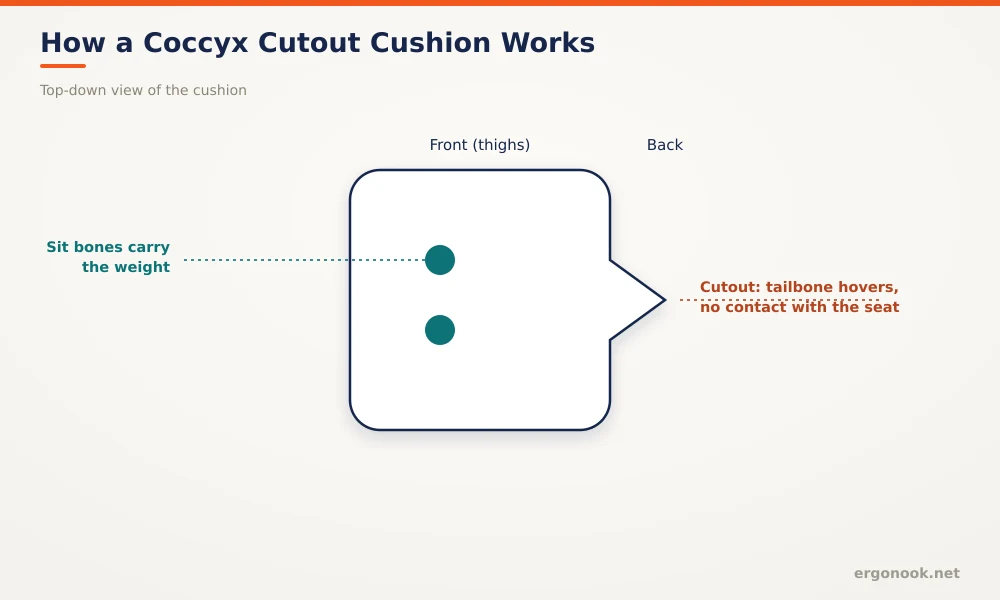
- The cutout works by letting the coccyx hover over an empty space, shifting your weight onto your sit bones instead.
- Tailbone pain usually resolves on its own within a few weeks to months with self-care, per Mayo Clinic, but a cushion helps in the meantime.
- Donut-style ring cushions and wedge cutout cushions solve different problems. Check which shape actually fits your situation before buying.
This article is for informational purposes only and is not medical advice. If tailbone pain is severe, follows a fall or injury, or doesn’t improve with self-care, talk to a doctor.
In this article:
- Why sitting hurts your tailbone
- Features that actually matter
- Wedge cutout vs donut cushion
- How to measure your seat
- Red flags in cushion listings
- When to see a doctor
- Frequently asked questions
Why Sitting Hurts Your Tailbone
The coccyx, or tailbone, is the small bony structure at the very bottom of your spine. Pain there, called coccydynia, commonly comes from a fall onto the tailbone, sitting for a long time on a hard or narrow surface, or joint changes related to arthritis or childbirth (Cleveland Clinic, Coccydynia: Tailbone Pain). Sitting directly loads the coccyx more than standing does, especially on a hard chair or a seat that puts you in a slouched, reclined position. That’s the mechanism a cutout cushion is built to interrupt.
Features That Actually Matter
1. A Wedge-Shaped Cutout at the Back
Mayo Clinic specifically calls out a wedge-shaped cutout as a helpful design for tailbone pain: the cutout lets the coccyx hover over the open space rather than bearing weight, which reduces the load on it directly (Mayo Clinic, Tailbone Pain: How Can I Relieve It?). Check that the cutout is deep and wide enough to fully clear your tailbone rather than just a shallow dent.
2. Firm Enough to Hold Its Shape
A cutout only works if it stays open under your weight. Soft, low-density foam compresses over weeks of use and can flatten enough that the cutout stops doing its job. Firmer memory foam or molded foam holds the shape longer, even though it feels less plush when you first sit down.
3. A Non-Slip Base
A cushion that slides forward on the chair defeats the cutout’s positioning, since the tailbone drifts off the open space and back onto padding. A rubberized or textured bottom keeps the cushion locked in place through the day.
4. A Breathable Cover
Dense foam traps heat. A removable, washable, breathable cover matters more here than on a general seat cushion, since you’re likely using it for extended, consistent stretches while pain resolves.
Wedge Cutout vs Donut Cushion
These two shapes get sold for overlapping but different problems, and it’s worth knowing which one you actually need. A wedge cutout cushion, the shape Mayo Clinic points to for coccydynia, supports your sit bones on solid foam while leaving the tailbone area open. A donut, or ring, cushion has an open center that keeps pressure off a small central area entirely, which suits recovery from a specific tailbone injury or surgery. That same open-center design is generally discouraged for hemorrhoid-related pain, since the area can sink into the hole with nothing supporting it, potentially making swelling worse. If your pain involves both a sore tailbone and hemorrhoids, that’s a case worth mentioning to a doctor rather than guessing at the right cushion shape yourself.
| Cushion Type | How It Works | Best Suited For |
|---|---|---|
| Wedge cutout | Solid foam supports sit bones, tailbone hovers over an open notch | General coccydynia from sitting, arthritis, or an old injury |
| Donut / ring | Open center keeps pressure off one small central area | Recovery from a specific tailbone injury or surgery |
| Flat gel or foam pad | Even pressure distribution, no cutout | General sitting comfort, not targeted tailbone relief |
How to Measure Your Seat
A cushion that’s the wrong size for your chair changes your seat depth and can undo the fit of an otherwise well-adjusted chair.
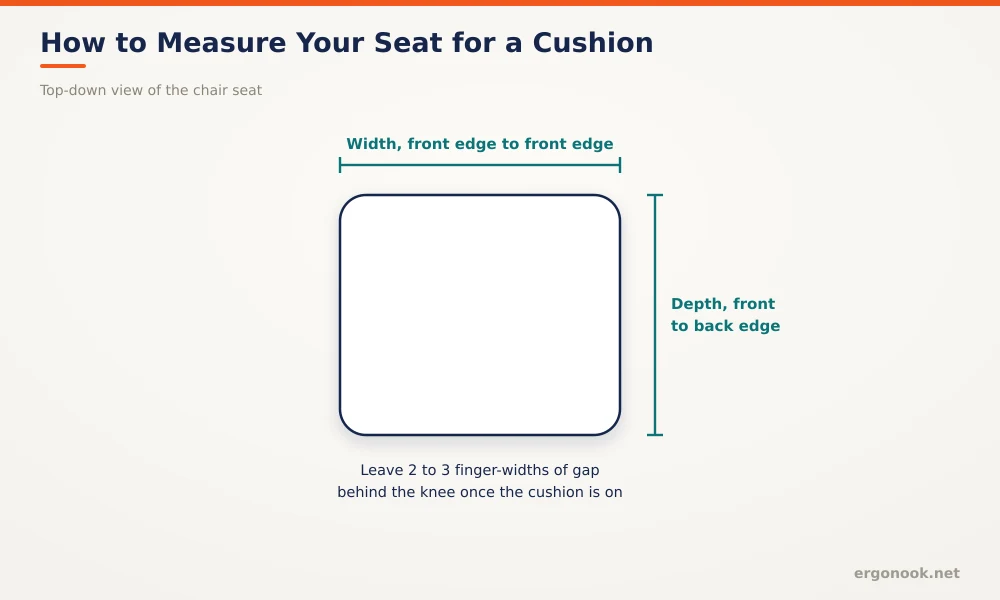
- Measure your seat’s width from front edge to front edge, side to side.
- Measure your seat’s depth from the front edge to the backrest.
- Sit down and check the gap behind your knees, aiming for roughly 2 to 3 finger-widths once the cushion is in place.
- Confirm the cutout position lines up with where your tailbone actually sits, not just the back edge of the cushion.
Red Flags in Cushion Listings
Watch for listings that show a shallow, decorative notch rather than a real cutout deep enough to clear the tailbone. Watch too for foam density left unspecified, since “memory foam” alone doesn’t guarantee it holds shape under daily use. If a listing photo shows the cutout positioned dead center rather than toward the back edge, it’s likely built for general pressure relief rather than tailbone-specific support.
Our seat cushion picks for tailbone pain cover models with a genuine wedge cutout and firm enough foam to hold it.
When to See a Doctor
Mayo Clinic notes tailbone pain often resolves on its own within a few weeks to months with self-care like a pressure-reduction cushion, leaning forward while sitting, and heat or ice. Pain following a fall, pain that’s severe, or pain that doesn’t improve with these steps is worth having evaluated, since it can point to a fracture or another issue a cushion alone won’t fix.
Frequently Asked Questions
How long does tailbone pain usually last?
Mayo Clinic notes it often goes away within a few weeks to a few months with self-care. A cushion helps manage pain during that window rather than speeding up healing directly.
Should I use the cushion in my car too?
If you have a long commute, yes, the same pressure principle applies. Many wedge cutout cushions are sized to fit both office chairs and car seats.
Should a tailbone cushion feel soft or firm?
Firm enough to hold the cutout shape under your weight. A cushion that feels very soft and plush at first often compresses flat within weeks and stops relieving pressure.
Do I still need a cushion if I use a standing desk?
Only for your seated time. Alternating with standing reduces total sitting time, which helps, but doesn’t replace the need for pressure relief during the sitting portion of your day.
For tailbone pain, a firm cushion with a genuine wedge-shaped cutout, sized to fit your actual chair, is what Mayo Clinic’s own guidance points to. Give self-care a few weeks to work, and see a doctor if pain is severe, follows an injury, or isn’t improving.




Write Your Review
No reviews yet. Be the first to share your experience!