

Leather is the most common upholstery choice among big and tall office chairs, valued for wiping clean easily and holding a more formal look than mesh or fabric. The trade-off is heat retention over long sitting sessions, since leather and PU leather do not breathe the way mesh does. The eight chairs below range from a 300 pound entry-level pick to a 500 pound reclining model, all in genuine leather or PU leather rather than fabric.
Weight capacity, recline range, and armrest adjustment vary meaningfully across this price range, and a higher price does not always mean a higher capacity rating. Each entry below lists its published weight rating directly rather than relying on big and tall branding alone, and every product was checked against chairs already used elsewhere on this site to keep the comparison to distinct options rather than the same handful of listings reshuffled under a new headline. Reviews and prices reflect Amazon listings checked at the time of research and can shift, so treat the ratings here as a starting point for comparison rather than a live price guarantee. Disclosure: this article contains Amazon affiliate links. If you buy through one, we may earn a commission at no extra cost to you, and that commission never influences which chairs make this list or how they are ranked.

Pros
- Established brand with a commercial furniture track record beyond direct-to-consumer listings.
- 400 pound rating covers most big and tall shoppers.
- Executive styling suits a home office that doubles as a client-facing space.
- Bonded leather is easier to wipe clean than fabric.
Cons
- Highest price point among the candidates checked for this roundup.
- Bonded leather wears differently than full-grain leather over years of daily use; expect eventual surface cracking sooner than premium leather.
Staples sells the Randolph as a 400 pound rated big and tall executive chair, built with bonded leather upholstery over a reinforced frame. As an established office supply brand with a commercial furniture history, the build quality track record extends beyond a single direct-to-consumer listing.
The executive high-back profile and adjustable height and tilt controls are standard for the category, and the bonded leather finish is easier to wipe down than fabric upholstery, a practical consideration for a chair used daily.
This is the highest priced chair among the candidates checked for this roundup, positioning it as a premium pick within an already premium material category.
Weight capacity: 400 pounds.
Upholstery: bonded leather.
Design: executive high-back.
Adjustment: height and tilt.
Brand: Staples (commercial office furniture history).
Best for buyers who want a recognizable commercial brand behind the chair and are comfortable paying more for that track record.
Bonded leather buyers should expect the surface to show wear over years of daily use sooner than full-grain leather, a tradeoff against the lower price relative to genuine leather options.
Compare against the lower-priced 400 pound rated chairs in this roundup if brand history is not a priority.

Pros
- Footrest is built into the frame rather than a separate accessory.
- 400 pound rating with a thick cushion seat for extended sitting.
- Padded armrests add comfort over hard plastic arm caps.
- Mid-range price relative to other footrest-equipped chairs in this roundup.
Cons
- PU leather does not breathe as well as mesh, a consideration in warmer rooms.
- Footrest adds bulk to the base, taking up more floor space when extended.
EXCEBET rates this executive chair to 400 pounds and builds it around PU leather upholstery, a thick cushion seat, and a built-in footrest that folds away under the seat when not in use.
Padded armrests sit on top of the frame rather than exposed hard plastic caps, and the high-back design covers more of the upper back than the mid-back chairs elsewhere in this roundup.
The footrest is the standout feature here, useful for reclined breaks without buying a separate accessory, though it does add bulk to the base footprint.
Weight capacity: 400 pounds.
Upholstery: PU leather.
Cushion: thick padded seat.
Armrests: padded.
Extras: built-in footrest.
A fit for buyers who specifically want a footrest built into a leather big and tall chair rather than shopping for one separately.
PU leather runs warmer than mesh over long sessions; anyone in a warm room without strong air conditioning should weigh that against the cushioning benefit.
The extended footrest takes up floor space, so measure the area in front of the desk before choosing this over a footrest-free model.

Pros
- 500 pound rating covers heavier users than the 400 pound chairs common in this category.
- Quiet rubber wheels are a practical upgrade over standard hard casters in a shared home office.
- Extra padded seat for long sitting sessions.
- Mid-range price for the capacity offered.
Cons
- High back design takes up more vertical space, worth checking against ceiling or shelf clearance in a home office.
- Fixed lumbar support rather than an adjustable pad, less precise than chairs with a movable lumbar mechanism.
This chair carries a 500 pound rating, higher than the 400 pound ceiling common among leather big and tall chairs in this price range, built around a high back executive profile with fixed lumbar support and an extra padded seat.
Quiet rubber wheels are a practical detail for a shared home office where a rolling chair can otherwise be a distraction, and the leather upholstery wipes clean easily.
The lumbar support is fixed in position rather than height-adjustable, a tradeoff against the more flexible lumbar mechanisms on pricier chairs.
Weight capacity: 500 pounds.
Design: high back executive.
Lumbar: fixed support.
Wheels: quiet rubber casters.
Seat: extra padded.
A strong fit for users above the 400 pound range who still want leather upholstery rather than moving to a mesh-only heavy capacity chair.
The fixed lumbar support suits users whose lower back position does not change much through the day; anyone who wants a height-adjustable lumbar pad should compare against other chairs in this roundup.
The quiet wheels are worth prioritizing for anyone working near a sleeping household member or on a video call frequently.

Pros
- 500 pound rating with a reclining mechanism, a combination not every heavy-capacity chair offers.
- Adjustable armrests rather than a fixed position.
- Built-in footrest for reclined breaks.
- Distinct criss cross leg base sets it apart visually from the standard five-star base used elsewhere in this roundup.
Cons
- Criss cross base is less common than a standard five-star wheeled base, worth checking mobility needs before choosing it.
- Reclining mechanisms add moving parts that a simple fixed-back chair does not have.
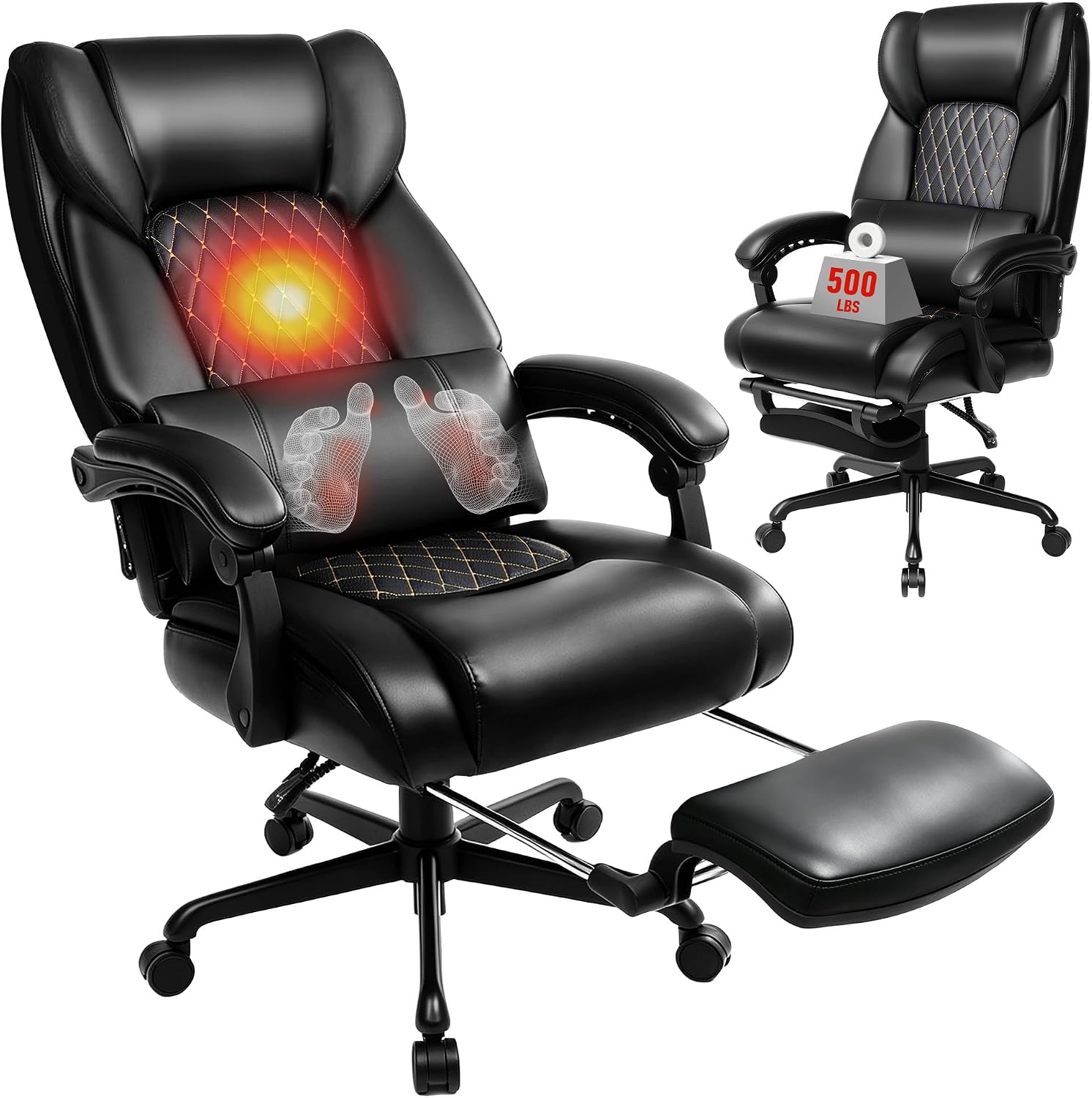
This chair combines a 500 pound rating with a reclining swivel mechanism, adjustable armrests, built-in lumbar support, and a footrest, a fuller feature set than most chairs at a similar price point in this category.
The criss cross leg base is a visual departure from the standard five-star wheeled base used on most of the other chairs in this roundup, giving it a different look better suited to some home office decors, though it trades some rolling mobility for that styling.
Leather upholstery and the ergonomic high back round out a chair built for users who want recline and footrest functionality without moving to a mesh gaming-style chair.
Weight capacity: 500 pounds.
Recline: swivel reclining mechanism.
Armrests: adjustable.
Extras: built-in lumbar support and footrest.
Base: criss cross leg design.
A fit for buyers who want recline, footrest, and adjustable arms together in a leather chair without paying premium executive brand pricing.
Consider the criss cross base carefully if frequent rolling movement around a desk matters; a standard wheeled base offers more mobility.
The 500 pound rating puts this among the higher-capacity leather options in this roundup.

Pros
- Highest review rating among the candidates checked for this roundup.
- Adjustable lumbar support rather than a fixed pad.
- Footrest included at a moderate price point.
- Wide seat suited to larger frames.
Cons
- 400 pound rating sits below the 500 pound chairs elsewhere in this roundup.
- PU leather runs warmer than mesh over long sessions.
This executive chair carries a 400 pound rating and the highest review score among the leather candidates checked for this roundup, built with adjustable lumbar support rather than a fixed pad, a built-in footrest, and padded armrests.
The reclining high back and wide seat target larger frames specifically, and the PU leather upholstery holds up to daily wiping better than fabric.
The adjustable lumbar support stands out against several competitors in this roundup that ship with fixed lumbar positioning instead.
Weight capacity: 400 pounds.
Lumbar: adjustable support.
Extras: built-in footrest.
Armrests: padded.
Design: high back reclining.
A strong all-around pick for buyers who want adjustable lumbar support specifically, since most leather chairs in this price range ship with a fixed pad instead.
Users above 400 pounds should move to one of the 500 pound rated chairs elsewhere in this roundup.
The high review score makes this a reasonable default choice when no single feature is the deciding factor.

Pros
- Lowest price in this roundup, useful for a big and tall shopper on a tighter budget.
- Infinite-lock recline stops at any angle within its range, not just fixed positions.
- 20 spring packs give more cushioning structure than standard foam alone.
- Footrest included at this price point.
Cons
- 300 pound rating is the lowest capacity in this roundup, not suited to users above that weight.
- Recline range tops out at 135 degrees, narrower than some competitors here.
amseatec rates this chair to 300 pounds and builds the seat cushion around 20 internal spring packs rather than foam alone, intended to hold shape longer under repeated use than a standard foam-only seat.
The recline mechanism locks at any point between 90 and 135 degrees rather than only fixed stops, giving finer control over recline angle than the step-locked mechanisms on some competitors.
A built-in footrest and leather upholstery round out the feature set at the lowest price point among the candidates checked for this roundup.
Weight capacity: 300 pounds.
Recline: infinite-lock, 90 to 135 degrees.
Cushion: 20 internal spring packs.
Extras: built-in footrest.
Upholstery: leather.
A budget-friendly entry point for shoppers near the 300 pound capacity ceiling who want infinite-lock recline and a footrest without paying executive chair pricing.
Users above 300 pounds should choose one of the higher-capacity chairs elsewhere in this roundup instead.
The spring pack cushion construction is worth comparing directly against foam-only seats if long-term cushion support matters most.

Pros
- 155 degree recline is wider than the 135 to 150 degree range on most competitors in this roundup.
- Adjustable lumbar support pillow rather than a fixed pad.
- 3 inch armrest adjustment range.
- High review rating relative to price.
Cons
- Deep recline angles need floor clearance behind the chair, worth checking against desk placement.
- Locking function adds a mechanism that a simple tilt-only chair does not have.
This chair is rated to 400 pounds and stands out in this roundup for its 155 degree recline with a locking function, wider than the 135 to 150 degree range typical among the other leather chairs checked here.
A 3 inch adjustable armrest range and an adjustable lumbar support pillow, rather than a fixed pad, round out the ergonomic controls. The recline lock lets the chair hold at any angle within its range rather than snapping to fixed stops only.
Deep recline needs floor clearance behind the chair, so measure the space between the desk and any wall or furniture behind it before ordering.
Weight capacity: 400 pounds.
Recline: up to 155 degrees with locking function.
Armrests: 3 inch adjustable range.
Lumbar: adjustable support pillow.
Best for buyers who specifically want the widest recline range in this leather roundup and have the floor space behind the desk to use it.
The adjustable lumbar pillow is a plus for anyone who has struggled with fixed lumbar pads on other big and tall chairs.
Measure recline clearance before ordering if the desk sits close to a wall.

Pros
- Vintage styling stands apart from the modern executive look common across this roundup.
- Built-in footrest included.
- 400 pound rating with a high back for larger frames.
- Distinct visual option for a home office with traditional decor.
Cons
- Vintage styling will not suit every home office aesthetic, worth checking photos against your own room before ordering.
- No adjustable lumbar mechanism specified beyond built-in support.
This chair is rated to 400 pounds and built around vintage-style leather upholstery, a visual departure from the modern executive look shared by most other chairs in this roundup, suited to a home office with more traditional decor.
A high back and reclining mechanism target larger frames, and the built-in footrest folds away when not needed. Lumbar support is built into the backrest shape rather than through a separate adjustable pad or pillow.
The distinct styling is the main reason to choose this over a similarly priced modern executive chair; the underlying capacity and feature set are comparable to other 400 pound rated options here.
Weight capacity: 400 pounds.
Upholstery: vintage-style leather.
Design: high back, reclining.
Extras: built-in footrest.
Lumbar: built into backrest shape.
Best for buyers who specifically want a traditional or vintage look rather than the modern executive styling common elsewhere in this roundup.
Since lumbar support is built into the shape rather than separately adjustable, anyone with specific lower back positioning needs should compare against chairs with a dedicated adjustable lumbar pad.
Check the product photos against your own office decor before ordering, since the visual style is the main differentiator here.
Buying Guide
Bonded leather versus PU leather versus genuine leather
These terms are not interchangeable, and the difference affects how a chair ages. Bonded leather uses shredded leather fibers bonded to a fabric backing, and tends to crack or peel sooner than other options under years of daily friction from getting in and out of the chair. PU leather is a synthetic polyurethane coating with no real leather content, generally more consistent and less prone to cracking than bonded leather, though it still lacks the breathability and long-term durability of genuine leather. Genuine or full-grain leather costs more but typically outlasts both. Check the listing copy for the specific material before assuming leather means the same thing across every chair in this price range.
Weight capacity relative to price
A higher price does not automatically mean a higher weight rating in this category. Some of the most expensive chairs checked for this roundup carry the same 400 pound rating as mid-range options, with the extra cost going toward brand reputation, recline range, or finish quality instead of capacity. If weight rating is the deciding factor, compare that number directly rather than assuming price scales with it. See our guide to office chairs for heavier users for capacity considerations that apply across materials, not leather alone.
Recline range and locking mechanisms
Recline range among leather big and tall chairs typically falls between 90 and 155 degrees, with most clustering around 135 to 150. A locking mechanism that holds at any point within that range offers finer control than a chair that only stops at fixed positions. Deeper recline angles need floor clearance behind the chair, so measure the space between the desk and any wall or furniture behind it, especially in a smaller home office where a fully reclined chair could otherwise hit the wall.
Fixed versus adjustable lumbar support
Several chairs in this price range build lumbar support into the shape of the backrest rather than offering a separate adjustable pad or pillow. That works fine for users whose lower back position does not change much through the day, but anyone who has struggled with fixed lumbar support on a previous chair should prioritize a model with a movable pad instead. See what to look for in an ergonomic office chair for a broader rundown of lumbar support types across materials.
Base style and mobility
Most leather big and tall chairs use a standard five-star base with caster wheels, but a small number use a criss cross leg design instead, trading rolling mobility for a different visual style. If you move around your desk frequently during the day, a wheeled base matters more than it might seem; if the chair mostly stays in one position facing a fixed monitor setup, the styling tradeoff of a criss cross base is less of a practical downside. Quiet rubber wheels are worth prioritizing over standard hard casters if the chair will be used near a sleeping household member, a shared living space, or during frequent video calls where rolling noise is picked up by a microphone.
The leather versus mesh question extends beyond big and tall sizing. For a fuller comparison of breathability, cleaning, and long-term wear between the two materials across chair categories generally, see our mesh versus leather office chair guide.
Final Thoughts
For most shoppers who want a dependable leather chair without overpaying, the top-rated 400 pound pick from this roundup stands out for pairing a 400 pound rating with adjustable lumbar support and the highest review score among the candidates checked, at a moderate price point, making it the default recommendation when no single feature is the deciding factor. Anyone who needs the widest recline range in this roundup should look at the 155 degree recline pick from this roundup instead, which locks anywhere up to 155 degrees and includes an adjustable lumbar pillow rather than fixed backrest support.
FAQ
Does leather run hotter than mesh for big and tall users?
Yes, leather and PU leather do not breathe the way mesh does, and heat retention is more noticeable on a larger seating surface over long sessions. If overheating during the day is a concern, a mesh big and tall chair may suit you better than any of the leather picks in this roundup, even though leather remains more common in this weight category overall.
What is the difference between bonded leather and PU leather?
Bonded leather bonds shredded real leather fibers to a fabric backing and tends to crack or peel sooner under repeated friction. PU leather is a fully synthetic polyurethane surface with no real leather content, generally holding up more consistently than bonded leather, though neither matches the longevity of full-grain genuine leather. Check the specific listing copy rather than assuming all leather chairs in this price range use the same material.
How much floor space does a reclining big and tall chair need?
Measure the distance from the back of the chair to the nearest wall or furniture at your desk before ordering a model with a deep recline range. A chair that locks at 150 to 155 degrees needs meaningfully more clearance than one that tops out at 130 degrees, and that clearance matters more in a smaller home office where desks often sit close to a wall.
Should I choose a higher weight capacity than I need?
A chair rated well above your actual weight tends to have a sturdier frame and longer lifespan under daily use, but that is not a strict requirement. Matching or modestly exceeding your weight is generally sufficient; the main reason to size up further is if you expect your weight to change or want extra long-term durability margin rather than the minimum rating that covers you today.
Do these chairs work well for video calls in a home office?
Leather and PU leather upholstery generally look more polished on camera than mesh, which can appear busy or textured in low light, so many buyers choose leather specifically for a home office that doubles as a video call space. Quiet rubber wheels are worth prioritizing in that setup as well, since a rolling adjustment mid-call is picked up by most laptop and headset microphones more easily than expected.




Write Your Review
No reviews yet. Be the first to share your experience!