

Armrest adjustability sounds like a minor detail until a fixed-height arm sits too low to support your elbows or too high to clear your desk. Big and tall chairs vary widely in how many directions their arms actually move, from a simple up-and-down flip to 5D systems that adjust height, width, depth, angle, and fold flat. This guide to big and tall office chairs compares six chairs built around genuinely adjustable arms, ranging from 400 to 700 pounds in rated capacity.
Every armrest adjustment claim here, whether it is a 3D, 4D, or 5D system, or a swivel-out design that changes the entire seating width, is confirmed directly from that chair’s own product listing. Disclosure: this article contains Amazon affiliate links. If you buy through one, we may earn a commission at no extra cost to you, and that commission never influences which chairs make this list or how they are ranked.

Pros
- 700 pound rating is among the highest capacities in this roundup.
- Fabric upholstery offers a different feel and airflow profile than leather or mesh alternatives.
- 3D armrests give more adjustment range than fixed or simple flip-up designs.
Cons
- Fabric upholstery is harder to wipe clean than leather or PU if spills happen.
- Larger frame takes up more floor space than the lower-capacity chairs in this roundup.
VUZI rates this chair to 700 pounds, built around a sturdy reinforced metal base and thick high-density foam throughout the seat and backrest, aimed at extended desk hours rather than occasional sitting.
3D flip armrests adjust height and width and fold flat when not needed, giving more range than the fixed or simple flip-up arms found on many chairs at this price point.
Soft fabric upholstery sets it apart from the leather and PU chairs common in this weight class, offering a different tactile feel and airflow profile for buyers who prefer cloth over leather.
Weight capacity: 700 pounds.
Armrests: 3D flip, height and width adjustable.
Upholstery: fabric.
Cushion: high-density foam.
Base: reinforced metal.
This chair suits a buyer who wants fabric upholstery and 3D armrest adjustment at a 700 pound capacity.
Buyers who prioritize easy spill cleanup should compare it against the leather or PU chairs elsewhere in this roundup.
Buyers comfortably under 500 pounds may not need this much capacity and could save with a lower-rated chair instead.

Pros
- Swivel-out armrests create genuinely more usable width than any fixed-arm chair in this roundup, useful for cross-legged sitting or a pet curling up beside you.
- Five adjustment gears give finer control than a simple up-down flip mechanism.
- Includes both a deep recline and a footrest in the same chair.
Cons
- 400 pound rating is on the lower end of this roundup.
- The wider swivel-out position takes up more floor space than a standard armrest stance.
FelixKing rates this chair to 400 pounds and builds the armrests around a 5-gear adjustable design that swivels outward 90 degrees, transforming the usable sitting width from 22 to 46.5 inches, a range no fixed-arm chair in this roundup can match.
That extra width supports cross-legged sitting, meditation-style postures, or simply making room for a pet to sit alongside you, a genuinely different take on what "adjustable arms" means compared with chairs that only adjust height.
A 135 degree recline and pull-out footrest round out the design, giving it both the width flexibility and a break position in the same chair.
Weight capacity: 400 pounds.
Armrests: 5-gear, swivel outward 90 degrees.
Sitting width range: 22 to 46.5 inches.
Recline: up to 135 degrees.
Footrest: pull-out.
This chair fits a buyer who wants genuinely adjustable seating width, not just armrest height, for cross-legged sitting or sharing the chair with a pet.
Measure your floor space with the arms swiveled fully outward before buying, since the wide position takes up considerably more room.
Buyers above 400 pounds should choose one of the higher-capacity chairs elsewhere in this roundup.

Pros
- 4D armrests give more precise arm positioning than 2D or fixed designs.
- Combining memory foam with internal springs adds durability alongside comfort.
- Breathable mesh keeps the back cooler than leather over a full workday.
Cons
- No footrest or reclining option included.
- Fewer named certifications than some of the higher-priced chairs in this roundup.
Coolka rates this chair to 500 pounds and builds the armrests around a 4D adjustment system, covering height, width, depth, and pivot angle for more precise arm positioning than the 2D or fixed designs found on lower-priced chairs.
The seat combines memory foam filling with an internal spring structure, aimed at adding durability alongside comfort rather than relying on foam density alone to hold up under sustained daily use.
A breathable mesh backrest and adjustable backrest angle round out a chair built for a full workday rather than occasional sitting.
Weight capacity: 500 pounds.
Armrests: 4D adjustable.
Seat: memory foam with internal springs.
Backrest: breathable mesh, adjustable.
Base: metal.
This chair suits a buyer who wants precise 4D armrest control and mesh ventilation at a 500 pound capacity.
Buyers who want a footrest or deep recline should compare it against the chairs elsewhere in this roundup that include those features.
The memory foam and spring combination is worth prioritizing for anyone who has found single-density foam seats compress too quickly.

Pros
- Pocket spring cushion holds shape better over time than solid foam alone, useful for a chair expected to last through several years of school
- 5D flip arms give the most adjustment directions of any armrest in this roundup
- High weight rating matches the top of this list at 700 lbs
Cons
- Highest price in this roundup
- Larger, plusher build takes up more space than the leaner budget picks

Pros
- Fabric upholstery feels different from the leather and mesh options that dominate this category, a real material choice rather than just color variation
- Seat height around 22.4 inches suits taller users without needing a footrest workaround
- 5D armrests give more adjustment directions than fixed or flip-only designs
Cons
- Fabric shows stains more readily than leather or PU alternatives
- Heavier chair overall due to reinforced frame for the 700 lb rating

Pros
- Height-adjustable soft armrests are padded rather than hard plastic, a comfort detail some competitors skip.
- Recline range up to 150 degrees is deeper than most executive-style chairs in this roundup.
- Includes a footrest and lumbar pillow in the same package.
Cons
- Listing does not specify a numeric weight rating the way most other chairs in this roundup do; confirm current capacity on the listing before buying if that is a hard requirement.
- Armrests adjust for height only, not the multi-directional 3D, 4D, or 5D range offered by several other picks here.
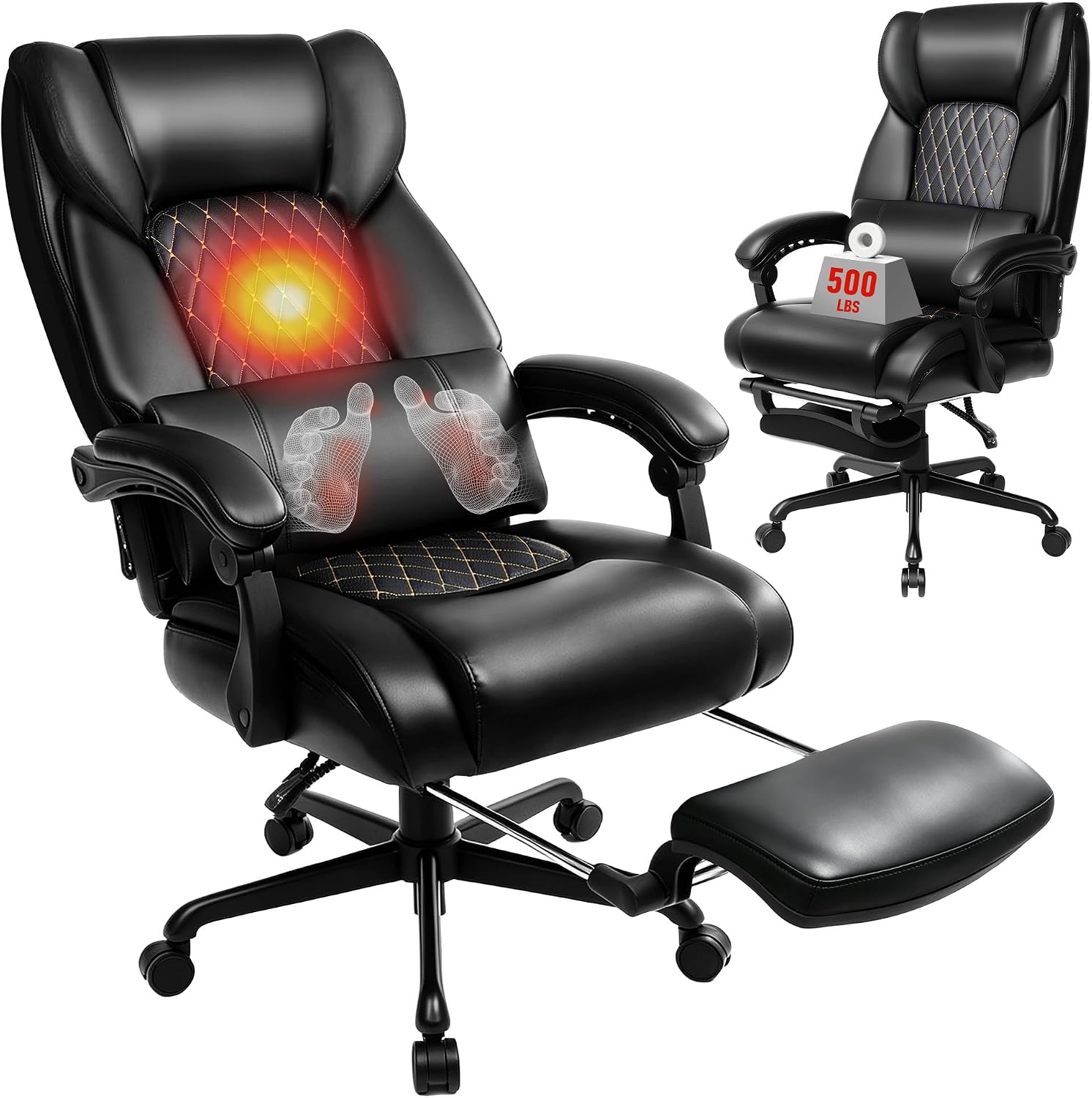
GTPLAYER builds this wide, wingback-style chair around height-adjustable soft armrests, a padded detail that some competitors leave hard and fixed, paired with built-in lumbar support pocket springs for the backrest.
A pull-out footrest and a recline reaching 150 degrees give it a deeper break position than most executive-style chairs in this roundup, closer to a gaming chair's reclining range than a standard office chair.
Embossed PU leather upholstery and an included pillow round out the package, though buyers who need a confirmed numeric weight rating should check the current listing directly, since it is not stated as clearly here as on the other picks in this roundup.
Armrests: height-adjustable, soft padding.
Lumbar: pocket spring support.
Footrest: pull-out.
Recline: 90 to 150 degrees.
Upholstery: embossed PU leather.
This chair fits a buyer who wants a deep recline and padded height-adjustable arms in a gaming-chair-style frame.
Confirm the current listed weight capacity directly on the product page before buying, since it is not specified as a clear number in the description reviewed here.
Buyers who want multi-directional 3D or 4D armrest adjustment should compare it against the other picks in this roundup.
Buying Guide
What the “D” in 3D, 4D, and 5D armrests actually means
Each added dimension refers to a distinct axis of movement. A 2D armrest typically adjusts height and width. A 3D armrest adds depth, letting the pad slide forward or back. A 4D armrest adds pivot, so the pad can angle inward or outward to match your shoulder width. A 5D armrest usually adds the ability to fold flat against the chair, useful for sliding fully under a desk or saving space against a wall. More axes generally mean a closer fit to your specific desk and body, but they also mean more joints that can loosen over years of adjustment. If your desk height rarely changes, a simpler 2D or 3D system may serve you just as well as a 5D one, and you will have fewer moving parts to worry about years down the road. For more on how armrest height interacts with desk and keyboard position, see our guide on what to look for in an ergonomic office chair.
A swivel-out armrest can change more than just arm position
One chair in this roundup takes a different approach entirely: instead of just moving the armrest pads, the arms swivel outward 90 degrees and change the usable width of the entire seat, from 22 to 46.5 inches in this case. That is a meaningfully different feature than height or depth adjustment, useful for cross-legged sitting, sharing the seat with a pet, or simply wanting more lateral room during a break. It is worth deciding whether you want the arms to move you into a better desk-typing position, or whether you want the option to widen the whole seat for something other than typing. Few chairs at any price offer this kind of structural width change, so it is worth calling out separately from the more common height and depth adjustments covered by the rest of this roundup.
Fabric upholstery shows up more often in this feature category
Two of the picks in this roundup use fabric upholstery rather than the leather or PU finish common across most big and tall chairs. Fabric offers a different tactile feel and, for some buyers, a more residential look that fits a home office better than a corporate leather chair. The tradeoff is cleanup: spills and stains take more effort to remove from fabric than from a wipeable leather or PU surface, which is worth weighing if your desk area sees food, drinks, or pets regularly. A fabric protector spray, applied before first use, can reduce how easily stains set in without changing the feel of the material noticeably.
Confirm the weight rating separately from the armrest specs
A chair can have an excellent, highly adjustable armrest system and still be a poor match if its weight rating does not fit your body. One listing in this roundup describes its armrest adjustability in detail but does not state a numeric weight capacity as clearly as the others, which is worth checking directly on the current product page before ordering. Sellers occasionally update specifications between production runs, so treating the listing as the current source of truth is safer than relying on this article alone months after publication. Persistent arm or shoulder discomfort that a better-adjusted armrest does not resolve is worth checking against our breakdown of signs your office chair is bad for your back, since posture issues are not always isolated to a single adjustment point.
Armrest adjustability is one piece of a larger comfort picture. Seat height, lumbar position, and recline tension all interact with where your arms rest, and improving one without the others can leave you readjusting constantly. Our broader guide to making an office chair more comfortable covers those adjustments together.
Final Thoughts
Buyers who want a genuinely different kind of armrest adjustment, one that changes the whole seat’s usable width rather than just the pad position, should look at the FelixKing 400 Lb Capacity Chair with Reversible Swivel Arms, whose swivel-out arms widen the seating surface from 22 to 46.5 inches. For a more conventional but still highly capable 4D system, the Coolka 500 Lb Capacity Chair with 4D Armrests pairs precise height, width, depth, and pivot adjustment with mesh ventilation at a 500 pound capacity. Both chairs go beyond the basic up-and-down flip found on entry-level big and tall chairs, and that extra range is exactly what a buyer shopping this specific feature is looking for.
FAQ
How many directions should a good adjustable armrest move?
For most desk work, height and depth adjustment cover the two changes that matter most: getting your elbows level with the desk and getting the pad close enough to actually rest your arm on it. Width and pivot adjustment add a finer fit for shoulder width and typing angle, worthwhile if you have tried a simpler chair and still felt your arms were not properly supported despite getting the height and depth right.
Do more adjustment points mean the armrests are more likely to break?
More joints mean more components that can theoretically loosen, but a well-built 4D or 5D mechanism from a reputable listing is not inherently less durable than a simpler 2D design. The bigger risk factor is generally build quality rather than the number of adjustment axes, so a well-reviewed 5D chair is usually a safer bet than a poorly reviewed 2D one. If you do notice play in an armrest joint after months of use, most designs allow you to tighten an exposed bolt or screw rather than requiring a full replacement.
Is a swivel-out armrest chair a good replacement for a standard desk chair?
It can serve as a standard desk chair just fine, since the swivel-out feature is an addition rather than a replacement for normal armrest function; the arms still work in a standard forward-facing position for typing. The wide-open position is simply an extra option for times you want more lateral room, not a requirement for everyday use.
Should I match my armrest height to my desk height or my keyboard height?
Keyboard height generally matters more than desk surface height, since the goal is keeping your elbows at roughly a 90 degree angle while typing without your shoulders hunching up or your wrists bending awkwardly. If your keyboard sits on a tray below the main desk surface, adjust the armrest to that lower height rather than the desktop itself, then recheck the fit any time you switch between a keyboard tray and typing directly on the desk.




Write Your Review
No reviews yet. Be the first to share your experience!