

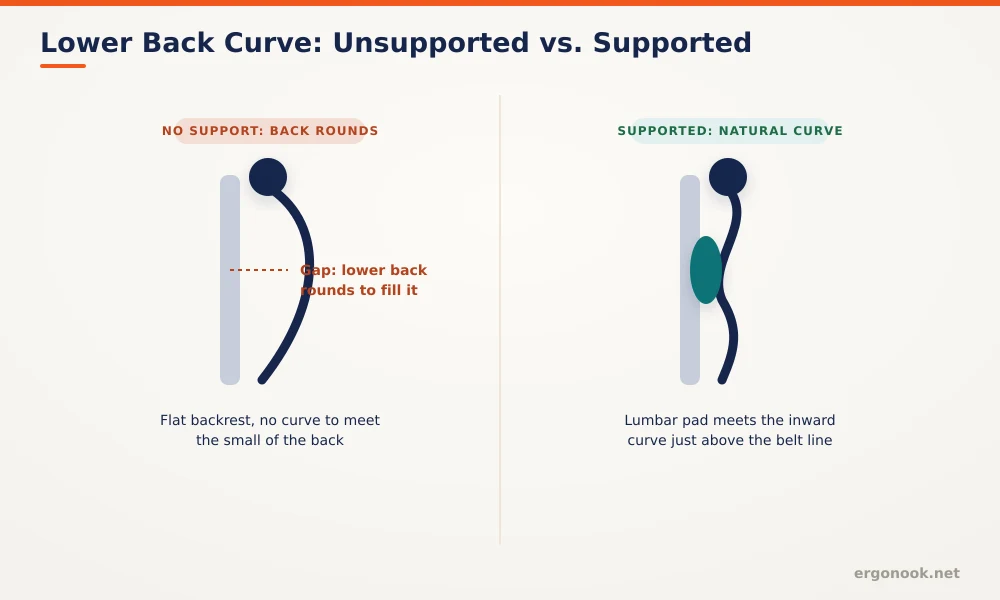
Lumbar support is padding or shaping built into a chair’s backrest that fills the gap at your lower back, holding its natural inward curve instead of letting it round backward. Without it, hours of sitting flatten that curve into a posterior pelvic tilt, per Cleveland Clinic, which loads the discs and muscles of the lower back more than a supported, neutral posture does.
- The lumbar spine, your lower back, naturally curves slightly inward. Lumbar support is designed to meet that curve, not flatten it.
- Cornell’s ergonomics program lists lumbar support as one of six essential adjustments on a task chair, alongside seat height, seat depth, armrests, recline, and tilt tension.
- Good lumbar support sits at the inward curve of your lower back, just above your belt line, not higher on your mid-back or lower at your tailbone.
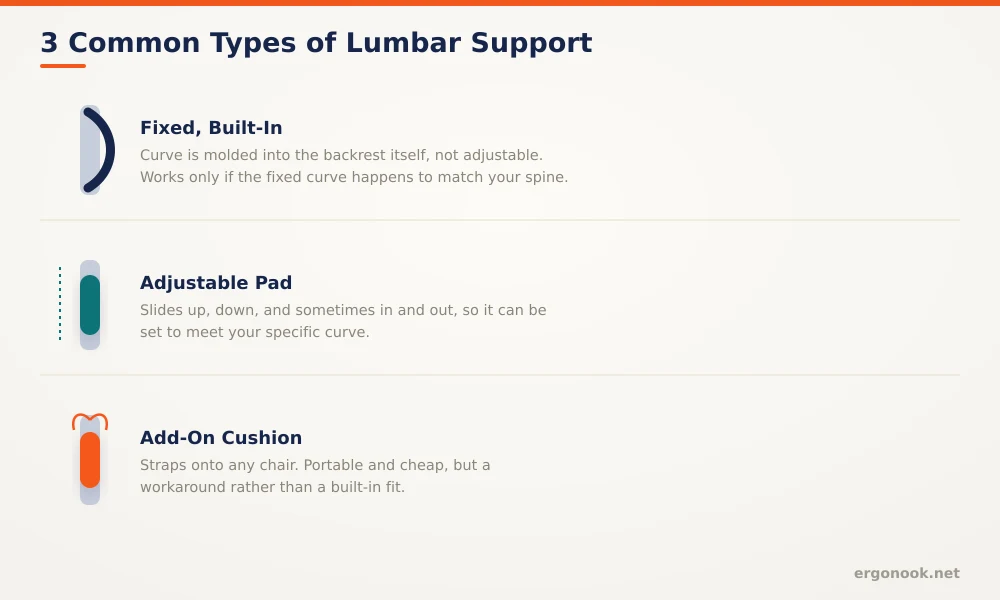
- Lumbar support comes in three main forms: fixed and built into the backrest, adjustable pads that slide to fit you, and add-on cushions that strap to any chair.
In this article:
- What is lumbar support?
- How lumbar support works
- Types of lumbar support
- Do you actually need it?
- Lumbar support vs general back support
- How to choose the right one
- Frequently asked questions
What Is Lumbar Support?
Lumbar support is any padding, shaping, or cushion built into or added onto a chair’s backrest specifically to support the lumbar spine, the five vertebrae of your lower back. That section of the spine has a natural inward curve. A chair with a flat backrest doesn’t meet that curve, which leaves a gap between your lower back and the chair. Lumbar support closes that gap so the backrest actually touches and holds your lower back instead of leaving it unsupported.
How Lumbar Support Works
Sitting itself changes your posture from standing. Left unsupported, most people’s pelvis rotates backward as they sit, which flattens the lower back’s natural curve into a posterior pelvic tilt. Cleveland Clinic notes that this rounded position pushes more load onto the spinal discs and surrounding muscles the longer you hold it, which is exactly what happens over a full workday at a desk (Cleveland Clinic, Low Back Pain: Coping). Lumbar support works by physically holding the curve in place, so your lower back doesn’t have to rely on muscle tension alone to keep from rounding. Less muscular effort spent holding posture means less fatigue building up through the day.
Types of Lumbar Support
Not all lumbar support works the same way, and the type matters as much as whether a chair has it at all.
| Type | How It Adjusts | Best For |
|---|---|---|
| Fixed, built-in | Doesn’t adjust, curve is molded into the backrest | Budget chairs, if the fixed curve happens to fit you |
| Adjustable pad | Height, and sometimes depth, slides to meet your curve | Most home office users, works across more body types |
| Add-on cushion | Straps to any chair, position is manual | Fixing a chair you already own, or a shared/office chair |
Do You Actually Need Lumbar Support?
If you sit for more than a couple of hours at a stretch, yes, in some form. The question is less whether you need it and more whether your current chair already has it built in and positioned correctly. A chair with lumbar support that doesn’t actually reach your lower back curve, because it’s mounted too high or too low, isn’t doing its job even though the feature exists on paper. Our lumbar support cushion picks cover add-on options if your current chair’s built-in support falls short, and our chairs for lower back pain roundup covers chairs with adjustable lumbar systems built in from the start.
Lumbar Support vs General Back Support
These terms get used interchangeably, but they’re not quite the same thing. General back support is the overall shape and structure of a backrest, how it holds your whole spine from your mid-back down. Lumbar support is specific to one section, the lower back’s inward curve. A chair can have a supportive, well-shaped backrest overall and still lack real lumbar support if that backrest is a single flat or gently curved surface with nothing that specifically meets the lower back. That’s why lumbar support is listed as its own adjustment point in Cornell’s ergonomics guidelines, separate from backrest angle and recline.
How to Choose the Right One for You
- Sit back in your current chair and feel where the gap is between your lower back and the backrest.
- Check adjustability. If your chair has a lumbar adjustment, slide it until it meets that gap, not above or below it.
- Add a cushion if your chair has no adjustment, or if the built-in curve doesn’t match your body.
- Recheck after long sits. If your lower back still aches by afternoon, the support likely isn’t positioned correctly rather than absent entirely.
Frequently Asked Questions
Where exactly should lumbar support sit on your back?
At the inward curve of your lower back, roughly at your belt line. If it sits higher, on your mid-back, or lower, near your tailbone, it isn’t doing its job even if the chair technically has lumbar support.
Can I add lumbar support to any chair?
Yes, a strap-on lumbar cushion works on most chairs, including dining chairs and car seats, though it’s a workaround rather than a substitute for a chair with adjustable support built in.
Do mesh office chairs have good lumbar support?
It varies by model. Some mesh chairs build a lumbar curve into the mesh tension itself, others add a separate adjustable pad. Check the specific chair rather than assuming mesh alone provides it.
Does lumbar support matter if I use a standing desk?
Less during standing time, since there’s no backrest involved, but it still matters for whatever sitting time remains in your day.
Lumbar support is a small piece of shaping that does a specific job: holding the natural inward curve of your lower back instead of letting hours of sitting flatten it. Whether that comes built into your chair or added on afterward matters less than whether it actually reaches your lower back curve, positioned correctly, every time you sit down.

Write Your Review
No reviews yet. Be the first to share your experience!