

You are deep in focus, typing away on a project, when the loud clatter of your keyboard breaks the silence. Whether you share an office, work from a home desk, or simply value a quiet environment, a noisy keyboard can be a constant distraction. The quest for the quietest ergonomic keyboard is not just about comfort; it is about preserving your concentration and respecting those around you. In this guide, we have evaluated nine of the top models on the market, focusing on models that deliver both exceptional ergonomic support and near-silent operation. From split designs to cushioned wrist rests, we cover the features that matter most for a peaceful and productive typing experience in 2026. If you are also dealing with wrist pain, check out our dedicated guide on the best ergonomic keyboard for wrist pain.
The quietest keyboards on this list use dampened switches that reduce tactile feedback, so anyone who relies on audible click confirmation to avoid mistyping may prefer a standard membrane board.
Disclosure: Ergonook is a participant in the Amazon Associates program. Links below are affiliate links, and we may earn a commission from qualifying purchases. This does not affect which products we recommend or how we rank them.

Pros
- Certified by an independent ergonomics organization
- Full-size layout keeps a familiar typing experience
- Quiet keys suited to shared workspaces
Cons
- Fixed split angle rather than fully separable key modules like the Kinesis models here
- Larger footprint than a standard compact keyboard
The Ergo K860 uses a curved, split keyframe that slopes outward, aiming to keep your wrists and forearms in a more natural position without fully separating the two halves.
Its memory foam wrist rest and three tilt angles let you fine-tune the typing posture whether you're sitting or standing, and it's certified by United States Ergonomics.
It connects over Bluetooth or the included USB receiver, and keeps a full-size layout with quiet keys, so the transition from a standard keyboard is relatively gentle.
Compared with the fully split Kinesis models in this comparison, its fixed curve is less adjustable but easier to adapt to.
It suits anyone who wants proven ergonomic credentials in a familiar, full-size keyboard shape.
Dimensions: 17.95 inches long by 9.17 inches wide by 1.89 inches high.
Connectivity: Bluetooth or included USB receiver.
Tilt options: 0, negative 4, or negative 7 degrees.
Layout: Full-size, 105 keys.
Weight: 2.6 pounds.
Who should buy this keyboard? Anyone who wants a certified ergonomic keyboard that still feels close to a standard full-size layout.
Who might want to look elsewhere? Anyone who wants fully separable key modules for maximum shoulder-width typing should look at the Kinesis Freestyle2 or Advantage360 instead.
Setup tip: Start at the flat 0 degree tilt and only add negative tilt once you're comfortable with the split shape.

Pros
- Exceptional battery life of up to 277 days without backlight.
- 15 customizable RGB lighting effects for personalization.
- Ergonomic wave design with leather wrist rest reduces strain.
- Whisper-quiet keys suitable for shared spaces.
- Plug-and-play 2.4GHz connection with 33ft range.
Cons
- Only 2.4GHz wireless, no Bluetooth option for multiple devices.
- Backlight reduces battery life to 10 days, requiring more frequent charging.
- Membrane keys may not satisfy mechanical keyboard enthusiasts.
The COLIKES Wireless Ergonomic Keyboard is a feature-rich peripheral designed for professionals and home users seeking comfort and style. Its wave-shaped layout and leather wrist rest cater to those who type for long hours, while the silent membrane keys make it ideal for quiet environments like offices or libraries.
With a massive 2500mAh battery, this keyboard offers up to 277 days of use without backlight, or 10 days with the 15 RGB lighting effects enabled. The customizable lighting includes breathing, wave, and static modes, letting you match your mood or setup. The 2.4GHz wireless connection ensures lag-free typing up to 33 feet away.
The ergonomic wave design promotes a natural hand position, and the included leather wrist rest adds plush support. Adjustable legs allow you to tilt the keyboard for better typing angle. The spill-resistant construction and durable membrane switches promise longevity, even with daily use.
However, the keyboard relies solely on a 2.4GHz USB receiver, lacking Bluetooth for easy multi-device switching. The backlight significantly drains the battery, so heavy RGB users will need to recharge every week or so. Also, the membrane keys lack the tactile feedback that mechanical enthusiasts prefer.
Overall, the COLIKES Wireless Ergonomic Keyboard delivers excellent battery life, customizable aesthetics, and ergonomic comfort at a reasonable price point. It is a solid choice for anyone who prioritizes typing comfort and long wireless operation over mechanical switches or Bluetooth connectivity.
Connection: 2.4GHz wireless with USB receiver
Battery: 2500mAh rechargeable, up to 277 days (backlight off) or 10 days (backlight on)
Charging: USB-C, full charge in 5 hours
Lighting: 15 RGB effects with 5 backlight modes and 3 brightness levels
Keys: Membrane, silent, spill-resistant
Wrist Rest: Leather, detachable
Compatibility: Windows, Mac, Chrome OS, Linux
Range: Up to 33 feet (10 meters)

Pros
- Significant reduction in wrist strain compared to standard keyboard and mouse setups
- High build quality with stain-resistant fabric and soft-touch grip
- Long battery life: up to 2 years for keyboard and mouse on a single AA battery each
- Multi-device support with easy switching and Logitech Flow for cross-screen file transfers
Cons
- Split keyboard design may take a few days to get used to for touch typists
- Lift mouse is designed specifically for small to medium hands, not ideal for larger hands
- No backlighting on the keyboard, which could be a drawback for low-light environments
The Logitech Ergo K860 keyboard and Lift vertical mouse combo is a complete ergonomic solution for anyone who spends long hours at a desk. This set targets office workers, programmers, and creative professionals who experience wrist or forearm fatigue from conventional peripherals. By combining a curved split keyboard with a vertical mouse, Logitech addresses the two main sources of upper body strain: unnatural wrist angles and repetitive motion.
The K860 keyboard stands out with its split keyframe that reduces wrist bending by 25%, while the memory foam wrist rest supports 54% more of your palm compared to standard models. Real-world use reveals a noticeably relaxed typing posture, especially when using the adjustable palm lift to angle the board. The Perfect Stroke keys are scooped to match fingertips, delivering quiet, fluid keystrokes that feel precise without being mushy. The Lift mouse complements this with a 57-degree vertical grip that lifts the wrist into a natural handshake position, easing tension in the forearm and upper body. Its SmartWheel shifts smoothly between notched and free scrolling, and the four custom buttons (programmable via Logi Options+) boost productivity.
Design and build quality are excellent. The graphite finish is professional, and the keyboard's fabric surface is stain-resistant and easy to clean. The mouse has a softly textured grip with a thumb rest for added comfort. Both devices connect via Bluetooth or the included Logi Bolt USB receiver, supporting up to three devices with instant switching. Battery life is rated at two years per device on a single AA battery, which is impressive for a wireless set.
One minor drawback is the learning curve for the split keyboard layout: touch typists may need a few sessions to adapt to the curved key arrangement. Additionally, the Lift mouse is sized for small to medium hands, so users with larger hands might find it cramped. The keyboard also lacks backlighting, which could be an issue for those who work in dimly lit spaces.
Overall, this combo delivers on its ergonomic promise with thoughtful engineering and high-quality materials. It is a worthwhile investment for anyone committed to reducing repetitive strain injuries without sacrificing performance or connectivity. For users seeking relief from wrist pain and a more natural workstation setup, the Logitech K860 and Lift combo is a top-tier choice.

Pros
- Comprehensive 3-in-1 design saves desk space and reduces clutter.
- Quiet operation with scissor-switch keys and silent mouse clicks.
- Ergonomic vertical mouse helps maintain natural wrist alignment.
- Long battery life with USB-C recharging.
- Wide compatibility with Windows 7-11 and macOS 11.2.1+.
Cons
- Keyboard layout may feel compact for users with larger hands.
- Limited to 2.4GHz wireless, no Bluetooth option for multi-device switching.
- Replacement receivers must be purchased separately if lost.
The Perixx PERIDUO-606IIA is a 3-in-1 wireless ergonomic set designed for desktop users who spend long hours typing and navigating. It combines a compact keyboard, a vertical mouse, and a numeric keypad, all connected via a single nano receiver. This bundle is ideal for professionals, remote workers, or anyone seeking to reduce wrist and forearm strain without sacrificing desk space.
Standout features include the quiet scissor-switch keys and silent mouse clicks, which make it a top choice for shared offices or late-night work. The vertical mouse promotes a natural handshake position, with adjustable DPI settings (800 to 2400) for precise tracking. The cushioned wrist rest and adjustable tilt feet allow you to customize your typing angle for added comfort during marathon sessions.
Build quality is solid, with a durable plastic construction that feels sturdy but lightweight. The keyboard's compact layout saves space, though it may feel cramped for users with larger hands. The wireless connection is stable within 30 feet, and the USB-C rechargeable batteries last up to a month with typical daily use, reducing the hassle of frequent charging.
One drawback is the lack of Bluetooth connectivity, limiting it to a single 2.4GHz connection. If you lose the nano receiver, you'll need to purchase a replacement separately. Additionally, the numeric keypad is a separate unit, which might feel less integrated than a full-size keyboard.
Overall, the Perixx PERIDUO-606IIA offers excellent value for an ergonomic 3-in-1 solution. It's quiet, comfortable, and efficient, making it a smart choice for anyone looking to improve their workspace ergonomics without breaking the bank.

Pros
- Certified by an independent ergonomics organization
- Compact size closer to a standard keyboard footprint
- Long rated battery life
Cons
- Not fully split, so the wrist angle change is more subtle than the Kinesis or Perixx keyboards
- Membrane switches rather than mechanical
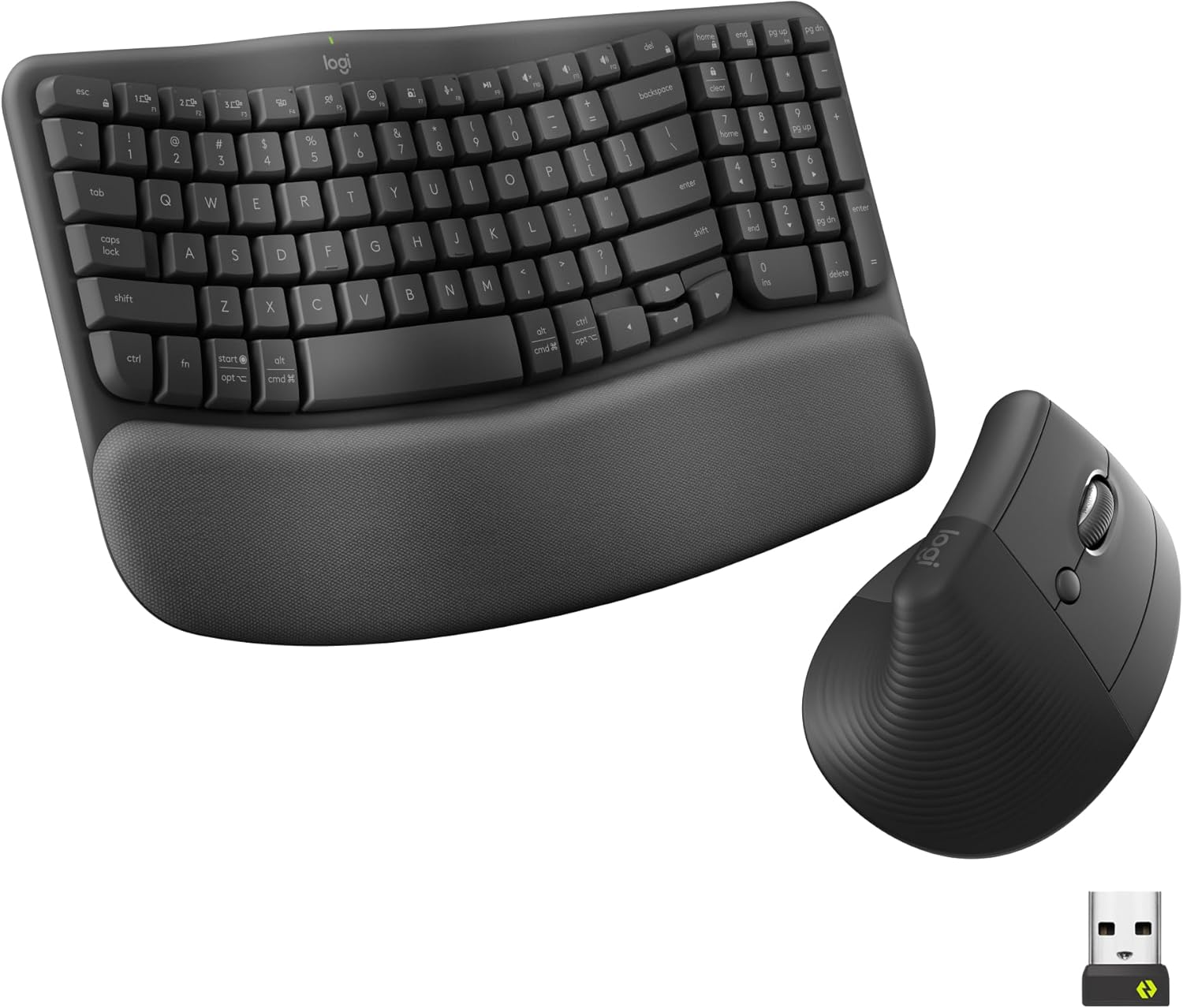
Wave Keys uses a gently wavy, contoured shape rather than a fully split layout, aiming to guide your hands into a more natural position without a steep learning curve.
Its built-in memory foam palm rest adds cushioned support, and it's certified by United States Ergonomics for posture and strain reduction.
It connects over Bluetooth or the included Logi Bolt receiver, with Easy-Switch letting you jump between paired devices, and a battery rated to last up to three years.
Because it isn't fully split, the wrist angle change is more subtle than the Kinesis or Perixx keyboards in this comparison.
It suits anyone who wants ergonomic support with minimal adjustment from a standard keyboard.
Dimensions: 14.8 inches long by 8.62 inches wide by 1.18 inches high.
Connectivity: Bluetooth or included Logi Bolt receiver.
Switch type: Membrane.
Battery life: Rated up to three years.
Weight: 2.1 pounds.
Who should buy this keyboard? Anyone who wants certified ergonomic support with a gentle learning curve from a standard keyboard.
Who might want to look elsewhere? Anyone who wants a fully split or mechanical layout should consider the Perixx or Kinesis keyboards instead.
Setup tip: Pair it with a compatible Logitech mouse through the same Easy-Switch profile for a consistent multi-device setup.

Pros
- Rechargeable battery with a long rated life per charge
- Simple plug-and-play setup, no Bluetooth pairing required
- One of the more affordable split keyboards in this comparison
Cons
- Fixed split angle rather than fully separable modules
- USB receiver only, no Bluetooth option
The Arteck split keyboard uses a fixed split layout with a soft cushioned wrist and palm rest, aimed at a more natural hand position than a flat keyboard.
It connects through a nano USB receiver stored in the keyboard itself, and its rechargeable battery is rated for about six months per charge based on typical daily use.
It's backed by a 24 month warranty, and is one of the more affordable split keyboards in this comparison.
It doesn't offer Bluetooth or fully separable key modules, so it's a more modest step up from a standard keyboard than the Kinesis models here.
It suits anyone who wants an affordable, low-effort introduction to a split keyboard layout.
Dimensions: 16.5 inches long by 9.6 inches wide by 1.02 inches high.
Connectivity: 2.4G USB wireless receiver.
Battery: Rechargeable, rated around six months per charge.
Warranty: 24 months.
Who should buy this keyboard? Anyone who wants an affordable, simple introduction to a split ergonomic layout.
Who might want to look elsewhere? Anyone who wants Bluetooth or fully separable key modules should consider the Logitech K860 or Kinesis models instead.
Setup tip: The nano receiver stores inside the keyboard when not in use, so check there first if you misplace it.

Pros
- Excellent ergonomic design reduces wrist and hand strain during extended typing.
- Customizable tilt with removable elevator for personalized comfort.
- Strong data security with AES 128-bit encryption for every keystroke.
- Convenient dedicated Windows key and back button for efficient navigation.
- Flexible number pad placement allows you to optimize your desktop layout.
Cons
- Split layout may require an adjustment period for users accustomed to traditional keyboards.
- Integrated palm rest cannot be detached for cleaning or replacement.
- No backlighting, which can be a drawback in low-light environments.
The Incase Sculpt Ergonomic Keyboard, designed by Microsoft, is a wireless split-layout keyboard aimed at professionals and heavy typists seeking to reduce wrist strain and improve posture. Its domed geometry and cushioned palm rest promote a natural typing position, making it ideal for long work sessions or anyone with repetitive strain concerns.
Key features include a removable elevator for adjusting tilt, AES 128-bit encryption for secure data entry, and a dedicated Windows key for quick navigation. The standalone numeric keypad adds flexibility, allowing you to place it where it suits your workflow. Users report a noticeable reduction in wrist fatigue after extended use.
The keyboard has a sleek black finish with a split layout that encourages a shoulder-width hand position. The palm rest is plush and supportive, though it is integrated and not removable. The keys have a comfortable scissor-switch feel, and wireless connectivity is reliable with a secure encrypted link.
The split layout may require a brief adjustment period for those used to standard keyboards, and the lack of backlighting can be a drawback in dim environments. Additionally, the integrated palm rest may not suit users who prefer a detachable option for cleaning.
Overall, the Incase Sculpt Ergonomic Keyboard offers excellent ergonomic support and security features for productivity-focused users. While it has a few limitations, its comfort and thoughtful design make it a strong choice for anyone looking to upgrade their typing experience.

Pros
- Widely reviewed with a strong track record
- Distinct tactile feedback for typists who prefer a firmer keystroke
- Straightforward wired setup
Cons
- Manufacturer notes a one to two week adjustment period is typical
- Wired only, no wireless option
The PERIBOARD-512 uses a one-piece split layout with curved, stepped key rows, aiming to reduce wrist bending during long typing sessions.
Its extended key travel gives a tactile, audible response similar to a mechanical keyboard, and the curved keycaps are shaped to fit fingertip contours.
It's rated for up to 20 million keystrokes and has one of the most widely reviewed track records in this comparison.
Perixx notes most users adapt within one to two weeks, which is worth expecting going in.
It suits anyone who wants a proven, wired split keyboard with distinct tactile feedback.
Dimensions: 19.09 inches long by 9.29 inches wide by 1.73 inches high.
Connectivity: Wired USB.
Switch type: Tactile membrane, rated for up to 20 million keystrokes.
Weight: 2.3 pounds.
Who should buy this keyboard? Anyone who wants a proven, wired split keyboard with distinct tactile feedback.
Who might want to look elsewhere? Anyone who wants a wireless connection should consider the Logitech Wave Keys or Nulea keyboard instead.
Setup tip: Give yourself the one to two week adjustment period Perixx notes rather than judging comfort in the first few days.

Pros
- Excellent ergonomic design with curved split frame and scooped keys.
- Long-lasting 2000mAh battery with auto sleep mode.
- Seamless 3-device switching via Bluetooth and 2.4G.
- Adjustable backlight with three brightness levels.
- Comfortable cushioned wrist rest and adjustable tilt feet.
Cons
- Full-size design takes up significant desk space.
- No wired connection option; relies on wireless only.
- Backlight needs to be manually turned on after the keyboard wakes from sleep.
The ProtoArc EK01 Plus is a full-size ergonomic keyboard designed to reduce wrist and forearm strain during long typing sessions. Its curved split-frame and scooped keys promote a natural hand position, making it ideal for professionals, writers, and anyone who spends hours at a computer.
Standout features include adjustable white LED backlighting with three brightness levels, a 2000mAh rechargeable battery that lasts up to 90-100 days with backlight off, and seamless switching between three devices via Bluetooth or 2.4G USB. The cushioned wrist rest provides 54% more support, and the four adjustable tilt feet let you find the perfect typing angle.
The build quality feels robust with a grey finish that fits most workspaces. However, the full-size layout requires ample desk space, and there is no wired connection option. The backlight must be manually turned on after the keyboard wakes from sleep, which may be a minor inconvenience.
Overall, the ProtoArc EK01 Plus offers excellent value for those seeking ergonomic comfort and wireless flexibility. Its combination of comfort features, long battery life, and multi-device support makes it a strong choice for productivity-focused users.
Buying Guide: What to Look for in a Quiet Ergonomic Keyboard
Choosing the right quiet ergonomic keyboard involves balancing several key factors. Here are the most important criteria to consider before making your purchase.
Switch Type and Noise Level
The primary source of keyboard noise is the switch mechanism beneath each key. Membrane and scissor-switch keyboards are inherently quieter than traditional mechanical switches, offering a soft, cushioned feel with minimal click. For the quietest experience, look for models specifically described as having silent keys or whisper-quiet clicks, such as the Perixx PERIDUO-606IIA, which features silent scissor-switch keys. If you prefer a mechanical feel, some ergonomic boards use dampened switches that produce a softer sound, but membrane-based designs remain the gold standard for silence.
Ergonomic Design and Wrist Support
A quiet keyboard is only useful if it is comfortable for long typing sessions. Look for features like a split keyframe, curved layout, or a cushioned wrist rest. The Logitech Ergo K860, for example, offers a pillowed wrist rest that provides significant support and reduces wrist bending. A good ergonomic design not only reduces strain but also encourages a natural typing posture, which can further minimize noise by preventing forceful keystrokes. For more on this, read our comparison of ergonomic keyboard vs regular keyboard.
Connectivity and Compatibility
Consider how you will connect the keyboard to your devices. Wireless options like Bluetooth or a 2.4 GHz USB receiver offer a clutter-free desk, while wired models provide a stable, lag-free connection. Many quiet ergonomic keyboards, such as the ProtoArc EK01 Plus, support multi-device switching, allowing you to toggle between your laptop, tablet, and desktop with ease. Ensure the keyboard is compatible with your operating system, whether Windows, macOS, or Chrome OS, to avoid any setup frustrations.
Final Thoughts
After evaluating these models, we believe the Logitech Ergo K860 Wireless Ergonomic Split Keyboard stands out as the top overall choice for those seeking a balance of whisper-quiet keys, superior wrist support, and a proven ergonomic design that reduces strain. For budget-conscious buyers who still want a silent typing experience with the added benefit of a vertical mouse, the Perixx PERIDUO-606IIA 3-in-1 Wireless Compact Ergonomic Keyboard offers exceptional value without compromising on comfort or noise reduction. Whichever you choose, investing in a quiet ergonomic keyboard will transform your workspace into a more focused and comfortable environment.
Frequently Asked Questions
1. Are ergonomic keyboards quieter than regular keyboards?
Not necessarily, but many ergonomic keyboards are designed with membrane or scissor-switch mechanisms that produce less noise than standard mechanical keyboards. Models like the Logitech Wave Keys and Perixx PERIDUO-606IIA are specifically engineered for quiet operation.
2. How do I clean a quiet ergonomic keyboard?
For most models, you can use compressed air to remove debris from between keys and a slightly damp microfiber cloth to wipe the surface. Avoid using liquids directly on the keyboard. Always check the manufacturer’s instructions for specific cleaning guidelines.
3. Can I use a quiet ergonomic keyboard for gaming in 2026?
Yes, many quiet ergonomic keyboards are suitable for casual gaming, especially those with low-latency wireless connections. However, dedicated gaming keyboards often offer faster response times and customizable keys. For a balance, the ProtoArc EK01 Plus with its backlit keys and multi-device support can work well for both work and play.
4. What is the difference between a split and a curved ergonomic keyboard?
A split keyboard separates the key layout into two distinct halves, allowing you to position your hands shoulder-width apart. A curved keyboard, like the Logitech Ergo K860, has a single curved frame that angles the keys to match your fingertips. Both reduce wrist strain, but split keyboards offer more adjustability. Learn more in our guide on the best split ergonomic keyboard.


Write Your Review
No reviews yet. Be the first to share your experience!