

This article covers general seating features, not medical treatment. Adjustable lumbar support can help match a chair to your own posture, but it is not a medical device and will not resolve an underlying condition. If back pain is severe, persistent, or radiating into the legs, talk to a doctor or physical therapist rather than relying on a chair alone.
Fixed lumbar curves work fine if your torso happens to match the shape a manufacturer designed around, but plenty of people do not. An adjustable lumbar system lets you move the support to match your own spine rather than the other way around, whether that means a simple height slider, a two-direction pad, or an inflatable airbag you fill to your own preferred firmness. This list of office chairs for back pain is limited to picks with a genuinely adjustable, not fixed, lumbar mechanism. For background on why lumbar position matters in the first place, our guide on what lumbar support actually does covers the underlying reasoning before you compare the mechanisms below.
We pulled six chairs currently sold on Amazon, ranging from a simple single-axis height adjustment to a five-way system that adjusts up, down, forward, backward, and by rotation.
Disclosure: Ergonook is a participant in the Amazon Associates program. Links below are affiliate links, and we may earn a commission from qualifying purchases. This does not affect which chairs we recommend or how we rank them.

Pros
- Wide seat pan suits a broader range of body types than narrower task chairs
- Stated height range helps set expectations before ordering
- Simple, no-frills adjustment is easy to set correctly the first time
Cons
- Fewer premium features, such as a headrest or inflatable lumbar, than pricier picks on this list
- Armrests are simpler than the multi-directional arms on higher-priced chairs here

Pros
- Nearly 3 inches of lumbar height travel covers a wide range of torso lengths
- Extra-thick molded foam seat reduces pressure during long sitting sessions
- Flip-up, rotating armrests slide neatly under tables when not needed
Cons
- Lumbar adjusts in height only, not forward-and-backward depth
- Lower price point means fewer premium finishing details than the executive-style picks on this list
Pros
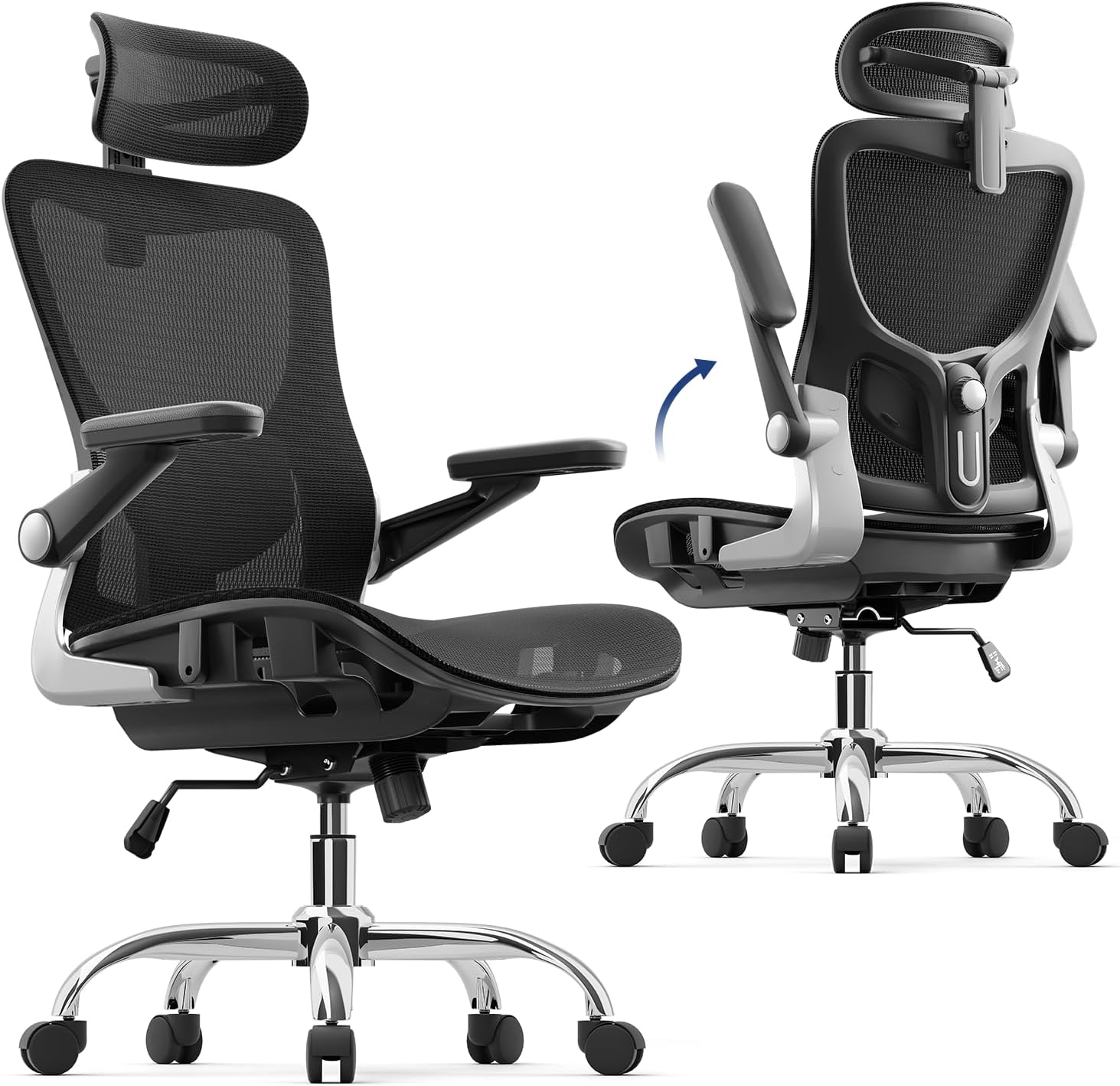
- Two-direction lumbar adjustment covers more body shapes than height-only adjustment
- 3D armrests offer more posture variety than fixed or flip-up-only arms
- Rocking function adds light movement without a full recline mechanism
Cons
- Rocking range is modest compared to the dedicated reclining chairs elsewhere in this category
- Mid-range price sits above the simplest lumbar-only picks on this list

Pros
- Most adjustment axes for lumbar positioning among the picks on this list
- V-shaped backrest is a distinct design from the flat or gently curved backs elsewhere in this roundup
- Headrest and armrests both adjust independently of the lumbar system
Cons
- More adjustment points means more initial setup time to dial in correctly
- Rotation adjustment is a less common mechanism that may take longer to get used to than a simple slider

Pros
- Inflatable lumbar lets you dial in exact firmness rather than a preset curve
- Heavy-duty metal base feels solid under daily use
- Included storage bags are a genuine practical bonus not found on most competing chairs
Cons
- Inflatable airbags need occasional reinflation to maintain firmness over time
- Bonded leather runs warmer than mesh over a full workday

Pros
- Inflatable lumbar targets support precisely where needed rather than a fixed zone
- Wide 21 inch seat is roomier than many task chairs at a similar price
- PU leather is easy to wipe clean
Cons
- Inflatable system needs occasional reinflation over time
- PU leather runs warmer than mesh over long sitting sessions
How to Compare Adjustable Lumbar Mechanisms
Number of Adjustment Axes
The simplest adjustable lumbar systems move in one direction, usually height. More elaborate ones add forward-and-backward depth, and the most configurable add rotation on top of both. More axes generally means a better potential fit, but it also means more initial setup time to find the right combination. If you know roughly what position works for your back already, a single-axis system may get you there faster than a five-way system that takes longer to dial in. On the other hand, if you have tried several chairs before without finding a comfortable lumbar position, a system with more adjustment axes gives more room to actually solve that problem rather than running into the same fixed-shape limitation again. Torso length, the depth of your natural lumbar curve, and how far back you tend to sit in a chair all factor into which axis matters most for your own body, which is worth thinking through before assuming more adjustment is automatically better than a simpler design.
Inflatable Versus Mechanical Adjustment
Inflatable lumbar systems let you customize firmness precisely by adding or releasing air, which some people prefer over a fixed mechanical slider. The tradeoff is that airbags can lose some pressure gradually over time and need occasional reinflation to maintain the same support level, while a mechanical slider or dial stays exactly where you set it until you move it again. Neither mechanism is more or less durable in general use, the difference is mainly in how much periodic attention the adjustment itself requires. A mechanical system also tends to be easier to diagnose if something feels off, since you can see and feel the physical position of the slider or dial, while an underinflated airbag is less obvious until the support noticeably softens.
Seat Comfort Still Matters Alongside Lumbar Adjustment
A perfectly adjusted lumbar system will not fully compensate for a thin, low-density seat cushion that compresses within months. Look at the seat cushion thickness and material alongside the lumbar mechanism, since both contribute to comfort over a full workday, and a chair with excellent lumbar adjustment but a thin seat can still leave you shifting position frequently to avoid pressure points. Our seat cushion picks are worth pairing with any chair here if the seat itself feels thin after extended use.
Set It Once, Then Leave It Alone
Adjustable lumbar support only helps if it is actually set correctly, which usually takes a few minutes of deliberate adjustment rather than sitting down and expecting an immediate fit. Spend time in the chair adjusting the lumbar position while seated normally, not while leaning forward to reach the adjustment lever, since your posture changes the moment you lean in to make the adjustment. It is worth rechecking the adjustment after a few weeks of regular use as well, since your own sense of what feels correct can shift once you get used to a new chair, and a position that felt right on day one may need a small tweak once your posture settles into a routine with the chair. For general guidance on what else to check in an ergonomic chair beyond lumbar support, see our ergonomic office chair buying guide.
Final Thoughts
For a simple, budget-friendly option with a wide seat and a straightforward lumbar adjustment, the Nexthro Wide Seat Chair with Adjustable Lumbar Support covers the basics without extra mechanisms to configure, and includes a stated height range that many budget chairs skip, which is a genuinely useful detail for anyone ordering online without being able to sit in the chair first. For a shopper who wants the most configurable lumbar system in this roundup and is willing to spend extra time dialing it in, the HOLLUDLE 3D Adjustable Lumbar Chair adjusts up, down, forward, backward, and by rotation, built into a V-shaped backrest designed to follow the spine. Both are reasonable starting points before comparing the inflatable and two-direction picks further down the list.
FAQ
How long does it take to properly adjust lumbar support?
Plan on a few minutes of deliberate adjustment while sitting in your normal working posture, not a single quick tweak. Multi-axis systems in particular benefit from adjusting one axis at a time rather than trying to set height, depth, and rotation all at once, since changing several settings simultaneously makes it harder to tell which adjustment actually improved the fit.
Is an inflatable lumbar system better than a mechanical one?
Neither is universally better. An inflatable system allows finer firmness customization but needs occasional reinflation over time, while a mechanical slider or dial holds its position indefinitely but offers less precise firmness control. Choose based on whether you value fine-tuned firmness or a set-and-forget mechanism, and how much you mind the occasional maintenance step of topping off an airbag.
Can I add adjustable lumbar support to a chair that does not have it?
Yes, a separate lumbar support cushion is a reasonable option if you already own a chair you like otherwise and do not want to replace the whole thing just to fix lumbar fit. Our lumbar support cushion picks cover standalone options that attach to most existing chairs, giving many of the same adjustment benefits without a full chair purchase.
When should I see a doctor instead of just adjusting my chair?
If back pain is severe, does not improve with proper lumbar adjustment and regular movement, or radiates into the legs, that is a signal to see a doctor or physical therapist rather than continuing to try different adjustment settings on your own. Adjustable lumbar support is a comfort and posture tool, not a diagnosis or a treatment plan, and no amount of fine-tuning replaces a professional evaluation when pain persists.







Write Your Review
No reviews yet. Be the first to share your experience!