

Most mesh chairs recline a little, a single tilt lock or a couple of preset positions, but a genuinely reclining back is a different category entirely, built to tip back 45 degrees or more without losing support. That range matters for anyone who takes real breaks in the chair rather than just leaning back for a few seconds during a call. See our full mesh office chair lineup for more options.
We compared six mesh chairs specifically on recline range and how the mechanism locks in place, from a modest 3-position tilt up to a near-flat 160 degrees. For the full range of criteria worth checking regardless of which feature matters most to you, our full buying guide for ergonomic office chairs covers it in depth.
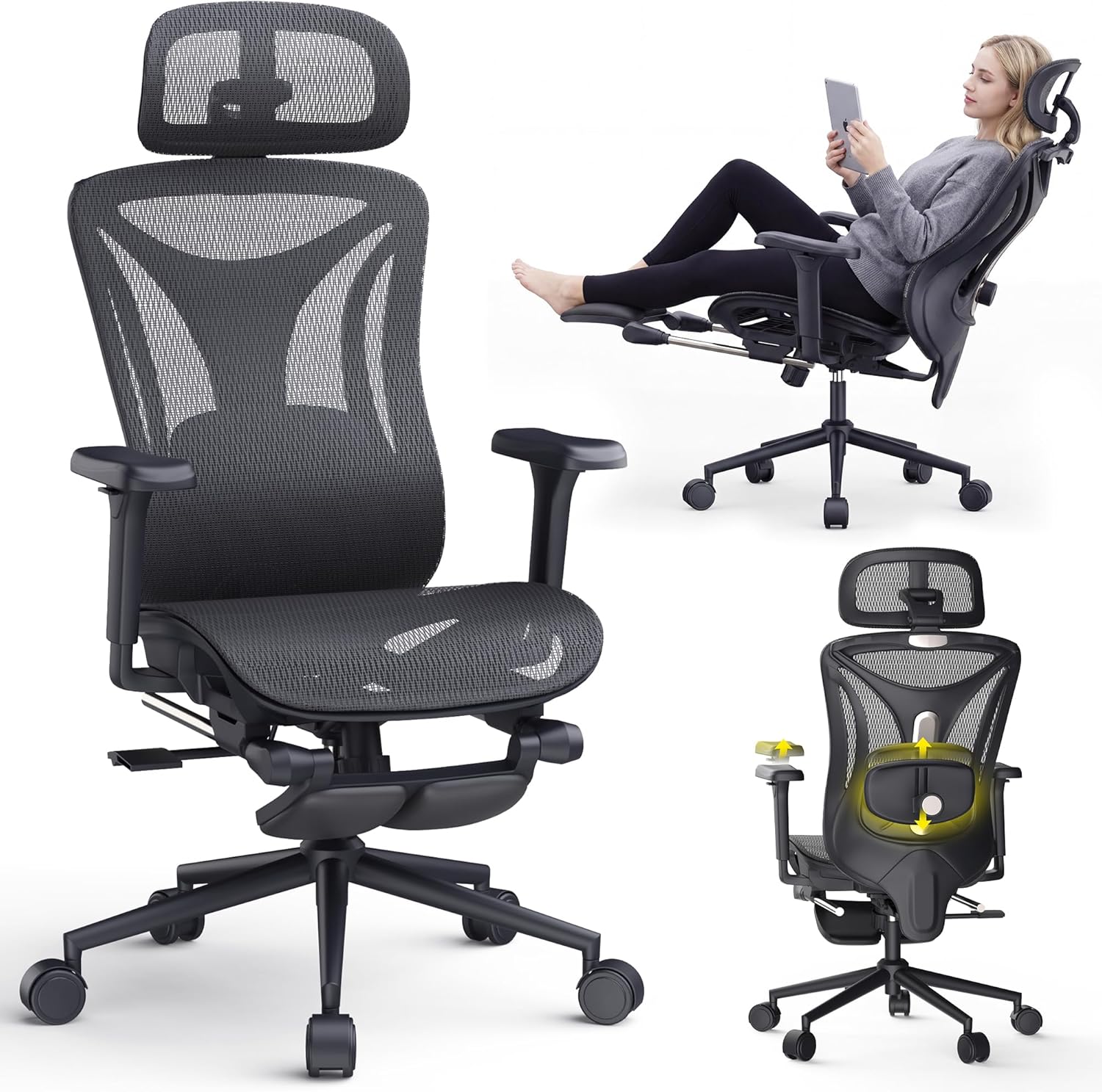
Pros
- Deepest recline range of any footrest chair in this comparison at 160 degrees
- High average rating
- 350 lb weight capacity
Cons
- Smallest review count of any chair in this comparison
- Newer brand without a long track record
- A near-flat recline angle may not suit every desk setup or room layout
This CYKOV model shares the brand's precisely specified adjustment approach but pushes the recline range further than any other chair in this comparison, reclining to 160 degrees, close to fully flat.
Adjustable lumbar support and headrest carry over from the brand's other model, and the 350 lb weight rating matches its sibling chair in this comparison.
The review count is the smallest of any chair we compared here, reflecting a newer or lower-volume listing.
For anyone who specifically wants the deepest possible recline in a footrest chair, this is the clearest specialist pick in this comparison.
Chair Type: Ergonomic mesh office chair with footrest. Recline: 90 to 160 degrees. Lumbar Support: Adjustable. Headrest: Adjustable.
Brand: CYKOV. Maximum weight recommendation: 350 pounds.
If the deepest possible recline is your priority in a footrest chair, this pick leads every other chair in this comparison on that specific spec.
Consider this chair if you plan to use the near-flat recline regularly rather than as an occasional feature.
Weigh the small review count carefully against the more established picks in this comparison.
This is best suited to buyers who prioritize maximum recline depth above review volume or brand history.

Pros
- Highest average rating of any footrest chair we compared
- Highest weight capacity among the footrest chairs in this comparison
- Alloy steel frame is more durable than the plastic or basic nylon frames on some competitors
Cons
- Much smaller review count than the SIHOO or GABRYLLY picks in this comparison
- Newer, less established brand
- Fewer independently verified specifications available than longer-running listings
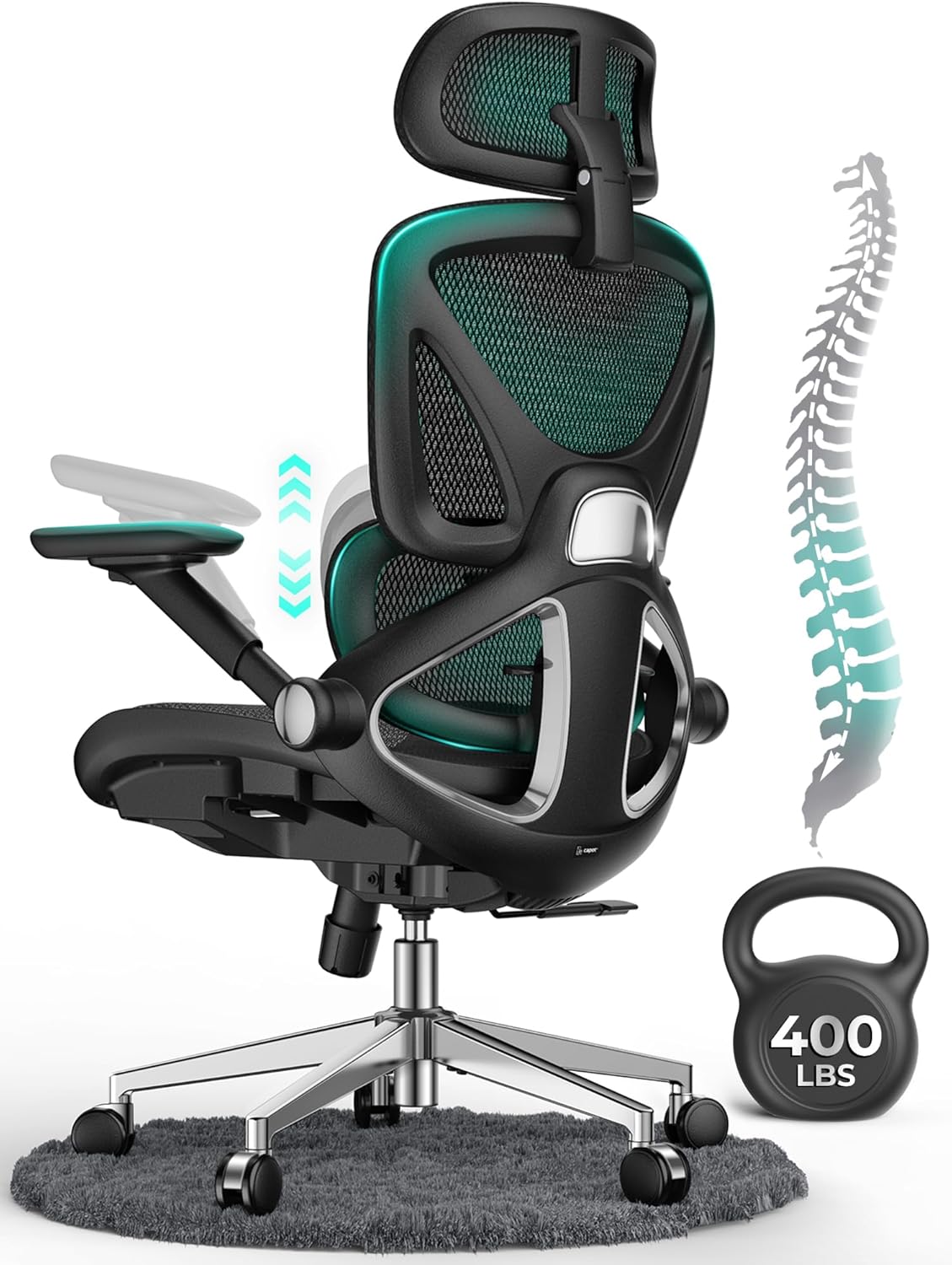
This chair holds the highest average rating of any footrest chair in this comparison, backed by an alloy steel frame and a 400 lb weight rating, both higher than most competitors here.
The recline range extends to 145 degrees, deeper than most footrest chairs at this price, and the memory foam seat pairs with adjustable lumbar support and headrest.
The review count is considerably smaller than the more established SIHOO or GABRYLLY picks in this comparison, reflecting a newer listing rather than a known issue with the build.
For anyone who weighs rating and weight capacity heavily, this is currently the top performer among footrest chairs we have compared, with the caveat of a smaller sample size.
Chair Type: High back ergonomic mesh office chair with footrest. Frame Material: Alloy steel. Seat Material: Memory foam. Back Style: Mesh back.
Armrests: Rounded. Recline: 90 to 145 degrees, 3 positions. Lumbar Support: Adjustable.
Weight: 30 pounds. Maximum weight recommendation: 400 pounds.
If overall rating and weight capacity matter most to you among footrest chairs, this pick currently leads this comparison on both.
Consider this chair if a deeper recline range appeals to you alongside a sturdier steel frame.
Weigh the smaller review count against the more established picks in this comparison if a longer track record matters more.
This is best suited to buyers who prioritize current rating and capacity over brand history.

Pros
- 5-year warranty, longer than most footrest chairs in this comparison
- Precise 4-way headrest and 2-way lumbar adjustment, measured in specific inch and degree increments
- 350 lb weight capacity
Cons
- Smaller review count than the SIHOO or GABRYLLY picks in this comparison
- Rating trails the higher-rated picks here
- Newer brand without a long track record
CYKOV backs this footrest chair with a 5-year warranty, notably longer than most competitors in this comparison, alongside precisely specified adjustment ranges: 4-way headrest movement and 2-way lumbar adjustment measured in exact inch and degree increments rather than vague marketing language.
The recline range runs from 90 to 135 degrees, and the frame is rated for 350 pounds, higher than several other footrest chairs in this comparison.
The review count is smaller than the more established SIHOO and GABRYLLY picks here, and the rating trails the highest performers in this comparison.
For anyone who wants precisely specified adjustment ranges and a longer warranty over raw review volume, this is a reasonable pick.
Chair Type: Ergonomic mesh office chair with footrest. Recline: 90 to 135 degrees. Headrest: 4-way adjustable. Lumbar Support: 2-way adjustable.
Brand: CYKOV. Warranty: 5 years. Weight: 13 kilograms (about 29 pounds). Maximum weight recommendation: 350 pounds.
If warranty length matters most to you among footrest chairs, this pick's 5-year coverage beats most competitors in this comparison.
Consider this chair if you want precisely specified headrest and lumbar adjustment ranges rather than vague adjustable language.
Weigh the smaller review count against the SIHOO or GABRYLLY picks if a longer track record matters more to you.
This is best suited to buyers who prioritize warranty backing and precise specifications over the single largest review base.

Pros
- Largest review base of any footrest chair in this comparison
- Adaptive lumbar support in addition to the footrest, a rare combination
- Armrests rotate a full 360 degrees, more flexible than a standard flip-up hinge
Cons
- Split-back design is a visual departure from solid mesh backs elsewhere in this comparison
- Heavier than several other picks here
- 300 lb weight capacity, lower than the highest-rated pick in this comparison
SIHOO's B100 PRO adds a built-in footrest to the same adaptive lumbar mechanism found on the standard B100, extending its posture-tracking lumbar support to a chair built for reclined breaks as well as focused sitting.
The armrests rotate a full 360 degrees in addition to flipping up, more flexible than the simple flip-up hinges on most other footrest chairs. The wide headrest and split-back mesh design carry over from SIHOO's other models.
It carries by far the largest review base of any footrest chair in this comparison, a strong signal of consistent performance across a huge number of buyers.
For anyone who wants a footrest paired with SIHOO's adaptive lumbar mechanism specifically, this is the most field-proven option in this comparison.
Chair Type: Ergonomic mesh office chair with footrest. Frame Material: Polypropylene. Seat Material: Mesh. Back Style: Split back.
Armrests: 360-degree rotatable flip-up. Lumbar Support: Adaptive. Recline: 3 positions.
Weight: 38.3 pounds. Maximum weight recommendation: 300 pounds.
If review volume matters most to you among footrest chairs specifically, this pick's track record is difficult for any competitor in this comparison to match.
Consider this chair if adaptive lumbar support is as important to you as the footrest itself, since few footrest chairs combine both mechanisms.
Weigh the 300 lb capacity against the higher-rated picks in this comparison if you need more headroom.
This is best suited to buyers who want a well-proven footrest chair with genuinely adaptive lumbar support.

Pros
- Second-largest review base of any footrest chair in this comparison
- Deeper recline range than most footrest chairs at this price
- Same proven frame as one of our top overall mesh chair picks
Cons
- Heaviest chair in this comparison
- 300 lb weight capacity, lower than the highest-rated pick here
- Requires full assembly
This is the footrest version of GABRYLLY's widely reviewed mesh chair, carrying over the same 3D headrest and flip-up arms while adding a built-in footrest and a deeper 135-degree tilt range.
The wide seat cushion and heavy duty mesh construction are built for extended sessions, and the footrest specifically supports reclined breaks without leaving the chair.
At 42.8 pounds, it is the heaviest chair in this comparison, and the weight capacity trails the highest-rated footrest pick here.
For anyone who already trusts GABRYLLY's standard chair and wants the added footrest and deeper recline, this is a natural upgrade.
Chair Type: High back ergonomic mesh office chair with footrest. Frame Material: Nylon. Seat Material: Mesh. Back Style: High back.
Armrests: Flip-up. Headrest: 3D. Recline: 135-degree tilt, 3 positions.
Weight: 42.8 pounds. Maximum weight recommendation: 300 pounds.
If you want a footrest chair backed by a large, established review base, this is one of the strongest options in this comparison on that specific point.
Consider this chair if a deeper recline range matters to you alongside the footrest itself.
Keep the heavier overall weight in mind if you plan to move the chair between rooms often.
This is best suited to buyers who want a well-proven frame with a footrest added rather than a newer, unproven design.

Pros
- Weight rating clears the 300-pound threshold with room to spare
- 4D lumbar adjustment is more precise than most chairs at this price
- Mesh back stays cool during long sessions compared to foam-backed chairs
- Recline and tilt tension adjust independently for a more personalized fit
Cons
- Seat pan is standard width, not an oversized XL seat, so very broad-framed users should check the dedicated big and tall picks below
- Assembly instructions are adequate but not as detailed as premium competitors
The Duramont sits in an interesting spot for this list. It is not marketed as a big and tall chair, but its manufacturer weight rating of 330 pounds clears the 300-pound threshold this roundup is built around, and it does so while keeping a more standard seat width and profile than the XL-specific chairs further down this page.
The main draw is adjustability. The 4D lumbar system moves in four directions rather than the simple up-down adjustment found on cheaper chairs, so users can dial in support for the exact curve of their lower back. Recline angle and tilt tension are also independently adjustable, which matters for anyone who alternates between focused typing and leaning back to think.
Build quality centers on a reinforced aluminum base and a breathable mesh backrest, with a memory foam seat cushion that holds its shape better than basic polyurethane foam over time. Reviewers consistently point to the lumbar support and mesh breathability as the strongest points of the design.
The tradeoff is proportions. Because this is a general ergonomic chair rather than a purpose-built big and tall model, the seat itself is not as wide as options like the HON Sadie or GABRYLLY below. It suits users near the lower end of this roundup's weight range who want strong adjustability more than extra-wide dimensions.
Weight Rating: 330 lbs per manufacturer specification. Frame: reinforced aluminum base with alloy steel frame. Backrest: 100 percent breathable mesh.
Seat: memory foam cushion with a boxed edge. Seat Height: approximately 20.8 inches. Seat Depth: approximately 20 inches.
Lumbar Support: 4D adjustable (up, down, in, out). Armrests: height-adjustable. Recline: 3 locking positions with adjustable tilt tension.
Item Weight: approximately 44.5 lbs. Warranty: 5 years. Color: black.
Consider the Duramont if your weight is close to the 300-pound mark and you value precise lumbar and recline adjustment over maximum seat width. Its 330-pound rating leaves a real margin, but it is not built with the reinforced, extra-wide frame of a true big and tall chair.
If you are closer to 400 pounds and above, or if you specifically need a wider seat pan for comfort rather than just weight capacity, look at the AnyGod, YFO, or KWKSV picks in this roundup instead, since they are engineered from the ground up for larger frames.
The independent recline and tilt tension controls make this a strong choice for anyone who shifts between upright typing and reclined reading or calls throughout the day.
How to Evaluate a Reclining Mesh Chair
Recline Range: Degrees, Not Just Positions
Listings that describe recline in discrete positions, 2-position, 3-position, tell you less than a stated degree range. A chair can offer three positions crammed into a narrow 15-degree window, or three positions spread across a genuinely wide range; the position count alone does not distinguish between them.
The chairs in this comparison that state an exact degree range, some reaching a near-flat 160 degrees, give a much clearer picture of what to expect than position counts alone. Prioritize listings with specific numbers over vague adjustable language. If a listing only says multi-position without a degree range attached, treat that as a gap in the information rather than assuming it matches the deeper-reclining chairs in this comparison.
Locking Mechanisms and Tension Control
A recline that only locks at fixed preset positions is more predictable but less personalized than a tension knob you can dial to any angle within the range and lock freely. Free-recline chairs without any lock at all can feel unstable if the tension is not set correctly for your weight.
If you plan to recline for extended periods rather than brief moments, a chair that locks securely at your preferred angle matters more than one offering a slightly wider range with a less confident lock. Reviews that specifically mention the lock holding steady over months of use are more reliable evidence than a spec sheet claim alone.
Headrest Coordination at Deep Recline
A deep recline is only comfortable if the headrest actually reaches your neck at that angle, which is not guaranteed just because a chair reclines far. Several chairs in this comparison pair their deeper recline ranges with an adjustable headrest specifically to address this. A headrest that only helps in an upright position becomes far less useful the moment you actually lean back to the range that made you choose a reclining chair in the first place.
None of the six chairs in this comparison needed a discount code or sponsored placement to make this list; each one is currently in stock with a verifiable rating and real specifications behind it.
Frame Stability Under a Reclined Load
Reclining shifts your weight backward and adds real leverage on the base and frame, more than the same body weight sitting upright. A chair with a wide, stable base and a weight rating well above your own body weight is a safer bet at deep recline angles than one rated right at the limit.
If your primary use case is reclining regularly for long periods, a slightly heavier, sturdier chair is generally the safer choice over a lighter one optimized purely for portability. The extra weight is rarely noticeable once the chair is in place at a desk, since it only matters when you are actually moving it between rooms. If you are unsure whether your current chair’s recline mechanism might already be a problem, see our guide on signs your office chair is bad for your back.
Final Thoughts
CYKOV Mesh Office Chair with Deep Recline offers the deepest recline range of any chair we have compared, reaching a near-flat 160 degrees, making it the clearest pick if maximum recline depth is your priority over any other single spec. If you would rather have the largest possible review base behind a more moderate recline range, Duramont Ergonomic Office Chair carries more verified purchases than any other chair we have covered across our mesh office chair comparisons, with 3 recline positions and a steel-reinforced frame built to handle the added leverage.
Frequently Asked Questions
How far should an office chair recline?
It depends entirely on how you plan to use it. A modest 2 to 3-position tilt around 90 to 120 degrees covers most day-to-day adjustment needs for typing and general work. If you specifically want the chair to double as a break or rest spot, look for a range extending to 135 degrees or beyond, closer to what the deepest-reclining picks in this comparison offer. Matching the chair to your actual habits rather than the deepest number on a spec sheet tends to produce more satisfaction than chasing maximum recline for its own sake.
Is a near-flat recline actually comfortable in an office chair?
It can be, provided the chair pairs that recline range with adequate headrest support and a locking mechanism that holds the angle securely rather than drifting. Without those two things, a deep recline can feel unstable or leave your neck unsupported, which defeats much of the benefit. Check for both features together rather than the recline angle alone. Reading buyer photos and reviews specifically at the deepest recline setting, rather than the upright product shots most listings lead with, gives a more honest sense of what to expect.
Do reclining chairs need a higher weight rating?
A margin above your actual body weight is worth prioritizing more for a reclining chair than a standard upright one, since leaning back adds real leverage on the frame and base beyond your static weight. Look for a rating comfortably above what you weigh rather than right at the limit, particularly if you plan to recline for extended periods regularly. A base with a wider footprint also adds real stability at deep recline angles beyond what the weight rating alone communicates.
What is the difference between tilt lock and free recline?
Tilt lock holds the chair at one or several fixed angles you select, while free recline lets the chair move continuously within its range based on tension you set, without locking anywhere specific. Tilt lock offers more predictability for a preferred position, while free recline suits anyone who likes to shift and rock throughout the day rather than settling into one fixed angle.
Is a lockable recline safer than a free-float tilt mechanism?
For most desk work, yes. A lockable recline lets you set and hold a fixed angle, while a free-float tilt can feel unstable if you lean forward suddenly to reach your desk. A free-float mechanism suits reclined reading or relaxed breaks better than active, upright work.




Write Your Review
No reviews yet. Be the first to share your experience!