

Sciatica pain is often made worse, not caused, by sitting for long stretches, and a chair that piles pressure onto the back of the thighs or forces the lower back out of its natural curve tends to aggravate it further. The chairs worth considering for this specific problem share a few traits: a seat edge shaped to avoid pressing into the underside of the thighs, a recline range wide enough to shift weight periodically, and lumbar support that adapts rather than staying fixed at one height. For more background on why seated posture affects sciatic nerve irritation in the first place, see our guide on choosing an office chair for sciatica relief. See our full mesh office chair lineup for more options.
We compared seven mesh chairs specifically on seat depth and cushioning, recline and tilt range, and lumbar adjustability, the three factors most directly tied to reducing pressure on the sciatic nerve during long sitting sessions.
This article is for informational purposes only and is not medical advice. Sciatica has many possible underlying causes, and a chair alone cannot resolve nerve compression or a disc issue. If you have persistent or worsening sciatica symptoms, consult a physician or physical therapist rather than relying on a chair purchase alone.
Pros
- Highest average rating of any chair across our mesh office chair roundups so far
- Adjustable back support goes beyond a simple fixed lumbar pad
- Large and rapidly growing review base backs up that rating
Cons
- Heavier than most other picks at a similar price
- Newer brand relative to established names like Lorell or Staples
- Solid-back design rather than full mesh throughout
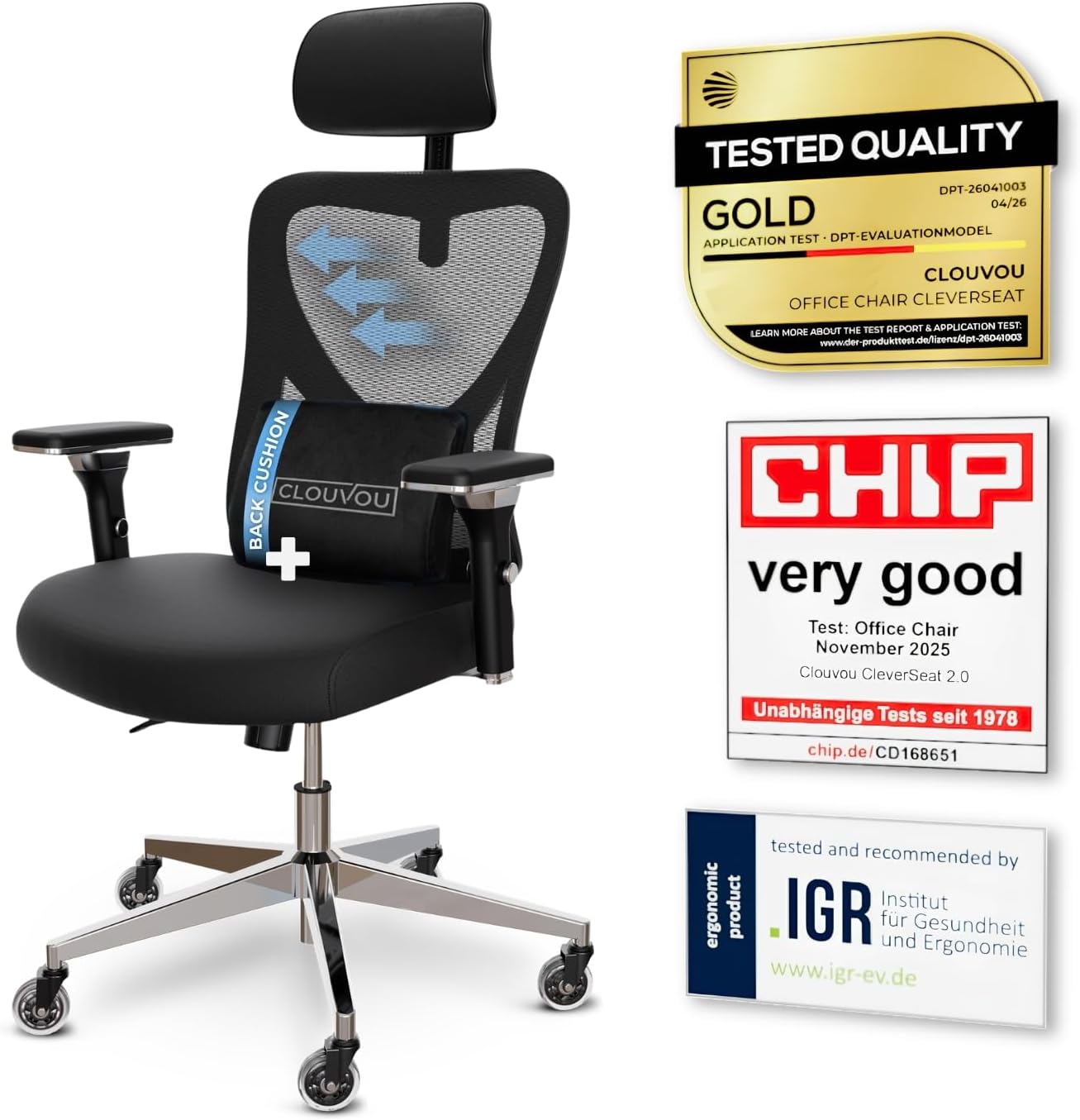
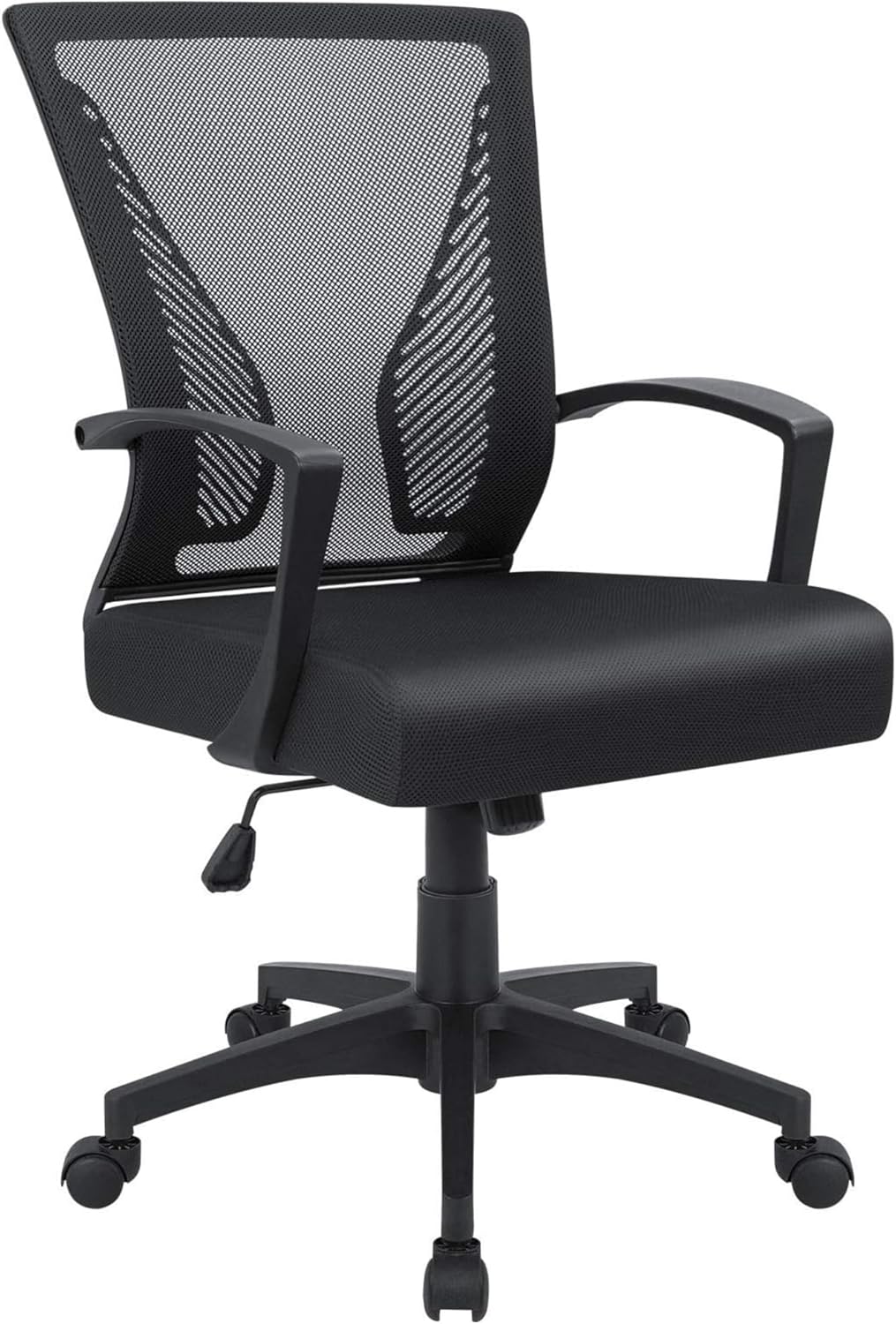
CleverSeat's chair carries the highest average rating of any chair we have covered across our mesh office chair comparisons, backed by a review base that has grown substantially in a short time, a strong signal of consistent buyer satisfaction.
The back support adjusts rather than relying on a single fixed lumbar bump, and the 2D headrest adds coverage that many chairs at this price skip entirely. It is rated for 330 pounds, matching the higher-capacity picks in our comparisons.
The backrest uses a solid-back design rather than full mesh throughout, trading some breathability for structure, and at 40 pounds it is heavier than several competitors.
For anyone prioritizing rating and adjustable back support above all else, this is currently the strongest performer we have found in this category.
Chair Type: Ergonomic mesh office chair with adjustable back. Frame Material: Reinforced polymer. Seat Material: Mesh. Back Style: Adjustable, solid back.
Armrests: Adjustable. Headrest: 2D. Base Movement: Swivel on rolling casters.
Weight: 40 pounds. Maximum weight recommendation: 330 pounds, per manufacturer listing.
If overall rating is your deciding factor above any single spec, this chair currently leads every comparison we have run in this category.
Consider this chair if adjustable back support and a 2D headrest matter more to you than a full mesh build throughout.
Weigh the newer brand history against more established names if a long-standing company track record matters to you specifically.
This is best suited to buyers who prioritize current buyer satisfaction over brand tenure.

Pros
- Highest rating in this comparison, backed by a substantial review count
- Footrest and 5D armrests add versatility rarely found together on one chair
- Tool-free assembly is faster than most competitors
Cons
- Heavier chair overall, which makes it harder to move between rooms once assembled
- A newer brand without the multi-decade track record of Lorell or Staples
- The larger footprint needs more clearance than the compact picks in this list
The X100 is built for bigger users and longer sitting sessions, with a reinforced metal base and a weight rating that leads this roundup. The 5D flip-up armrests adjust in nearly every direction, and the attached footrest extends out for a reclined break without leaving the desk.
Assembly is tool-free and reportedly takes about 15 minutes, faster than most mesh chairs that ship in pieces. The 3-position tilt lock pairs with adjustable 3D lumbar support, a more flexible setup than the fixed lumbar curve found on cheaper chairs.
The main tradeoff is size and weight. This is a larger, heavier chair than the rest of this list, which is exactly the point if you need the extra capacity, but worth knowing if you plan to move it often or have a smaller room.
For big and tall users specifically, this is the strongest pick in this roundup on both rating and feature set.
Chair Type: Ergonomic mesh office chair built for big and tall users, with a heavy-duty metal base rated for a higher weight capacity than standard mesh chairs. Frame Material: Metal base with nylon components. Seat Material: Mesh throughout, including the seat and backrest.
Armrests: 5D flip-up design that adjusts for height, width, depth, angle, and pivot. Lumbar Support: Adjustable 3D lumbar support. Recline: 3-position tilt lock. Footrest: Built-in, extendable footrest.
Base Movement: 360-degree swivel on smooth casters. Color: Midnight Mist. Brand: ELABEST. Model: X100. Assembly: Tool-free, reported to take about 15 minutes. Suitable for hard floor surfaces.
If you need a mesh chair that can comfortably handle a larger frame, this is one of the few options built specifically around that requirement rather than treating it as an afterthought. The reinforced metal base and higher weight rating make it a safer long-term choice than a standard mesh chair pushed past its limits.
Consider this chair if you also want a footrest built in. Extending it for a short break without leaving your desk is a small feature, but it is rarely included at this level, and it adds real value if you take short reclined breaks during the day.
The tool-free assembly is worth factoring in if you dread building furniture. Most mesh chairs in this category ship in several pieces and require tools; this one is designed to go together in about fifteen minutes without them.
This is best suited to users who specifically need the higher weight capacity and larger frame. If you are an average-sized user, a lighter and more compact chair elsewhere on this list will likely serve you just as well for less.

Pros
- 3D armrest rotates 215 degrees and adjusts up, down, forward, and back, more adjustment range than most fixed or single-direction arms
- Adjustable headrest adds neck support during recline breaks between coding sessions
- Double-back lumbar design targets fatigue reduction specifically, matching the stated use case
Cons
- 350 lb capacity is on the lower end of this roundup's range
- Mesh seat may feel firmer than a foam-padded alternative for very long sessions

Pros
- Enormous review base, among the largest of any chair in this comparison
- V-shaped back design distributes support differently than a standard flat mesh back
- 3D adjustment on both the lumbar support and armrests
Cons
- Single recline position only
- DIY-style assembly instructions, less detailed than some competitors
- V-shaped back design may not suit every body type equally well
This chair carries one of the largest review bases in this entire comparison, a strong signal of consistent performance across an unusually large number of buyers over time.
The V-shaped back is the most distinctive design choice here, aiming to distribute support differently than a standard flat mesh backrest. Both the lumbar support and armrests adjust in 3D, giving more precise positioning than fixed alternatives.
Assembly instructions are described as DIY-style, less hand-held than some competitors, and recline is limited to a single position.
For anyone curious about a genuinely different back design backed by an enormous amount of buyer feedback, this is one of the most-proven picks in this comparison.
Chair Type: Ergonomic mesh office chair with V-shaped back. Frame Material: Nylon. Seat Material: Foam.
Armrests: 3D adjustable. Lumbar Support: 3D adjustable. Recline: Single position. Assembly: DIY.
Back Style: V-shaped design, a departure from the flat mesh backs elsewhere in this comparison.
If review volume matters most to you, this chair's track record is among the strongest in this comparison.
Consider this chair if you want 3D adjustment on both the lumbar support and armrests rather than fixed or simpler flip-up designs.
Check photos of the V-shaped back carefully; it is a genuinely different silhouette than the standard flat mesh backs on most other picks here.
This is best suited to buyers drawn to a distinctive design backed by an unusually large amount of buyer feedback.
Pros
- Marketed and built specifically for long desk work sessions
- 400 lb weight capacity
- 4D armrests and a 3D headrest together, uncommon at this price
Cons
- Smaller review base than the more established picks in this comparison
- Newer brand without a long track record
- No stated multi-year warranty
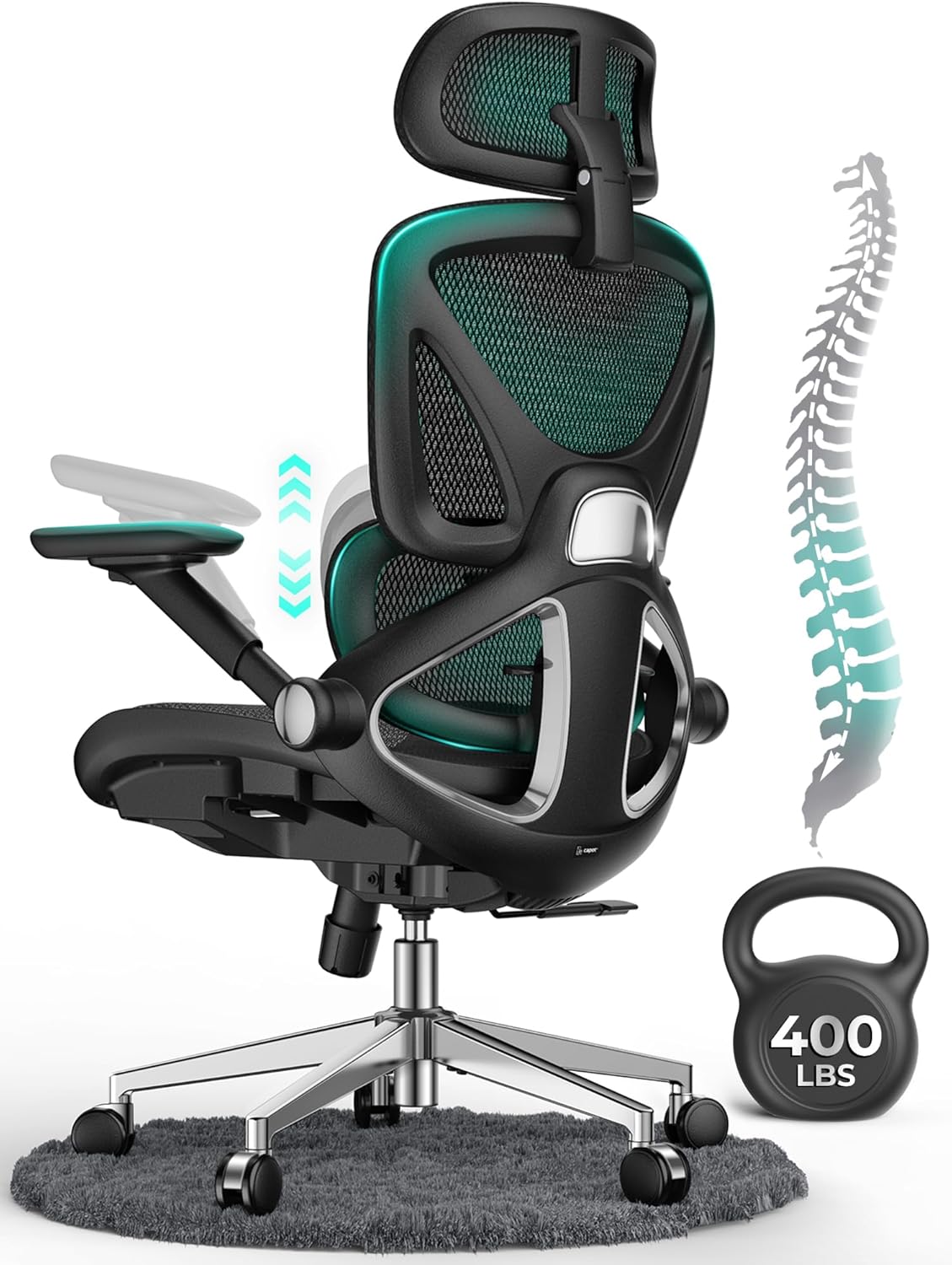
CAPOT positions this chair specifically for long desk work sessions, backing that claim with a 400 lb weight rating, 4D flip-up armrests, and a 3D headrest, a feature set usually reserved for pricier executive chairs.
The 3-level tilt backrest and stainless steel frame components add stability and flexibility for extended sitting, and PU wheels round out the build for smooth rolling on hard floors.
The review base is smaller than the more established picks in this comparison, and no multi-year warranty is explicitly stated on the listing.
For anyone who wants a feature-dense chair built around long sitting sessions specifically, this covers the key points at a reasonable price.
Chair Type: High-back ergonomic mesh office chair. Frame Material: Stainless steel and nylon. Seat Material: Mesh. Back Style: High back.
Armrests: 4D flip-up. Headrest: 3D. Recline: 3-level tilt.
Brand: CAPOT. Maximum weight recommendation: 400 pounds.
If you want a feature-dense chair built specifically for long desk sessions, this covers 4D arms, a headrest, and multi-level tilt together.
Consider this chair if the 400 lb capacity matters to you alongside that feature set.
Weigh the smaller review base against the more established picks in this comparison if a longer track record matters more.
This is best suited to buyers who want maximum adjustability for extended sitting at a moderate price.

Pros
- Adaptive lumbar tracks your recline instead of staying fixed, useful for anyone who shifts positions often
- Weight capacity matches the highest-rated chairs in this roundup
- Warranty coverage beats the budget and mid-range picks here
Cons
- Average rating trails the rest of the chairs in this roundup, though it remains solidly positive
- Split-back design looks different from the solid-back chairs on this list, worth checking photos against your preference
- Assembly involves attaching several parts with the included tool
SIHOO's pitch for the B100 centers on lumbar support that moves with you instead of staying locked at a fixed height, useful for anyone who alternates between leaning forward to type and sitting back for a call. The split-back mesh design is a visual departure from the solid mesh backs on the rest of this list, though it serves the same airflow purpose.
The armrests flip up, the headrest is wide and adjustable, and the frame supports multiple recline positions. Warranty coverage runs several years, ahead of the budget option in this roundup.
Its average rating trails the rest of the chairs compared here, though it remains solidly positive overall. Assembly requires attaching a few more parts than the simplest chairs on this list.
For anyone whose main priority is lumbar support that adapts through the day rather than a fixed pad, this is the most purpose-built option here.
Chair Type: Split-back mesh ergonomic office chair. Frame Material: Polypropylene frame. Seat Material: Polypropylene seat base with mesh, polyester, and nylon upholstery.
Headrest: Wide, adjustable headrest. Armrests: Flip-up design. Lumbar Support: Adaptive lumbar support that adjusts with posture. Recline: 3-position tilt, 5 height positions. Base Movement: Swivel on a star base.
Color: Grey. Brand: SIHOO. Model: B100. Warranty: 3-year parts replacement coverage. Suitable for hard floor and carpet surfaces.
If lower back support is your single biggest priority in a new chair, this is the most purpose-built option in this roundup, with lumbar support designed to move as you shift positions rather than staying fixed at one height.
Consider this chair if you spend long stretches alternating between leaning forward to focus and sitting back for calls or breaks. The adaptive lumbar mechanism is designed specifically for that kind of movement throughout the day.
The split-back mesh design is a visual departure from the solid-back chairs elsewhere on this list, so it is worth checking product photos to make sure the look fits your space before buying.
This is best suited to buyers whose main complaint with previous chairs has been inconsistent or fixed lower back support. If a more traditional solid-back look matters more to you, other picks on this list may be a better fit.

Pros
- 5-year warranty, longer than most chairs in this comparison
- Footrest and deep recline together support position changes throughout the day
- Precisely specified lumbar and headrest adjustment ranges rather than vague marketing language
Cons
- Lower average rating than the higher-volume picks in this comparison
- Linked armrests move together rather than independently
- Smaller review base than SIHOO or CleverSeat
CYKOV specifies this chair's adjustment ranges precisely: a 4-way headrest moving 4.72 inches and 60 degrees, a 2-way lumbar pad adjusting 2 inches and 1.18 inches, and a recline range from 90 to 135 degrees, backed by a 5-year warranty.
The built-in footrest pairs with that recline range to support genuine position changes throughout the day, useful for anyone who benefits from alternating between sitting upright and reclining periodically.
The armrests are linked, moving together rather than independently, and the average rating trails the higher-volume picks in this comparison.
For anyone who values precisely specified adjustment ranges and a long warranty over the largest possible review count, this is a reasonable pick.
Chair Type: Reclining ergonomic mesh office chair with footrest. Frame Material: Nylon. Seat Material: Foam. Back Style: Mesh back.
Armrests: Linked. Headrest: 4-way adjustable. Lumbar Support: 2-way adjustable. Recline: 90 to 135 degrees, 2 positions.
Brand: CYKOV. Warranty: 5 years. Maximum weight recommendation: 350 pounds.
If alternating between upright sitting and a genuine recline throughout the day matters to you, this chair's footrest and 135-degree range support that directly.
Consider this chair if a 5-year warranty and precisely specified adjustment ranges matter more to you than raw review volume.
Weigh the linked armrests against the independently adjustable systems on other picks if that flexibility matters to you.
This is best suited to buyers who value warranty length and precise specifications over brand recognition.
What to Look for in a Chair When You Deal With Sciatica
Seat Depth and a Waterfall Front Edge
A seat that runs too deep for your leg length forces the front edge to press directly into the back of your thighs and knees, a pressure point that sits close to where sciatic nerve irritation is often felt. A seat edge that curves downward and away, commonly described as a waterfall edge, reduces that contact point regardless of how far back you sit.
If the listing mentions adjustable seat depth specifically, that is worth prioritizing over a fixed-depth seat, since it lets you match the seat pan to your own leg length rather than settling for a one-size compromise. For a broader rundown of adjustment points worth checking beyond depth, see our guide on what to look for in an ergonomic office chair.
Recline and Tilt Range for Shifting Weight Off the Nerve
Staying in one fixed position for hours concentrates pressure in the same spot the entire time, which tends to make sciatic discomfort worse as the day goes on. A wider recline range, ideally reaching past 120 degrees, lets you periodically shift weight off the seat and onto the backrest, changing the pressure pattern rather than holding it constant.
A few of the chairs in this comparison pair that recline range with a built-in footrest, which extends how long a reclined position stays comfortable by supporting the legs instead of leaving them to dangle. Combining periodic reclining with short standing breaks tends to help more than either approach alone. Our guide on how to relieve sciatica pain while sitting covers movement strategies that work alongside chair adjustments.
Lumbar Support That Tracks Your Posture
A fixed lumbar curve only helps if it happens to land at the right height for your spine, and sciatica symptoms often shift with posture changes throughout the day in ways a static curve cannot follow. An adjustable or adaptive lumbar mechanism that moves as you shift position addresses a wider range of body types and sitting habits than a molded-in curve.
Look specifically for language describing multi-directional or adaptive lumbar adjustment on the listing rather than assuming any chair labeled ergonomic includes it. Several chairs in this comparison specify the exact adjustment range in inches, worth checking directly rather than relying on marketing language alone. Our guide on how to adjust an ergonomic office chair walks through setting lumbar height correctly once you own one.
Weight Capacity and Seat Width for a Proper Fit
A chair rated well under your body weight compresses its cushioning faster and loses pressure-relieving support sooner than one with headroom in its rating. A seat that runs too narrow can also concentrate pressure at the hips and upper thighs rather than distributing it evenly, which matters more for sciatica than for general comfort preference.
Several chairs in this comparison are built specifically for larger frames, with reinforced bases and wider seats rated well above the industry-standard 250 to 300 pound range. If your current chair shows visible sagging or uneven wear, that is often a sign it was undersized from the start rather than simply worn out, a pattern our guide on signs your office chair is bad for your back covers in more detail.
Armrests and Desk Height Also Affect the Lower Back
Armrests set too high or too low change how your shoulders and torso sit relative to your hips, which indirectly shifts pressure through the lower back and pelvis even if the chair’s own lumbar support is well set. Adjustable, ideally independently adjustable, armrests let you match arm height to your specific desk rather than compromising your posture to fit a fixed armrest height.
This matters alongside the chair itself, not instead of it. A chair with excellent lumbar and seat design still leaves you compensating with your posture if the desk and armrest heights force your shoulders to hunch or your hips to tilt forward. Checking armrest range as part of the same buying decision, rather than treating it as a minor detail, rounds out a setup aimed at reducing pressure through the entire lower body, not the seat alone.
Final Thoughts
CleverSeat Ergonomic Office Chair is the strongest all-around pick in this comparison, combining the highest average rating here with adjustable back support and a solid weight rating, a reasonable starting point if you are not yet sure which specific feature matters most for your symptoms. If seat depth and recline range for periodic weight shifting are your main concern, CYKOV Reclining Mesh Office Chair reclines further than most chairs here and pairs that range with a built-in footrest and a precisely specified lumbar adjustment.
Frequently Asked Questions
Can an office chair actually help with sciatica?
A chair that reduces pressure on the back of the thighs and supports the lower back’s natural curve can meaningfully reduce the sitting-related aggravation of sciatica symptoms for many people, but it does not treat the underlying cause, which can range from a herniated disc to piriformis muscle tension. See the disclaimer near the top of this article, and consult a physician or physical therapist for a proper diagnosis rather than relying on a chair purchase alone.
What seat depth is best if I have sciatica?
The right depth leaves two to three finger widths of space between the front edge of the seat and the back of your knees when your back is against the backrest. A seat that runs deeper than that presses into the thighs and can worsen nerve irritation, which is why adjustable seat depth is worth prioritizing if you can find it.
Does a mesh seat help compared to a foam cushion?
Mesh distributes weight and airflow differently than foam, but the seat pan underneath the mesh, not the mesh fabric itself, is usually what determines pressure distribution. A mesh chair with a thin or poorly shaped seat pan can still press uncomfortably on the thighs, so check the seat cushioning and edge shape specifically rather than assuming mesh alone solves pressure issues.
How often should I get up and move if I have sciatica?
Standing or walking briefly every 30 to 45 minutes tends to help more than staying seated continuously, even in a well-suited chair. Pairing a supportive chair with regular movement breaks and periodic reclining addresses both the static pressure and the prolonged position that tend to make sciatica worse.




Write Your Review
No reviews yet. Be the first to share your experience!