

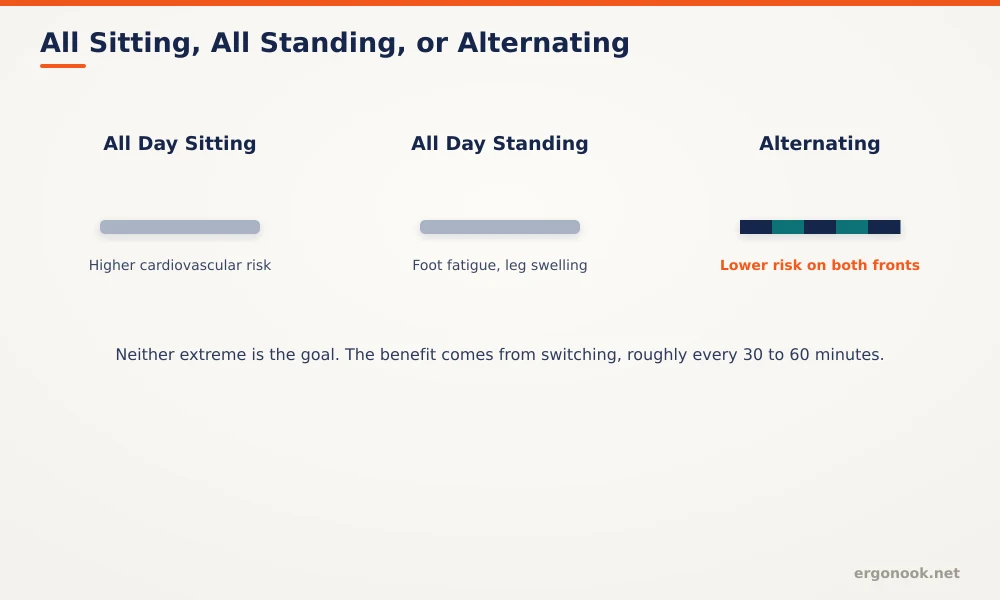
Stand at a standing desk for roughly 30 to 60 minutes at a time, then switch back to sitting. A Cochrane review of 34 studies found sit-stand desks reduce sitting by 84 to 116 minutes a day when used this way. Standing all day isn’t the goal and brings its own fatigue; alternating is what the evidence actually supports.
- A Cochrane review of 34 studies and 3,397 participants found sit-stand desks reduce workplace sitting by roughly 84 to 116 minutes a day when people alternate positions.
- Mayo Clinic links more than 6 to 8 hours of daily sitting to a 125% to 150% higher risk of cardiovascular events, but standing for the same length of time brings its own strain.
- Most anti-fatigue mat research shows the biggest comfort benefit after 30 minutes of continuous standing, with smaller benefit for shorter stretches.
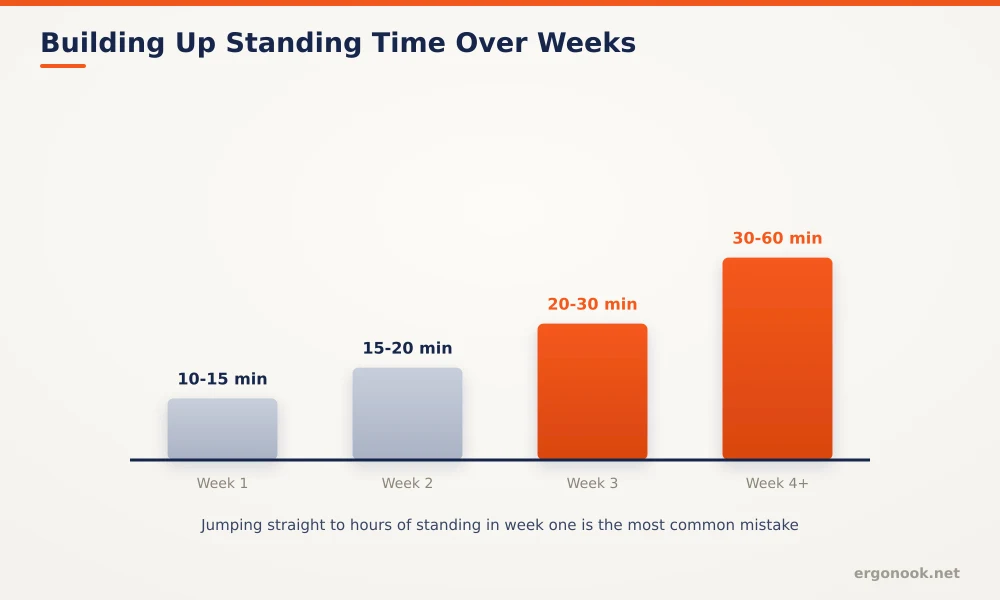
- Building up gradually over a few weeks, rather than standing for hours on day one, is what prevents most people from abandoning the habit.
In this article:
- The quick answer: standing time by experience level
- Why 30 to 60 minutes is the guideline
- How to build up your standing tolerance
- How to adjust your routine
- Special cases
- Signs you’re getting the balance wrong
- Frequently asked questions
The Quick Answer: Standing Time by Experience Level
| Experience Level | Standing Interval |
|---|---|
| New to a standing desk | 10 to 15 minutes, several times a day |
| A few weeks in | 20 to 30 minutes at a stretch |
| Comfortable, established habit | 30 to 60 minutes, alternating with sitting |
| Long meetings or calls | Match the meeting length if under an hour, then sit |
Why 30 to 60 Minutes Is the Guideline
The 30 to 60 minute range isn’t arbitrary. It’s roughly the point where sitting starts to produce measurable stiffness and where standing starts to produce measurable foot and leg fatigue, so it sits between the two. A Cochrane review examining 34 studies and 3,397 participants found sit-stand desks reduce workplace sitting by an average of 84 to 116 minutes a day among people who actually alternate, rather than just owning a desk that could (Cochrane). Mayo Clinic separately links sitting more than 6 to 8 hours a day to a 125% to 150% increase in cardiovascular event risk (Mayo Clinic), which is the risk alternating is meant to reduce, not eliminate by replacing it with all-day standing instead.
How to Build Up Your Standing Tolerance
Jumping straight to standing most of the day in week one is the single most common reason a standing desk ends up back at sitting height permanently. Start with short intervals, 10 to 15 minutes a few times a day, and let your legs and feet adjust over two to three weeks before extending toward the full 30 to 60 minute range. There’s no penalty for taking longer than that if your body needs it. The goal is a habit you keep, not a number you hit on a fixed schedule.
How to Adjust Your Routine
An anti-fatigue mat makes the standing portion noticeably more comfortable, especially once you’re past the 20 to 30 minute mark where foot fatigue starts to build. Our guide on whether anti-fatigue mats really work covers the research behind that specific benefit. Setting a simple timer or reminder tends to work better than trying to sense when 30 to 60 minutes has passed, since focused work makes time easy to lose track of in either position. If a small home office is part of the setup, our picks for the best standing desk for a small home office cover desks that make switching between positions easy.
Special Cases
If you have circulation issues, varicose veins, or another condition affecting your legs, talk to a doctor before adopting long standing intervals, since the general 30 to 60 minute guideline is aimed at healthy adults without those conditions. Pregnant users often find shorter, more frequent standing intervals more comfortable than the standard range. Anyone recovering from a back or leg injury should follow their physical therapist’s guidance over general advice like this, since the right interval depends on the specific injury.
Signs You’re Getting the Balance Wrong
Foot or lower back discomfort that shows up before the 30 minute mark suggests you’re standing longer than your current tolerance supports, and it’s worth shortening the interval rather than pushing through. On the other side, if you consistently forget to stand at all once you sit back down, that points to a routine problem more than a physical one, worth fixing with a reminder rather than more willpower. A desk that gets raised once a week isn’t providing much benefit either way, regardless of how long each standing session lasts when it does happen.
Frequently Asked Questions
Is standing all day worse than sitting all day?
Both are static postures if you don’t change position within them. Standing all day trades cardiovascular risk for foot, leg, and lower back fatigue rather than avoiding a downside entirely.
Do I really need a timer to alternate positions?
Not strictly, but most people lose track of time during focused work, so a simple reminder tends to work better than relying on noticing discomfort.
Do I need an anti-fatigue mat to stand for an hour?
Not required, but most people find standing on a hard floor for more than 20 to 30 minutes noticeably more tiring without one.
Is it fine to stand for only 15 minutes at a time long-term?
Yes, if that’s what feels sustainable. More frequent short intervals still break up sitting time, even if they don’t reach the 30 to 60 minute range.
How long you should stand at a standing desk comes down to 30 to 60 minutes at a time for most people, built up gradually rather than attempted all at once. The habit of alternating matters more than hitting an exact number every single day.




Write Your Review
No reviews yet. Be the first to share your experience!