

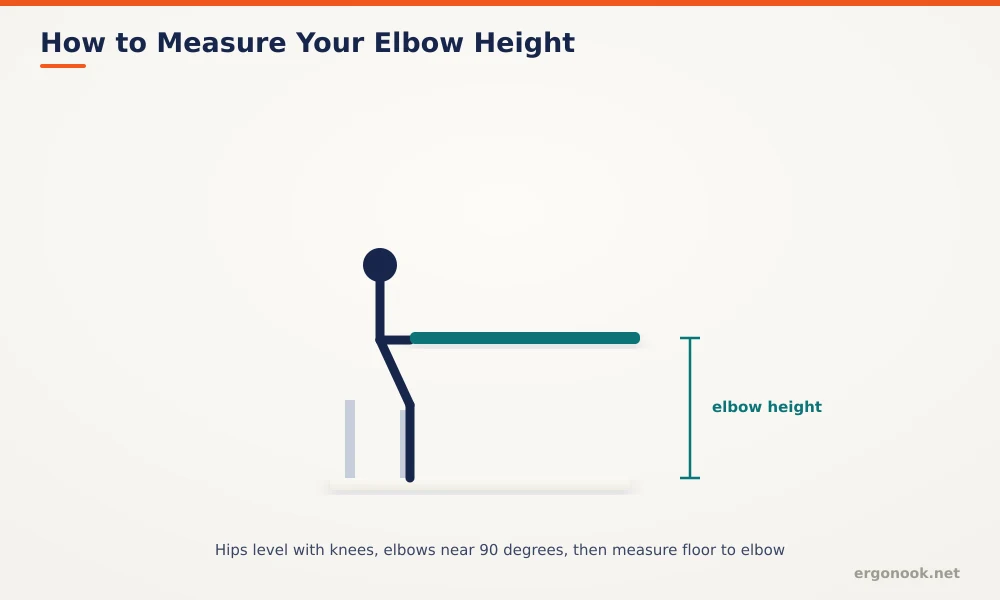
The correct desk height for your height is whatever puts your desk surface at elbow height, not a number pulled from your total height alone. UCSF’s ergonomics program recommends sitting with hips level with your knees, elbows bent near 90 degrees, then measuring floor to elbow. As a rough starting point, someone 5’5″ typically lands around 24 to 26.5 inches; someone 6’2″ closer to 27 to 29 inches seated.
- UCSF’s ergonomics program defines correct desk height as elbow height: hips level with knees, shoulders relaxed, elbows bent 90 degrees or slightly more.
- Total body height is a rough proxy, not the actual measurement. Torso and arm length vary enough between two people of the same height that elbow height can differ by an inch or two.
- Monitor distance should stay between 18 and 30 inches once desk height is correct, per the same UCSF guidance.
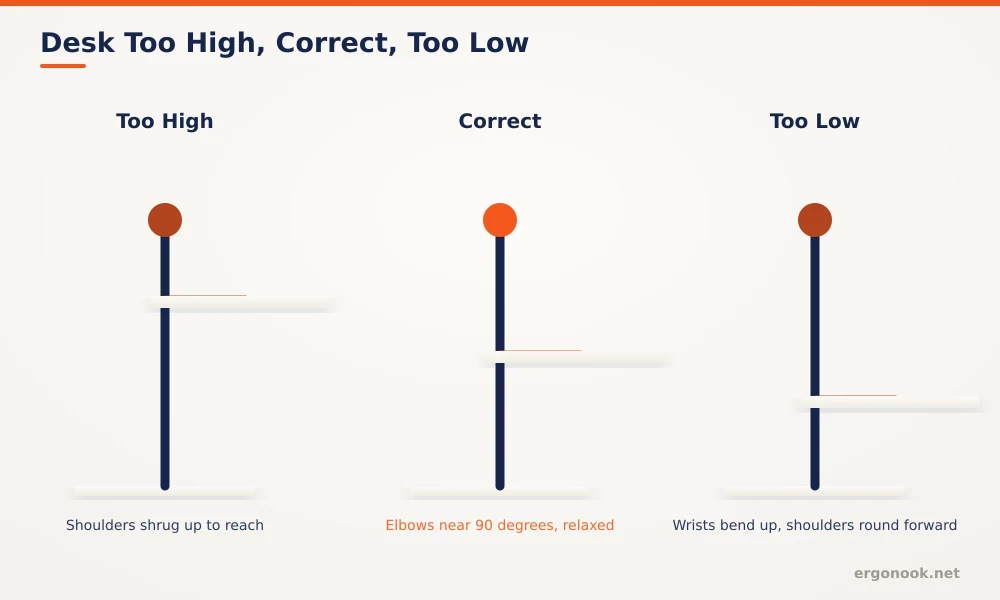
- A desk that’s too high makes you shrug your shoulders to reach the keyboard; too low forces your wrists to bend upward.
In this article:
- The quick answer: desk height by your height
- Why desk height matters more than the number on a chart
- How to measure your own elbow height
- How to adjust your desk to reach it
- Special cases
- Signs your desk height is wrong
- Frequently asked questions
The Quick Answer: Desk Height by Your Height
Use this as a rough starting point, then confirm with the elbow measurement below, since arm and torso proportions vary between people of the same height.
| Your Height | Seated Desk Height (Rough Starting Point) |
|---|---|
| 5’0″ to 5’4″ | 22 to 25 inches |
| 5’5″ to 5’8″ | 24 to 26.5 inches |
| 5’9″ to 6’1″ | 26 to 28 inches |
| 6’2″ and taller | 27 to 29 inches, sometimes more |
Why Desk Height Matters More Than the Number on a Chart
Correct desk height for your height is really shorthand for correct desk height for your elbow. UCSF’s ergonomics program frames it plainly: position your input devices at elbow height, with shoulders relaxed, upper arms hanging normally at your sides, and elbows bent at 90 degrees or a more open angle, so your forearms stay in line with your wrists instead of bending them up or down (UCSF Ergonomics Program). Two people who are both 5’8″ can have noticeably different elbow heights depending on how much of that height is torso versus legs, which is why a height chart is a starting point, not a final answer.
How to Measure Your Own Elbow Height
UCSF’s guidance lays out a simple method. Sit deep in your chair with your hips at roughly the same height as your knees and your feet supported on the floor. Relax your shoulders and let your arms hang naturally at your sides. Bend your elbows to about 90 degrees or a slightly more open angle, keeping your hands in line with your forearms. Measure the distance from the floor to the bottom of your elbow. That number is your target desk height (UCSF Ergonomics Program).
Most adjustable desks move in one-inch increments, so pick the closest available setting to your measured number. If you can, test the height for a few minutes with an actual keyboard before committing, since a number that looks right on a tape measure can still feel slightly off once you’re typing.
How to Adjust Your Desk to Reach It
If your current desk doesn’t reach the right height, you have a few options beyond replacing it outright. A height-adjustable electric desk gives you the full range and lets you switch between sitting and standing without recalculating anything. If a fixed desk sits too low, raising the chair and adding a footrest can compensate, though that only works if your feet can still rest flat. If a fixed desk sits too high, a negative-tilt keyboard tray positioned at elbow height solves the problem without touching the desk itself, though it’s a worse fit if you frequently reach for other items on the desk surface. Our standing desks for short people and budget electric standing desks roundups cover models with a wide enough height range to fit most of the chart above.
Special Cases
Very tall or very short users often fall outside what a fixed-height desk can offer at all, which is the main reason to prioritize an adjustable desk over a fixed one if your height is toward either end of the range. Standing desk height follows the same elbow logic, just measured while standing instead of seated, roughly 60 to 63% of your total height as a rough estimate before fine-tuning. If you share a desk with someone of a different height, memory height presets on an electric desk remove the need to recalculate every time someone else uses it.
Chair height and desk height are really one adjustment, not two separate ones. Setting your chair so your hips sit level with your knees and your feet rest flat comes first, since changing chair height afterward shifts your elbow height too and can throw off a desk setting you already dialed in. If your feet don’t reach the floor once the chair is at the right height for your legs, a footrest closes that gap without forcing you to raise the chair past where your knees want to be, which would then push your elbow height, and the desk height that follows it, higher than it needs to be.
Signs Your Desk Height Is Wrong
Shoulder tension that builds through the day, especially near the base of the neck, often points to a desk that’s too high, forcing your shoulders up to reach the keyboard. Wrist discomfort or a habit of resting your wrists heavily on the desk edge suggests it’s too low, since your hands are compensating for a keyboard that sits below elbow level. If you find yourself sliding forward to the edge of your chair to reach the desk comfortably, the height and your chair’s position aren’t matched, regardless of which one is technically correct on its own.
Frequently Asked Questions
Is the standard 28 to 30 inch desk height right for everyone?
No. That range suits people around 6 feet tall reasonably well, but it’s too high for most people shorter than that and can be too low for taller users.
Should I adjust desk height or chair height first?
Set your chair first so your hips are level with your knees and feet are flat, then measure elbow height and match the desk to that.
Can a keyboard tray fix a desk that’s the wrong height?
Yes, for typing specifically, though it’s a worse fit if you frequently reach for other items on the desk, since the tray adds extra reach distance.
Is standing desk height calculated the same way?
Same principle, elbow height, just measured while standing instead of seated. The actual number will be higher since you’re not sitting in a chair.
Correct desk height for your height ultimately means correct desk height for your elbow, measured directly rather than estimated from a chart. Use the table above to get in the right range, then confirm with the actual measurement before you settle on a final setting.



Write Your Review
No reviews yet. Be the first to share your experience!