

One chair in this roundup is not a traditional saddle design at all, but a wobble stool that tilts and rocks in response to small body movements. The goal is similar, keeping the spine active and the core lightly engaged rather than letting posture collapse into a slouch, but the mechanism is different: continuous micro-movement instead of a fixed, opened hip angle. If the idea of a straddled saddle seat does not appeal to you but active sitting still does, this style is worth considering as an alternative within the same general category.
Frame Material Affects Both Stability and Price
Saddle chairs in this roundup use either aluminum alloy or standard steel bases, and the difference shows up in both weight and price rather than pure stability. Aluminum bases tend to command a higher price for a similar footprint but resist corrosion better over years of use, while steel frames are typically more affordable and still perfectly stable when properly widened for the saddle seat’s narrower base. Neither material is a dealbreaker on its own; check the specific base width and star-point count alongside the material rather than assuming aluminum is automatically the safer choice.
Upholstery Affects Grip as Much as Comfort
A saddle seat relies partly on friction to keep you positioned correctly during the wider hip angle this posture requires, so upholstery choice matters more here than on a standard chair seat. PU leather and vinyl wipe clean easily but can feel slightly more slippery when new, while thicker padded fabric or leather blends tend to hold position better once broken in. If you plan to shift or lean forward frequently during work, a grippier surface is worth prioritizing over a purely easy-clean one.
Final Thoughts
For a commercial-grade build with an independently adjustable backrest, the Aluminum Base Saddle Chair with Adjustable Backrest pairs a 400 lb capacity with a reinforced aluminum base, though at the highest price in this roundup. If a foot ring and dual certification on the hydraulic lift matter more, the Saddle Stool with Concave Backrest and Footrest adds a genuine extra not found on most competitors here. Both are worth comparing against the more budget-friendly backless picks further down the list.
FAQ
Is a saddle chair better than a kneeling chair for back pain?
Neither is universally better; they solve the same problem, an overly reclined or slouched pelvis, in different ways. A saddle chair avoids putting pressure on the shins and knees the way a kneeling chair does, but it requires a wider hip angle that not everyone finds comfortable. Try to consider your own hip flexibility and comfort with a straddled position when choosing between the two, and if possible, try sitting on each style briefly before committing to one over the other.
Can I sit in a saddle chair all day?
As with a kneeling chair, most people benefit from alternating a saddle chair with a standard office chair rather than using it exclusively all day. Start with shorter sessions and build up gradually rather than committing to a full workday immediately.
Do I need a backrest on a saddle chair?
Not strictly, but a backrest is a more forgiving starting point if you are new to saddle-style seating, since it gives you somewhere to rest periodically. Experienced saddle chair users often prefer a backless design for its lighter, more compact profile.
Who should avoid a saddle chair?
Anyone with hip mobility limitations, certain knee conditions, or general discomfort with a straddled seating position may find this style unsuitable regardless of cushion quality. If you are unsure whether this posture is appropriate for you, talk to a doctor before switching, and consider a standard chair built for lower back support instead. Our guide on reducing back pain from sitting all day also covers general posture habits that apply regardless of chair style.
This article covers general office seating, not medical treatment. A saddle chair is not a certified medical device, and like a kneeling chair, it is not the right fit for everyone. The split-leg saddle posture opens the hip angle and encourages an upright spine, but it also requires a period of adjustment and is not designed for every back condition. If you have hip or knee issues, or if back pain is severe or persistent, talk to a doctor before switching to this seating style.
A saddle chair takes a different approach than either a standard office chair or a kneeling chair: the split, saddle-shaped seat straddles the legs at roughly a horse-riding angle, opening the hip angle beyond 90 degrees and letting the pelvis tilt into a naturally upright position without a backrest doing the work, similar in principle to a kneeling chair but without any pressure on the shins or knees. This roundup also includes one wobble-style stool built around continuous small movement rather than a fixed saddle shape, a genuinely different mechanism worth knowing about even though it is grouped here for its similar active-sitting goal. These picks are drawn from our broader Chairs for Back Pain lineup.
Disclosure: Ergonook is a participant in the Amazon Associates program. Links below are affiliate links, and we may earn a commission from qualifying purchases. This does not affect which chairs we recommend or how we rank them.

Pros
- Backrest is specifically adjustable rather than fixed, letting you tune lumbar support independently of the saddle seat
- Aluminum base and commercial-grade pneumatic lift are built for continuous professional use, a more demanding standard than typical home furniture
- Documented 400 lb weight capacity is on the higher end of this roundup
Cons
- Highest price point among the saddle chairs in this roundup
- Height range (21 to 26 inches) is narrower than some competitors here

Pros
- Concave backrest shape is specifically designed to wrap the back curve, a more deliberate shape than a flat backrest pad
- Foot ring is a genuine extra not included on most saddle chairs in this roundup, useful for shorter users or taller seat heights
- Both SGS and TUV certification on the hydraulic lift, two separate independent certifications rather than one
Cons
- Tallest minimum seat height (21.5 inches) in this roundup, may not suit shorter desks or users
- Among the pricier picks here

Pros
- Cushion thickness (2.5 inches) and seat width (16 inches) are both above average for a backless saddle design in this roundup
- Hydraulic lift carries both SGS and BIFMA certification, a stronger documentation pairing than most competitors
- Dual steel ball bearing casters are a more specific mechanical detail than most listings publish
Cons
- No backrest, a fully backless design like a couple of other picks in this roundup
- Listing leans on strong claims ("no more back pain") that should be read as marketing framing rather than a guarantee
Pros
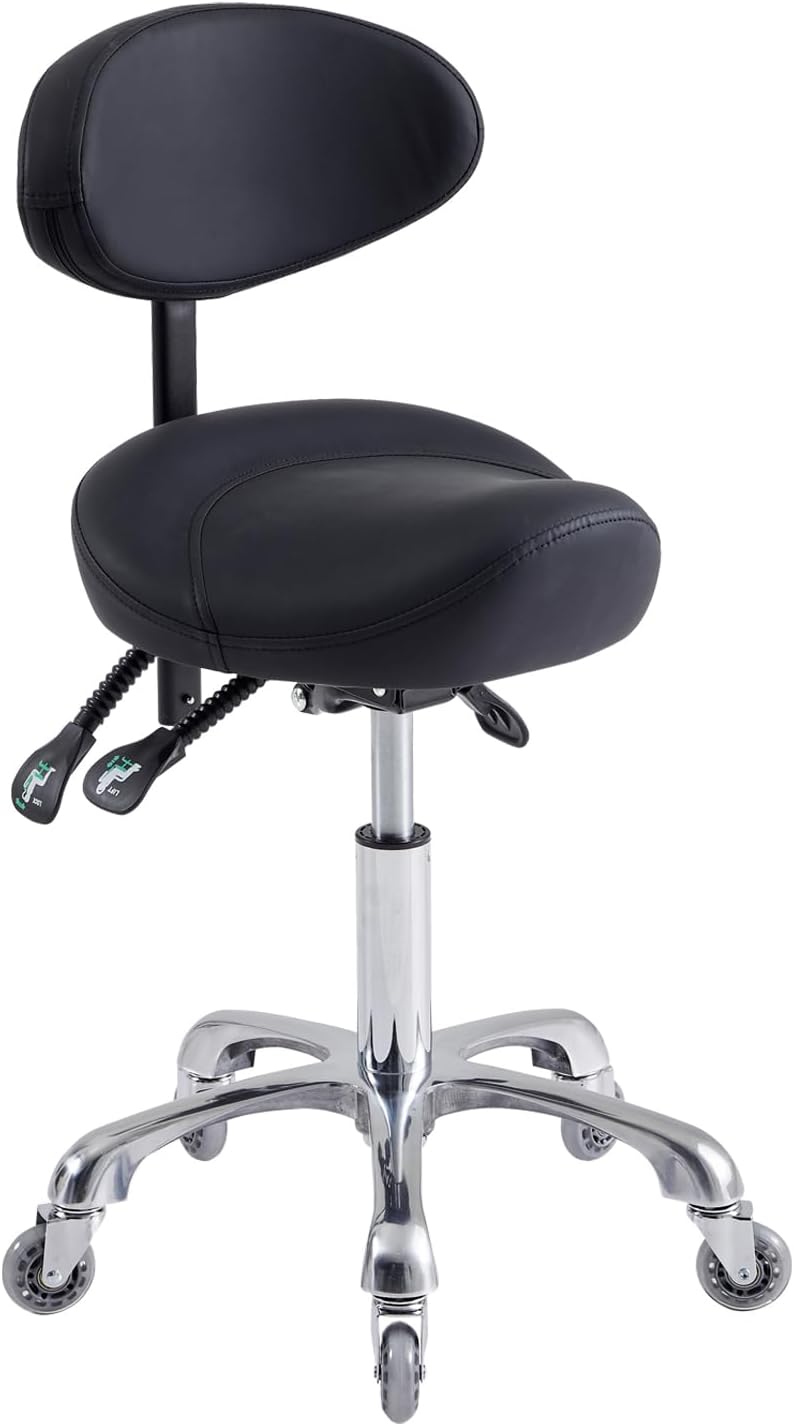
- Both the backrest and the seat itself recline, a more flexible combination than a fixed backrest found on most saddle chairs in this roundup
- Automotive-grade sponge is a specific, named cushion material rather than a generic foam claim
- Widened aluminum frame is described specifically as reducing tip risk, relevant for a seat style with a narrower footprint than a standard chair
Cons
- Shorter 1 year warranty than a couple of other picks in this roundup
- No stated weight capacity figure

Pros
- Backrest gives a place to rest periodically, useful for anyone new to saddle-style seating
- SGS-certified hydraulic pump is independently documented rather than a bare manufacturer claim
- Highest customer rating (4.9) among the chairs in this roundup
Cons
- 280 lb weight capacity is the lowest documented figure in this roundup
- No footrest included, unlike some other picks here

Pros
- Genuinely different mechanism than a standard saddle chair, built around movement rather than a fixed split-seat posture
- Anti-slip weighted base is specifically engineered for tilting stability, addressing the main safety concern with a wobble-style seat
- Compact, armless design fits under a desk when not in use, more space-efficient than a full saddle chair
Cons
- No backrest or footrest, a minimal design compared to the more full-featured saddle chairs in this roundup
- No published weight capacity figure

Pros
- Height range extends unusually tall (up to 30.5 inches), useful for a raised standing desk or a tall drafting-style surface
- Compact tripod footprint takes up less floor space than the wider five-star bases on other saddle chairs in this roundup
- Lowest price among the chairs with a documented replacement guarantee here
Cons
- No backrest included
- No published weight capacity figure
What to Know Before Trying a Saddle Chair
This Posture Is Not for Everyone
The split-leg saddle position opens the hip angle beyond what a standard chair does, which is the whole point, but it also means anyone with hip mobility limitations, certain knee conditions, or discomfort with a straddled seating position may find this style uncomfortable or unsuitable regardless of how good the cushion is. This is a genuinely different way of sitting, not a variation on a standard chair, and it deserves the same caution as switching to a kneeling chair.
Backrest or Backless Changes the Experience Significantly
Unlike a kneeling chair, where backless is fairly common across the category, saddle chairs split more evenly between backed and backless designs in this roundup. A backrest gives lumbar support on top of the natural posture benefit of the saddle shape, while a backless design keeps the profile compact and lets you move more freely. If you are new to saddle-style seating, a backrest version is generally the more forgiving starting point, since it gives you somewhere to lean back periodically as your body adjusts to the new posture.
Height Range Matters More Than It Does on a Standard Chair
Saddle chairs are frequently used at taller work surfaces, standing desks, drafting tables, or elevated counters, not just standard desks. The height ranges in this roundup vary widely, from the low 20-inch range up to over 30 inches, so check the published range against your specific setup rather than assuming any saddle chair will reach your desk height. A stool that tops out at 26 inches will not work at a standing-height counter, no matter how good its cushion or certification is. Measure your actual work surface height before ordering rather than estimating, since a few inches of mismatch is enough to make a saddle chair unusable at that desk.
Certification and Weight Rating Still Apply
A saddle chair concentrates weight differently than a standard five-star base chair, which makes the hydraulic lift and base stability especially important. Look for SGS, TUV, or BIFMA certification on the lift mechanism, and confirm the published weight capacity directly. For a broader look at ergonomic seating fundamentals, see our guide to what to look for in an ergonomic office chair.
A Wobble Stool Is a Related but Different Option
One chair in this roundup is not a traditional saddle design at all, but a wobble stool that tilts and rocks in response to small body movements. The goal is similar, keeping the spine active and the core lightly engaged rather than letting posture collapse into a slouch, but the mechanism is different: continuous micro-movement instead of a fixed, opened hip angle. If the idea of a straddled saddle seat does not appeal to you but active sitting still does, this style is worth considering as an alternative within the same general category.
Frame Material Affects Both Stability and Price
Saddle chairs in this roundup use either aluminum alloy or standard steel bases, and the difference shows up in both weight and price rather than pure stability. Aluminum bases tend to command a higher price for a similar footprint but resist corrosion better over years of use, while steel frames are typically more affordable and still perfectly stable when properly widened for the saddle seat’s narrower base. Neither material is a dealbreaker on its own; check the specific base width and star-point count alongside the material rather than assuming aluminum is automatically the safer choice.
Upholstery Affects Grip as Much as Comfort
A saddle seat relies partly on friction to keep you positioned correctly during the wider hip angle this posture requires, so upholstery choice matters more here than on a standard chair seat. PU leather and vinyl wipe clean easily but can feel slightly more slippery when new, while thicker padded fabric or leather blends tend to hold position better once broken in. If you plan to shift or lean forward frequently during work, a grippier surface is worth prioritizing over a purely easy-clean one.
Final Thoughts
For a commercial-grade build with an independently adjustable backrest, the Aluminum Base Saddle Chair with Adjustable Backrest pairs a 400 lb capacity with a reinforced aluminum base, though at the highest price in this roundup. If a foot ring and dual certification on the hydraulic lift matter more, the Saddle Stool with Concave Backrest and Footrest adds a genuine extra not found on most competitors here. Both are worth comparing against the more budget-friendly backless picks further down the list.
FAQ
Is a saddle chair better than a kneeling chair for back pain?
Neither is universally better; they solve the same problem, an overly reclined or slouched pelvis, in different ways. A saddle chair avoids putting pressure on the shins and knees the way a kneeling chair does, but it requires a wider hip angle that not everyone finds comfortable. Try to consider your own hip flexibility and comfort with a straddled position when choosing between the two, and if possible, try sitting on each style briefly before committing to one over the other.
Can I sit in a saddle chair all day?
As with a kneeling chair, most people benefit from alternating a saddle chair with a standard office chair rather than using it exclusively all day. Start with shorter sessions and build up gradually rather than committing to a full workday immediately.
Do I need a backrest on a saddle chair?
Not strictly, but a backrest is a more forgiving starting point if you are new to saddle-style seating, since it gives you somewhere to rest periodically. Experienced saddle chair users often prefer a backless design for its lighter, more compact profile.
Who should avoid a saddle chair?
Anyone with hip mobility limitations, certain knee conditions, or general discomfort with a straddled seating position may find this style unsuitable regardless of cushion quality. If you are unsure whether this posture is appropriate for you, talk to a doctor before switching, and consider a standard chair built for lower back support instead. Our guide on reducing back pain from sitting all day also covers general posture habits that apply regardless of chair style.




Write Your Review
No reviews yet. Be the first to share your experience!