

What to look for in an ergonomic office chair: independent lumbar adjustment, seat depth adjustment, and a published weight rating, in that order of importance. Cornell’s ergonomics program lists these among the core adjustments a task chair needs. Price alone doesn’t guarantee any of the three, so check the spec sheet, not just the price tag.
- Independent lumbar height and depth adjustment matters more than lumbar cushioning alone, since a fixed lumbar bump rarely lands in the right spot for every body.
- Seat depth adjustment prevents the two most common fit problems: pressure behind the knees for shorter users, and unsupported thighs for taller ones.
- BIFMA X5.1 is the industry testing standard for general-purpose office chairs, covering seat impact and caster durability, not comfort or ergonomics directly.
- A chair’s price tier tells you what adjustments it likely has, but always confirm on the actual spec sheet rather than assuming.
In this article:
- 6 features that actually matter
- Features you can safely ignore
- How much should you spend?
- Certifications and standards to look for
- Red flags in product listings
- Printable checklist
- Frequently asked questions
6 Features That Actually Matter
1. Independent Lumbar Support: Check the Adjustment Range
Look for lumbar support that moves up, down, and ideally in and out, independent of the recline mechanism. A fixed lumbar bump helps only the fraction of users whose spine curve happens to match its position. Cornell’s ergonomics program lists lumbar adjustment among the essential features on a task chair (Cornell University Ergonomics).
2. Seat Depth: Look for a Sliding Pan
A seat pan that slides forward and back lets you set a gap of roughly 2 to 3 finger-widths behind your knee, regardless of your leg length. Chairs without this adjustment fit a narrower range of body sizes well, even if every other spec looks premium.
3. Armrests: Height, and Ideally More
Height adjustment is the minimum. Armrests that also move in width and pivot, sometimes marketed as 3D or 4D, accommodate more desk and body configurations than fixed-width armrests, particularly for narrower or wider frames.
4. Tilt Tension With a Lockable Recline
A tension knob that lets you dial in resistance to your body weight, paired with the ability to lock the recline at a chosen angle, supports both active movement and a stable reclined position for calls or reading.
5. A Published Weight Rating
Any chair worth considering should list a maximum weight rating clearly, along with whether it’s been tested to BIFMA X5.1, the general-purpose office chair standard covering seat impact and caster durability. Listings without a stated weight rating are a sign the manufacturer hasn’t tested to that standard.
6. Seat Width and Depth That Match Your Frame
Standard chairs are sized for an average frame, which leaves plenty of people either swimming in too much seat or crowded by too little. Check the actual seat width and depth dimensions in inches, not just size labels like “standard” or “large,” which vary between brands.
Features You Can Safely Ignore
Built-in massage functions and heating elements add cost and failure points without addressing the actual causes of sitting discomfort, which are fit and adjustability, not vibration. Headrests look premium but only matter if you recline regularly. For upright work, they’re often more decorative than functional. RGB lighting and “gaming” branding on office chairs are aesthetic choices with no ergonomic function, priced the same as functional adjustments you’d otherwise get for less.
How Much Should You Spend?
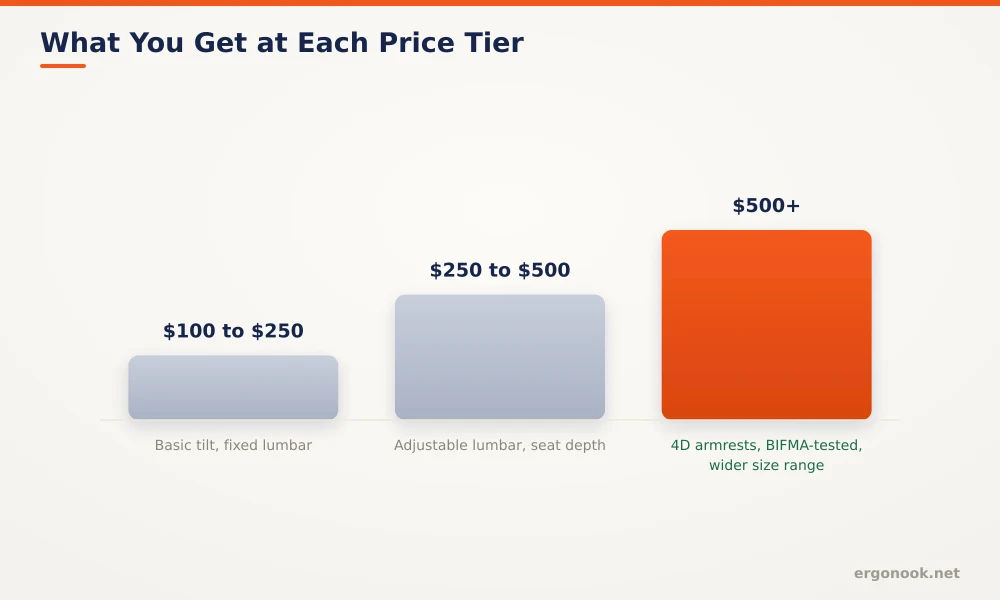
| Price Tier | What You Typically Get |
|---|---|
| $100 to $250 | Basic tilt, fixed or minimally adjustable lumbar, limited size range |
| $250 to $500 | Adjustable lumbar, sliding seat depth, height-adjustable armrests |
| $500 and up | 4D armrests, BIFMA-tested build, wider size and weight range |
Certifications and Standards to Look For
BIFMA X5.1 is the main standard to check for general-purpose office chairs, covering seat impact testing and caster durability over hundreds of thousands of cycles. It doesn’t test comfort or ergonomics directly, but a chair that hasn’t been tested to it is more likely to fail structurally over time. GREENGUARD certification indicates the chair has been tested for chemical emissions, relevant if you’re sensitive to off-gassing from new furniture or plan to use the chair in a small, enclosed room.
Red Flags in Product Listings
The word “ergonomic” in a product title with no adjustability specs listed anywhere in the description is the clearest red flag, since the term has no legal definition and gets applied to chairs with zero adjustable features. A missing weight rating is another, since it usually means the chair hasn’t been through BIFMA testing at all. Listings with only rendered product images and no photos of the adjustment mechanisms themselves make it hard to verify what’s actually adjustable versus what’s just described that way in bullet points.
Printable Checklist
- Independent lumbar height and depth adjustment
- Seat depth (pan slide) adjustment
- Height-adjustable armrests, ideally 3D or 4D
- Tilt tension control with a lockable recline
- Published weight rating and BIFMA X5.1 testing
- Seat width and depth dimensions that match your frame
If you’re dealing with a specific need beyond general fit, our chairs for lower back pain, mesh chairs for hot weather, and big and tall chairs roundups apply this checklist to specific categories of picks.
Frequently Asked Questions
Should I decide on mesh or leather before checking adjustability?
Adjustability first. Material is a comfort and climate preference that matters less than whether the chair actually fits your body.
Is a more expensive chair always more ergonomic?
Not automatically. Price often tracks materials and brand as much as adjustability, so always check the specific adjustment features rather than assuming price equals fit.
Does warranty length matter for an ergonomic chair?
It’s a reasonable proxy for build confidence. A longer warranty on the gas cylinder and mechanism specifically is more useful than a general warranty on the whole chair.
Can I judge a chair’s ergonomics without sitting in it first?
Not fully. Specs narrow the field well, but fit is personal enough that a generous return window matters if you can’t test it in person first.
What to look for in an ergonomic office chair comes down to adjustability you can verify on a spec sheet: lumbar, seat depth, armrests, tilt tension, and a real weight rating. Everything else is a preference, not a requirement.





Write Your Review
No reviews yet. Be the first to share your experience!