

Standard keyboards force your hands and shoulders inward, which can add strain during long typing sessions. A split keyboard changes that by separating or angling the two halves, letting your arms rest at a wider, more natural width.
We compared six split ergonomic keyboards, from fixed-curve designs that feel close to a standard keyboard to fully separable modules that adjust to shoulder width. Browse our full ergonomic keyboards category for more options.

Pros
- Certified by an independent ergonomics organization
- Full-size layout keeps a familiar typing experience
- Quiet keys suited to shared workspaces
Cons
- Fixed split angle rather than fully separable key modules like the Kinesis models here
- Larger footprint than a standard compact keyboard
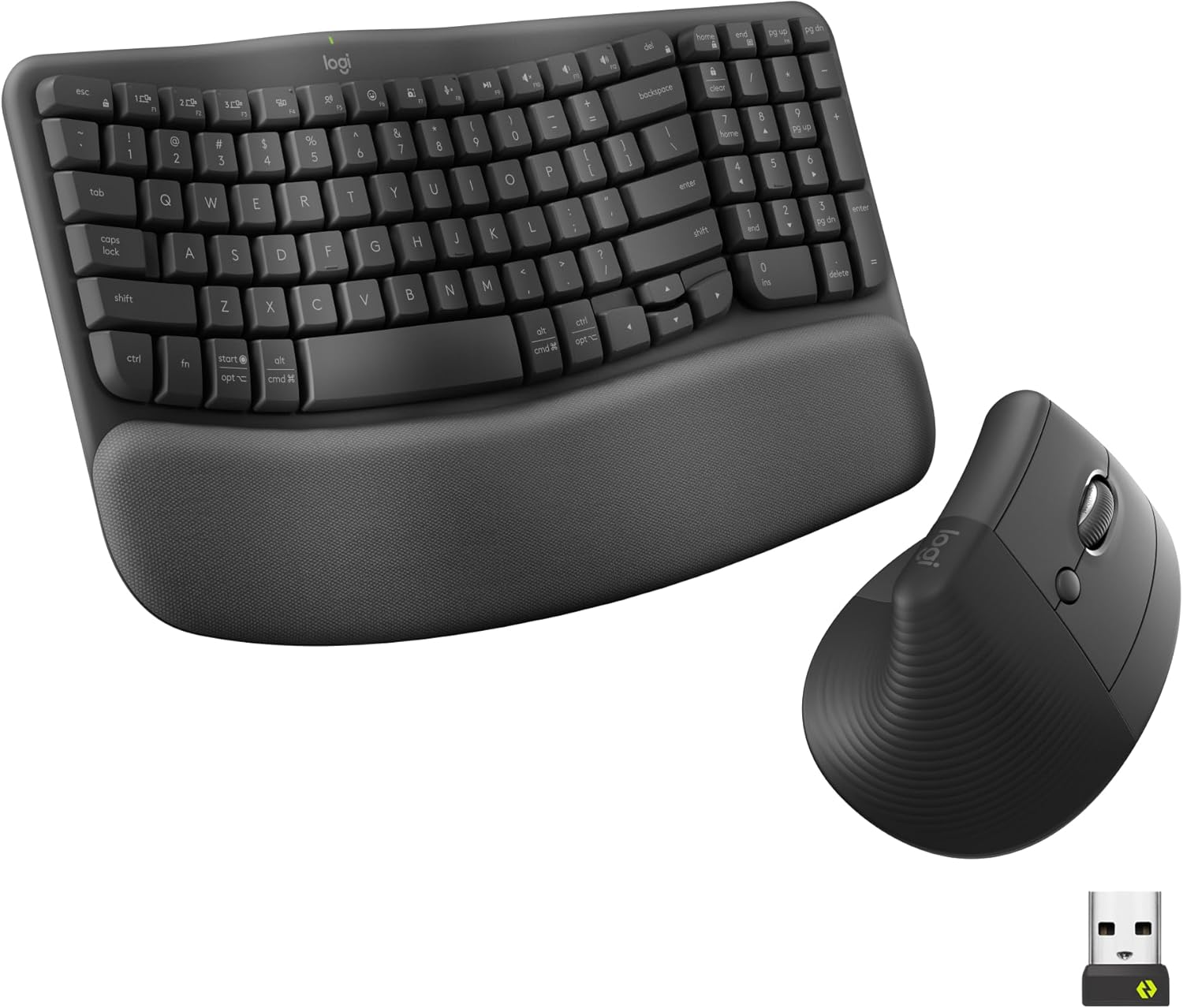
The Ergo K860 uses a curved, split keyframe that slopes outward, aiming to keep your wrists and forearms in a more natural position without fully separating the two halves.
Its memory foam wrist rest and three tilt angles let you fine-tune the typing posture whether you're sitting or standing, and it's certified by United States Ergonomics.
It connects over Bluetooth or the included USB receiver, and keeps a full-size layout with quiet keys, so the transition from a standard keyboard is relatively gentle.
Compared with the fully split Kinesis models in this comparison, its fixed curve is less adjustable but easier to adapt to.
It suits anyone who wants proven ergonomic credentials in a familiar, full-size keyboard shape.
Dimensions: 17.95 inches long by 9.17 inches wide by 1.89 inches high.
Connectivity: Bluetooth or included USB receiver.
Tilt options: 0, negative 4, or negative 7 degrees.
Layout: Full-size, 105 keys.
Weight: 2.6 pounds.
Who should buy this keyboard? Anyone who wants a certified ergonomic keyboard that still feels close to a standard full-size layout.
Who might want to look elsewhere? Anyone who wants fully separable key modules for maximum shoulder-width typing should look at the Kinesis Freestyle2 or Advantage360 instead.
Setup tip: Start at the flat 0 degree tilt and only add negative tilt once you're comfortable with the split shape.

Pros
- Rechargeable battery with a long rated life per charge
- Simple plug-and-play setup, no Bluetooth pairing required
- One of the more affordable split keyboards in this comparison
Cons
- Fixed split angle rather than fully separable modules
- USB receiver only, no Bluetooth option
The Arteck split keyboard uses a fixed split layout with a soft cushioned wrist and palm rest, aimed at a more natural hand position than a flat keyboard.
It connects through a nano USB receiver stored in the keyboard itself, and its rechargeable battery is rated for about six months per charge based on typical daily use.
It's backed by a 24 month warranty, and is one of the more affordable split keyboards in this comparison.
It doesn't offer Bluetooth or fully separable key modules, so it's a more modest step up from a standard keyboard than the Kinesis models here.
It suits anyone who wants an affordable, low-effort introduction to a split keyboard layout.
Dimensions: 16.5 inches long by 9.6 inches wide by 1.02 inches high.
Connectivity: 2.4G USB wireless receiver.
Battery: Rechargeable, rated around six months per charge.
Warranty: 24 months.
Who should buy this keyboard? Anyone who wants an affordable, simple introduction to a split ergonomic layout.
Who might want to look elsewhere? Anyone who wants Bluetooth or fully separable key modules should consider the Logitech K860 or Kinesis models instead.
Setup tip: The nano receiver stores inside the keyboard when not in use, so check there first if you misplace it.

Pros
- Most adjustable split design in this comparison, separating up to 10 inches
- Quiet mechanical switches
- Long 3 year manufacturer warranty
Cons
- As a newer listing, it doesn't yet have an established review history
- Steeper price and learning curve than the more traditional layouts in this comparison
The Advantage360 Professional takes split ergonomics further than the other keyboards here, with contoured, concave key wells that can separate up to 10 inches apart and three adjustable tenting heights.
It uses quiet mechanical switches rated for high durability, and is fully programmable through an open source configuration tool.
It connects over Bluetooth with wireless linking between the two halves, and is backed by a 3 year warranty.
As a newer listing, it doesn't have the review history of more established keyboards in this comparison yet.
It suits anyone who wants the most adjustable, fully split layout and is comfortable with a longer learning curve.
Separation: Up to 10 inches between key wells.
Tenting: Three adjustable heights.
Switches: Quiet mechanical, rated for high durability.
Connectivity: Bluetooth.
Warranty: 3 years.
Who should buy this keyboard? Anyone who wants the most adjustable, fully split layout available and is willing to invest time in the learning curve.
Who might want to look elsewhere? Anyone who wants an established review history or an easier transition should consider the Logitech K860 instead.
Setup tip: Start with a modest tenting angle and separation distance, then increase gradually as your hands adjust.

Pros
- Hotswappable switches allow easy customization without soldering
- Fully programmable for custom layouts and macros
- Detachable palm support adds flexibility
Cons
- Limited review history compared with more established keyboards in this comparison
- Wired USB-A only, no wireless option
The Freestyle Edge RGB Plus is a fully split mechanical keyboard built with hotswappable linear switches, so you can change the feel of the keys without soldering.
It includes RGB lighting, a detachable palm support, and a lift kit for tenting, and the layout is fully programmable.
It connects over a wired USB-A connection rather than wirelessly, and has a limited review history so far compared with more established options here.
It suits anyone who wants a highly customizable, fully split mechanical keyboard, particularly for gaming as well as typing.
Switches: Hotswappable linear mechanical.
Connectivity: Wired USB-A.
Lighting: RGB.
Included: Detachable palm support and lift kit for tenting.
Who should buy this keyboard? Anyone who wants a fully customizable, hotswappable split mechanical keyboard for typing and gaming.
Who might want to look elsewhere? Anyone who wants an established, widely reviewed option should consider the Logitech K860 instead.
Setup tip: Use the included lift kit to add tenting gradually rather than starting at the steepest angle.

Pros
- Established, well-reviewed split ergonomic design
- Adjustable tenting and separation in one package
- Standard layout keeps a familiar typing experience
Cons
- Membrane switches rather than mechanical, which some typists prefer differently
- Wired USB connection only
The Freestyle2 separates into two independent modules that rotate and pull apart up to 9 inches, letting you match the keyboard to your own shoulder width.
It ships with the VIP3 tenting accessory pre-installed, offering 5, 10, or 15 degrees of tilt along with integrated cushioned palm supports.
It uses a standard Windows layout with hotkeys and a numeric keypad, so the transition feels familiar despite the split design.
Its low-force membrane switches are designed to reduce finger fatigue, and it's an established, well-reviewed option in this comparison.
It suits anyone who wants a proven, fully separable keyboard without a mechanical switch premium.
Separation: Up to 9 inches between modules.
Tenting: 5, 10, or 15 degrees via the included VIP3 accessory.
Switches: Low-force membrane.
Connectivity: Wired USB.
Dimensions: 19 inches long by 12.5 inches wide by 3.5 inches high.
Who should buy this keyboard? Anyone who wants a proven, fully separable split keyboard with adjustable tenting and a familiar layout.
Who might want to look elsewhere? Anyone who specifically wants mechanical switches should look at the Kinesis Freestyle Edge or Advantage360 instead.
Setup tip: Start with a narrower separation and a lower tenting angle, then widen and increase gradually as you adjust.

Pros
- Backlighting adds visibility in low-light settings
- Simple wired setup with no batteries or pairing required
- Affordable relative to the mechanical options in this comparison
Cons
- Wired only, no wireless option
- Fixed split angle rather than fully separable modules
This is the wired version of Arteck's split ergonomic keyboard, adding seven backlight colors and adjustable brightness on top of the same cushioned wrist and palm rest.
It connects over a 6 foot USB cable, so there's no battery to charge or receiver to keep track of.
It's backed by a 24 month warranty and is one of the more affordable options in this comparison.
Like the wireless Arteck model, it uses a fixed split angle rather than fully separable modules.
It suits anyone who wants a simple, wired split keyboard with backlighting for low-light typing.
Connectivity: Wired USB, 6 foot cable.
Lighting: 7 backlight colors, adjustable brightness.
Switch type: Scissor-switch.
Warranty: 24 months.
Who should buy this keyboard? Anyone who wants a simple, affordable, wired split keyboard with backlighting.
Who might want to look elsewhere? Anyone who wants a wireless connection should consider the Arteck wireless model or the Logitech K860 instead.
Setup tip: Route the cable so it doesn't pull on the keyboard while typing, since the split halves are connected as one wired unit.
What to Look for in a Split Keyboard
Fixed Curve vs. Fully Separable
The Logitech K860 and both Arteck keyboards use a fixed split curve, which is easier to adapt to but doesn’t adjust to your exact shoulder width. The Kinesis Freestyle2 and Freestyle Edge separate into two independent modules, and the Advantage360 goes further still with contoured key wells that split up to 10 inches apart.
A fixed-curve keyboard is generally the gentler starting point if you’ve never used a split layout before.
Tenting and Adjustability
Tenting, tilting the keyboard so your palms face slightly inward, is available on several models here. The Freestyle2 offers 5, 10, or 15 degrees through its included lifters, the Advantage360 offers three adjustable heights, and the K860 offers three tilt legs, though in the opposite negative-tilt direction rather than tenting.
Switch Type
Switch feel varies across this lineup. The Freestyle2 uses low-force membrane switches, the Arteck models use scissor switches, and the two Kinesis mechanical keyboards use quiet or hotswappable mechanical switches for a firmer, more tactile typing feel.
Wired vs. Wireless
The K860, wireless Arteck, and Advantage360 all offer wireless connections, while the wired Arteck and Freestyle2 and Freestyle Edge keyboards connect over USB. If you want to avoid batteries and pairing altogether, a wired option keeps things simple.
Final Thoughts
For most people new to split keyboards, the Logitech Ergo K860 offers a certified, familiar starting point, while the Kinesis Freestyle2 is worth stepping up to if you want fully adjustable separation and tenting.
Frequently Asked Questions
Is a split keyboard hard to get used to?
Fixed-curve designs like the Logitech K860 or Arteck models are a relatively gentle adjustment, since the layout stays close to a standard keyboard. Fully separable keyboards take longer to adapt to but offer more precise fit once you do.
What is tenting on a split keyboard?
Tenting angles the two halves of the keyboard so your palms face slightly inward rather than flat down, which some people find reduces forearm rotation. Several keyboards in this comparison include adjustable tenting accessories.
Do I need mechanical switches on a split keyboard?
No. Mechanical switches offer a firmer, more tactile feel that some typists prefer, but membrane and scissor switches, like those on the Freestyle2 and Arteck keyboards, work well too and are generally quieter.
Which split keyboard is best for 2026 if I mostly want an easy transition?
A fixed-curve keyboard with a full-size layout, like the Logitech K860, is generally the easiest transition since the key positions stay close to what you’re used to typing on.




Write Your Review
No reviews yet. Be the first to share your experience!