

This article covers general active seating, not medical treatment. An exercise ball chair is not a certified medical device and is not designed for full-time, all-day use the way a standard office chair is. It engages core muscles through constant small balance adjustments, which some people find genuinely helpful for posture, but it also requires a period of adjustment and is not suitable for everyone. If you have balance issues, certain joint conditions, or back pain that is severe or persistent, talk to a doctor before switching to a ball chair.
A ball chair works on a different principle than any other seat in our Chairs for Back Pain lineup: instead of a fixed backrest or a shaped seat pan, the ball itself is slightly unstable, requiring continuous small muscle engagement to stay balanced. That constant micro-movement is the entire point, similar in spirit to the kneeling chair and saddle chair covered elsewhere in this category, though the mechanism here is balance rather than an opened hip angle.
The products in this category range from bare-bones frameless balls to fully accessorized chairs with wheels and back support, so unlike a standard office chair roundup, “chair” here covers a wider spread of designs than usual. We have grouped them by base type below rather than assuming every product labeled a ball chair works the same way.
Disclosure: Ergonook is a participant in the Amazon Associates program. Links below are affiliate links, and we may earn a commission from qualifying purchases. This does not affect which chairs we recommend or how we rank them.

Pros
- One of the few ball chairs in this roundup with an actual backrest built into the frame rather than being fully backless
- Documented 400 lb weight capacity is the highest among the chairs in this roundup
- Ball is removable and can be used separately for general exercise, a genuine dual-purpose design
Cons
- Listing includes some phrasing about helping with injury rehabilitation, which should be read as general wellness marketing rather than a clinical claim; this is a seating product, not a physical therapy device
- Re-inflation may be needed after initial setup as the ball material stretches, an extra step compared to simpler designs

Pros
- Fixed 4-leg base gives the posture benefits of a ball chair without the ball rolling out from under you, a common complaint with simpler ball-and-frame designs
- Two selectable heights let one chair fit more than one desk height without buying a different size
- Greenguard certification addresses indoor air quality specifically, not something most ball chairs publish
Cons
- 250 lb weight capacity is on the lower end for the price point
- No back support at all, a fully backless active-sitting design

Pros
- Documented 300 lb weight capacity is solidly mid-range for this roundup, higher than several competitors
- Design input from chiropractic professionals is stated directly by the brand, worth noting even though it does not make this a medical device
- Optional leg extenders let you add 2 inches of height later if your desk changes, a rare aftermarket option in this category
Cons
- Recommended for users 5 ft to 5 ft 11 in without extenders, taller users need to budget for the separate accessory
- Ball and frame both need periodic re-inflation and tightening checks over time, standard maintenance for this product type

Pros
- Five casters is more than most competitors in this roundup, likely contributing to smoother, more stable rolling
- Fully backless, armless design maximizes the core-engagement benefit of active sitting for anyone specifically seeking that over a hybrid chair
- Suitable for both adults and children per the listing, useful if the chair will be shared
Cons
- No back support at all, which will not suit anyone who wants even minimal positioning assistance
- Recommended user height range (5 ft to 5 ft 11 in) may not suit taller users

Pros
- Five-leg stability design keeps the ball from rolling away when not in active use, addressing a common complaint with simpler frame designs
- Comes with a printed exercise guide, a small but genuine extra not included with every competitor here
- Fixed height is specifically tuned to put users at eye level with most standard desks
Cons
- No wheels at all, so the chair cannot be rolled or repositioned like the caster-equipped picks in this roundup
- Narrower recommended height range (5 ft 6 in to 5 ft 11 in) than some other chairs here

Pros
- No separate frame or base at all, the simplest, most compact design in this roundup, easy to move or store when not in use
- Machine-washable cover is a practical detail most ball chairs in this roundup do not offer
- Documented 400 lb weight capacity ties for the highest in this roundup despite having no supporting frame
Cons
- No wheels, back support, or height adjustment of any kind, the most minimal design in this specific roundup
- Without a base, the ball can roll away when not actively sat on, unlike the stabilized designs elsewhere in this list
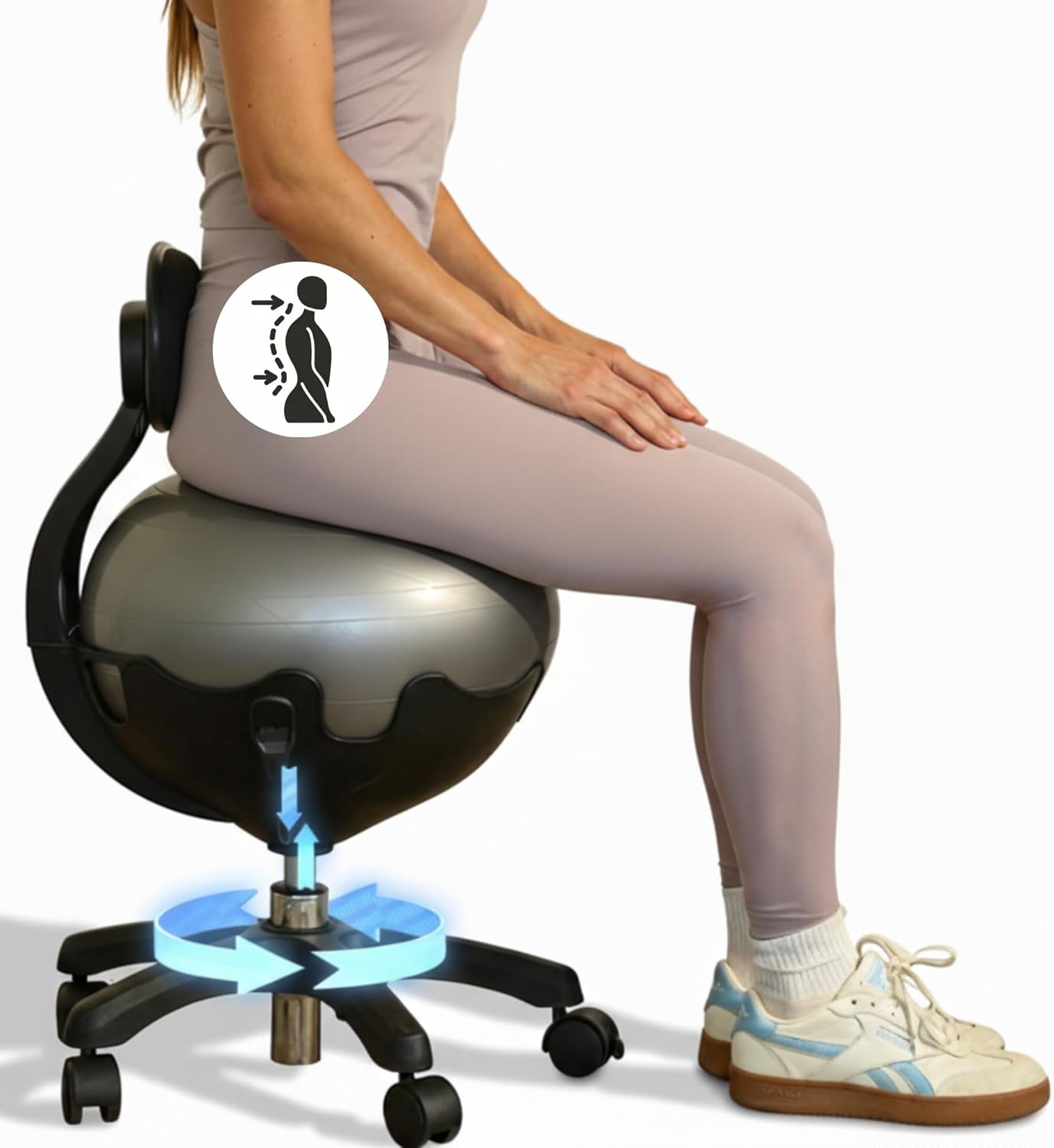
Pros
- Height adjustment (20 to 23 inches) is more flexible than fixed-height competitors in this roundup, useful if the chair will be shared across different desks or users
- Manufacturer is unusually direct about what the back support does and does not do, useful information rather than vague comfort language
- Lockable caster wheels combine mobility with stability once positioned
Cons
- Lowest customer rating (3.2) among the chairs in this roundup
- Back support is explicitly non-adjustable and not designed for reclining, a limitation the maker states directly
What to Know Before Switching to a Ball Chair
This Is Not an All-Day Chair
Most physical therapists and ergonomics resources recommend limiting ball chair use to a portion of the day, often an hour or two at a time, rather than a full 8-hour replacement for a standard office chair. The constant core engagement that makes it useful for posture is also tiring over extended periods, and pushing through fatigue tends to produce the opposite of good posture as your muscles tire and you slump. Treat it as a rotation tool alongside a regular chair rather than a full-time swap.
Rolling Base Versus Stable, Non-Rolling Base
Ball chairs split into two main designs: a caster-wheeled frame that rolls like a standard office chair, and a fixed multi-leg base that keeps the ball from rolling away but does not move. Wheeled versions are easier to reposition around a desk, while stable-leg versions are less likely to shift unexpectedly when you are not actively sitting on them. Neither is objectively better; it depends on how much you move around your workspace during the day. A third, more minimal option skips the base entirely and relies on a fitted cover alone, trading stability for portability and a cleaner look, though the ball can roll away on a hard floor if nothing is holding it in place when you step away from your desk.
Back Support Varies More Than You Might Expect
Some ball chairs are fully backless by design, maximizing core engagement, while others add a back support piece meant for light positioning rather than reclining. Read the specifics carefully: a few listings explicitly state their back support is not adjustable and not designed like a traditional chair backrest, which is honest information worth trusting over a chair that oversells a minimal support piece as full lumbar support.
Weight Capacity and Ball Material Quality
Anti-burst ball construction is standard across this category, but documented weight capacity still varies from 250 to 400 lbs among the chairs in this roundup. Confirm the published figure against your own needs, and expect to re-inflate the ball once after initial setup as the material stretches to its final size, a normal step rather than a defect, not a sign the ball was underfilled at the factory. For general ergonomic seating fundamentals beyond active sitting, see our guide to what to look for in an ergonomic office chair.
Sizing Yourself Correctly Matters More Than the Listing Photo
Most ball chairs publish a recommended user height range tied to the ball diameter, since sitting with knees noticeably higher or lower than hip level defeats much of the posture benefit. Check that range carefully rather than judging from product photos, which rarely convey scale accurately. A couple of chairs in this roundup offer optional height extenders or an adjustable base specifically to widen the usable height range beyond the standard fit.
What “Anti-Burst” Actually Means
Every ball in this roundup is described as anti-burst, meaning the material is designed to deflate slowly rather than pop suddenly if punctured, giving you time to notice and address a leak rather than being caught by a sudden collapse. This is a standard safety feature across the category at this point, not a premium extra, but it is still worth confirming on any ball chair you consider outside this list, since a handful of very cheap import listings skip this construction entirely. If a listing does not mention anti-burst material anywhere in its description or specifications, treat that as a reason to look elsewhere rather than assuming it is simply an oversight in the copy.
Final Thoughts
For the most complete package, with a backrest, rolling casters, and the highest documented weight capacity in this roundup, the Heavy Duty Rolling Ball Chair with Back Support is the strongest all-around pick. If a stable, non-rolling base and indoor air quality certification matter more to you, the Safco Zenergy Ball Chair offers a more polished, office-appropriate design with two selectable heights. Both are worth comparing against the simpler, more affordable picks further down the list.
FAQ
Does sitting on a ball chair actually fix back pain?
It can help some people by encouraging core engagement and reducing slouching, but it is not a medical treatment and results vary from person to person. It is not a substitute for care from a doctor or physical therapist if back pain is severe or persistent, and it should be introduced gradually rather than as a sudden full-time replacement for your current chair.
How long should I sit on a ball chair each day?
Most guidance suggests starting with shorter sessions, 20 to 30 minutes, and building up gradually, rather than using it as a full workday replacement immediately. Many people settle into using it for a portion of the day alongside a standard chair rather than exclusively.
Do I need a ball chair with a back support?
Not necessarily. A backless design maximizes the core-engagement benefit that is the whole point of a ball chair, while a version with back support offers a bit more positioning assistance for those easing into active sitting. Check exactly what the back support does, since several listings are explicit that it is for positioning only, not reclining, rather than assuming any back piece functions like a full office chair backrest.
Who should avoid a ball chair?
Anyone with balance issues, certain joint or vestibular conditions, or discomfort with an unstable seating surface should talk to a doctor before switching to a ball chair. If you are unsure, our guide on reducing back pain from sitting all day covers general posture habits that work with a standard chair as well.




Write Your Review
No reviews yet. Be the first to share your experience!