

Footrests benefit anyone whose feet don’t rest flat on the floor once their chair and desk are set to the right height, most often shorter people, and cost $15 to $60 for most models. OSHA specifically recommends one when a chair “cannot be lowered” enough without pushing the keyboard too high, since the alternative is dangling feet and pressure behind the knees.
- OSHA’s Computer Workstations eTool recommends a footrest specifically when seat height can’t be lowered enough without raising the desk or keyboard out of position.
- A footrest should provide stable support for the feet and can elevate the knee slightly to relieve pressure on the back of the leg, per OSHA.
- Cornell’s ergonomics guidelines list “feet flat on the floor or on a footrest” as one of the basic posture checks in a workstation setup.
- If your feet already rest flat once your chair is set correctly, a footrest doesn’t add anything, the money is better spent elsewhere.
In this article:
- What a footrest actually does
- What ergonomics guidelines say
- Who a footrest is worth it for
- Who should skip it
- How much a good footrest costs
- Footrest vs a stack of books
- Common mistakes that waste the money
- Frequently asked questions
What a Footrest Actually Does
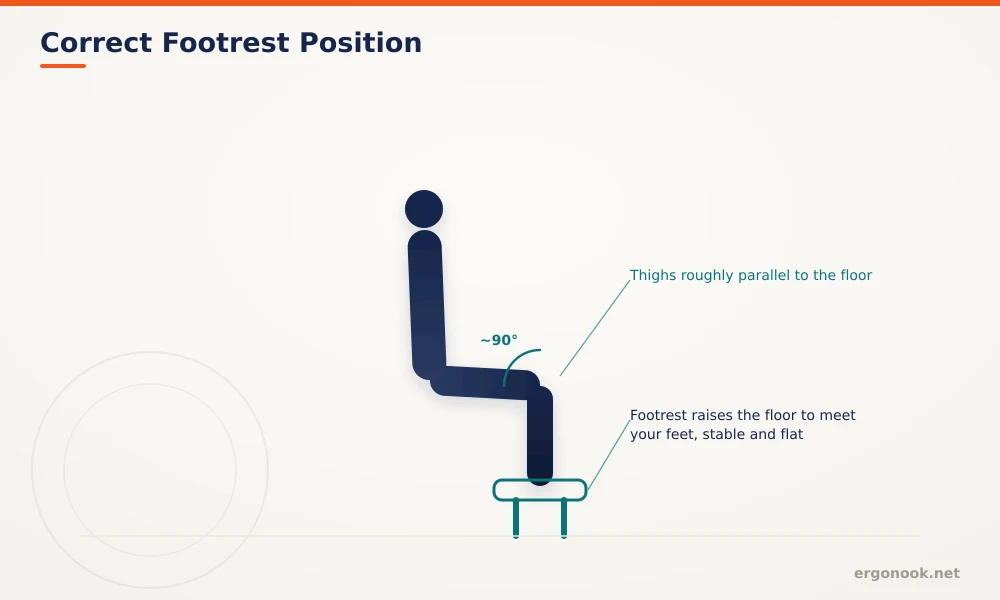
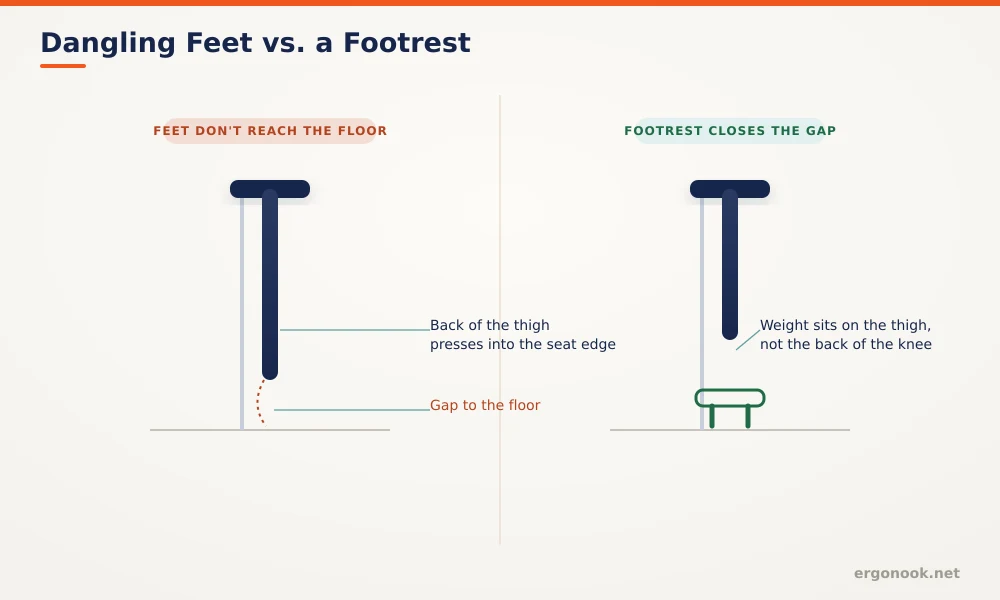
A footrest raises the effective floor to meet your feet when your chair is set at the correct height for your desk but your feet still don’t reach the ground. OSHA describes proper chair height as the point where the entire sole of the foot rests on the floor with the back of the knee slightly higher than the seat. When your legs are too short for that setup at your desk’s fixed height, a footrest closes the gap instead of forcing you to either raise the chair, which lifts your elbows above the keyboard, or leave your feet hanging (OSHA, Computer Workstations eTool, Chairs).
What Ergonomics Guidelines Say
OSHA is direct about when a footrest is warranted: when the seat cannot be lowered enough without pushing the keyboard or monitor too high. In that situation, a footrest should provide stable support for the feet, and it may elevate the knee slightly to relieve pressure on the back of the leg (OSHA, Computer Workstations eTool, Chairs). Cornell’s ergonomics program frames the same check more simply: feet should be flat on the floor or on a footrest, listed as a basic posture requirement rather than an optional extra (Cornell CUErgo, Computer Workstation Ergonomics Guidelines). Neither source treats a footrest as a luxury item. Both frame it as the fix for a specific, identifiable mismatch between your body and a fixed-height desk.
Who a Footrest Is Worth It For
A footrest earns its cost for a specific set of people, not everyone with a desk job.
- Shorter people at a fixed-height desk. If you’re under about 5’4″ and your desk isn’t height-adjustable, raising your chair enough for correct elbow height often leaves your feet well off the floor.
- Anyone at a desk that’s fixed too high. Some older or shared desks sit above the 28 to 30 inch range that fits most people, forcing the same tradeoff regardless of your height.
- People who sit for long, uninterrupted stretches. A footrest gives you somewhere to shift your feet and change position periodically, instead of holding one static leg posture for hours.
Who Should Skip It
If your feet already rest flat on the floor with your knees at roughly hip height once your chair is adjusted correctly, a footrest doesn’t add anything you don’t already have. Adding one anyway, and resting your feet on it out of habit rather than need, can actually push your knees higher than your hips, which tilts the pelvis backward and works against the lumbar support built into your chair. If you’re tall for your desk rather than short, the fix is a lower chair or a taller desk, not a footrest.
How Much Does a Good Footrest Cost?
| Tier | Typical Price | What You Get |
|---|---|---|
| Basic | $15 to $25 | Fixed height, flat platform, no rock or tilt |
| Mid-range | $25 to $45 | Height adjustment, tilt or rocking surface |
| Higher-end | $45 to $60+ | Multiple height positions, massage texture, wider platform |
Our under-desk footrest picks cover models across this range if you’ve confirmed you actually need one.
Footrest vs a Stack of Books
Cornell’s own guidance notes that a makeshift footrest, a stack of books or a sturdy box, works fine as a stand-in, as long as your feet are supported and nothing presses into the back of your knees. A dedicated footrest adds a wider, more stable platform and, on adjustable models, a tilt or rocking surface that lets you shift your ankle angle periodically instead of holding one fixed position. If you’re not sure a footrest will help before spending money, try the book stack first. If it helps, a dedicated footrest is a small upgrade, not a leap of faith.
Common Mistakes That Waste the Money
The most common mistake is buying a footrest before checking whether the chair itself is the real problem. If your chair’s seat height simply hasn’t been adjusted down, fixing that costs nothing and might make a footrest unnecessary. The second mistake is setting the footrest too high, which lifts your knees above your hips and tilts your pelvis backward, undoing whatever lumbar support your chair provides. A footrest should elevate your feet slightly, not stack your knees up toward your chest.
Frequently Asked Questions
Do tall people ever need a footrest?
Rarely for the same reason as shorter users. Occasionally a very high fixed desk creates the same mismatch regardless of height, but the more common fix for tall users is a taller desk or lower chair, not a footrest.
Is a rocking or tilting footrest worth the extra cost?
It can help you vary your ankle position instead of holding one static angle for hours, which some users find more comfortable over a full workday. A flat, fixed footrest still covers the core benefit of foot support.
Do I need a footrest with a standing desk?
Not while standing. If you alternate between sitting and standing, you may still want one for your seated periods, following the same criteria as any fixed-height desk.
If I get a height-adjustable desk, do I still need a footrest?
Usually not. A height-adjustable desk lets you set the correct height for both your elbows and your feet at once, which removes the mismatch a footrest is designed to fix.
A footrest is worth it when your feet don’t reach the floor at the chair height your desk requires, most commonly for shorter people at fixed-height desks. If your feet already sit flat once your chair is adjusted correctly, save the money and look at your desk height instead.




Write Your Review
No reviews yet. Be the first to share your experience!