

To use a standing desk correctly, alternate with sitting roughly every 30 to 60 minutes, shift your weight instead of standing frozen, and set height by measuring your elbow, not by feel. A Cochrane review found sit-stand desks only reduce sitting time when people actually alternate, not just when they own one.
- A Cochrane review of 34 studies found the sitting-reduction benefit of a standing desk depends on actually alternating, not on the desk’s presence alone.
- Standing motionless for long stretches produces the same kind of static-posture fatigue that sitting does, just in different muscles.
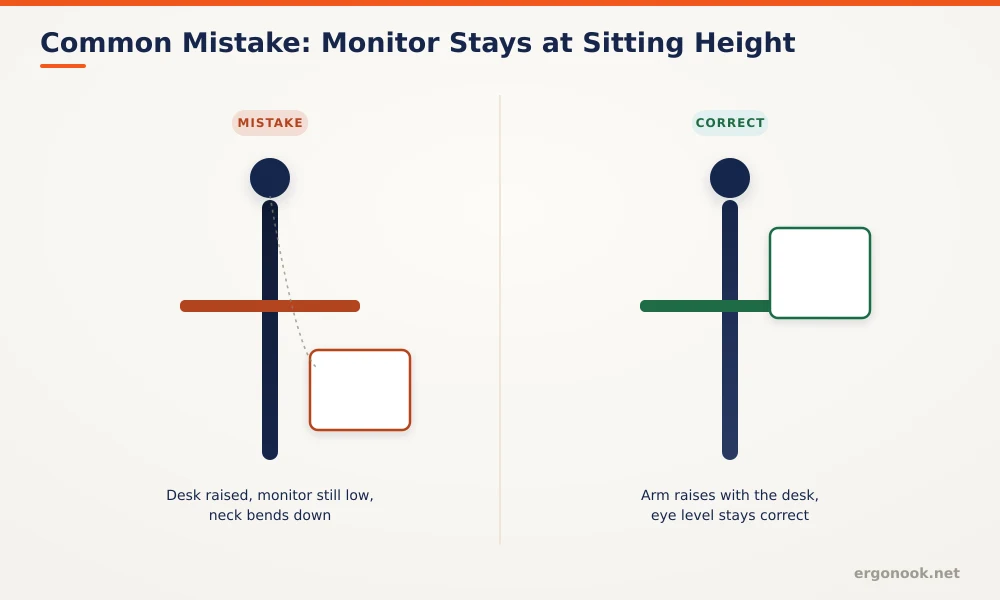
- A monitor that doesn’t move with the desk is one of the most common setup mistakes, forcing your neck to bend down every time you stand.
- Most anti-fatigue mat comfort benefit shows up after 20 to 30 minutes of continuous standing, not from the first minute.
In this article:
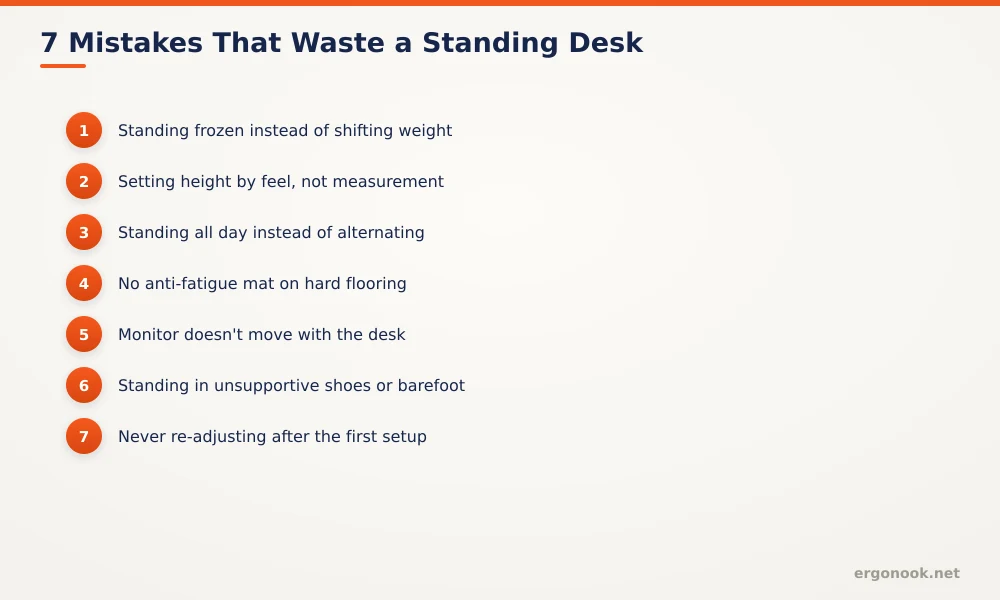
- 7 mistakes that waste a standing desk
- What to do if you spot these
- Quick fix vs bigger change
- Frequently asked questions
7 Mistakes That Waste a Standing Desk
1. Standing Frozen Instead of Shifting Weight
Standing perfectly still for an hour is nearly as hard on your legs and lower back as sitting perfectly still for the same stretch. The actual benefit of standing comes from the small, natural weight shifts your body makes when it’s not locked into one fixed stance. Let yourself move, shift your weight foot to foot, and change stance rather than treating standing as a second static posture.
2. Setting Height by Feel Instead of Measuring
Eyeballing standing desk height leads to the same shoulder-shrug or wrist-bend problems as a poorly set sitting desk. Measure your standing elbow height the same way you’d measure it seated, and match the desk surface to that number rather than guessing based on what looks roughly right.
3. Standing All Day Instead of Alternating
A Cochrane review of 34 studies and 3,397 participants found sit-stand desks reduce sitting time by 84 to 116 minutes a day among people who actually alternate positions, not among people who simply own an adjustable desk (Cochrane). Standing for eight hours straight trades one static-posture problem for another, foot fatigue and leg swelling instead of back stiffness.
4. No Anti-Fatigue Mat on Hard Flooring
Standing on concrete, tile, or hardwood over concrete for more than 20 to 30 minutes at a stretch is noticeably more tiring without a mat. Our guide on whether anti-fatigue mats really work covers the research behind that benefit, including why the mat matters more the longer each standing stretch runs.
5. Monitor Doesn’t Move With the Desk
A fixed monitor stand stays at sitting-eye-level even after you raise the desk to standing height, forcing your neck to bend down exactly the way a too-low monitor would in a normal seated setup. A monitor arm mounted to the desk itself solves this automatically, since it rises and falls with the surface instead of staying fixed.
6. Standing in Unsupportive Shoes or Barefoot
Flat, unsupportive shoes or bare feet on a hard floor carry impact and alignment problems that even a good anti-fatigue mat doesn’t fully address. Supportive footwear and a mat solve different parts of the same problem, foot alignment versus floor impact, and work best paired together rather than relying on just one.
7. Never Re-Adjusting After the First Setup
Height settings that were correct a year ago can drift out of date after a new chair, different shoes, or simply a change in how your body feels. Treat your saved height presets as a starting point to revisit occasionally, not a permanent setting you never touch again.
What to Do If You Spot These
Most of these are quick fixes: remeasure elbow height, add a mat, or reset your memory presets. If you’re still using a desk converter and finding the monitor height mismatch hard to solve, that’s often a sign you’ve outgrown the converter stage. Our standing desk converters for small spaces roundup and quietest standing desk converters roundup cover models with enough range to reduce this specific mismatch.
Quick Fix vs Bigger Change
| Mistake | Fix Type |
|---|---|
| Standing frozen, wrong height, no mat | Quick fix, free or under $50 |
| Monitor doesn’t move with the desk | Bigger change, needs a desk-mounted arm |
| Standing all day instead of alternating | Habit change, needs a reminder or timer |
| Converter too limited for your setup | Bigger change, consider a full electric desk |
Frequently Asked Questions
Do I need a timer to alternate correctly?
Not strictly, but most people lose track of time during focused work, so a simple reminder tends to work better than relying on noticing discomfort.
Is fidgeting or shifting weight actually good while standing?
Yes. Small, natural weight shifts are the mechanism behind reduced fatigue, not a sign of poor posture.
How often should I recheck my standing height setting?
Whenever your shoes, chair, or body changes meaningfully, and it’s worth a quick recheck every few months regardless, since small drifts are easy to miss.
Is an anti-fatigue mat mandatory for using a standing desk correctly?
Not mandatory, but most people find standing more than 20 to 30 minutes at a time noticeably more tiring without one, especially on hard flooring.
Using a standing desk correctly is less about the desk itself and more about the habits around it: alternating with sitting, moving instead of freezing, and keeping your monitor at the right height in both positions. Fix these seven and most of what makes a standing desk feel pointless goes away.



Write Your Review
No reviews yet. Be the first to share your experience!