

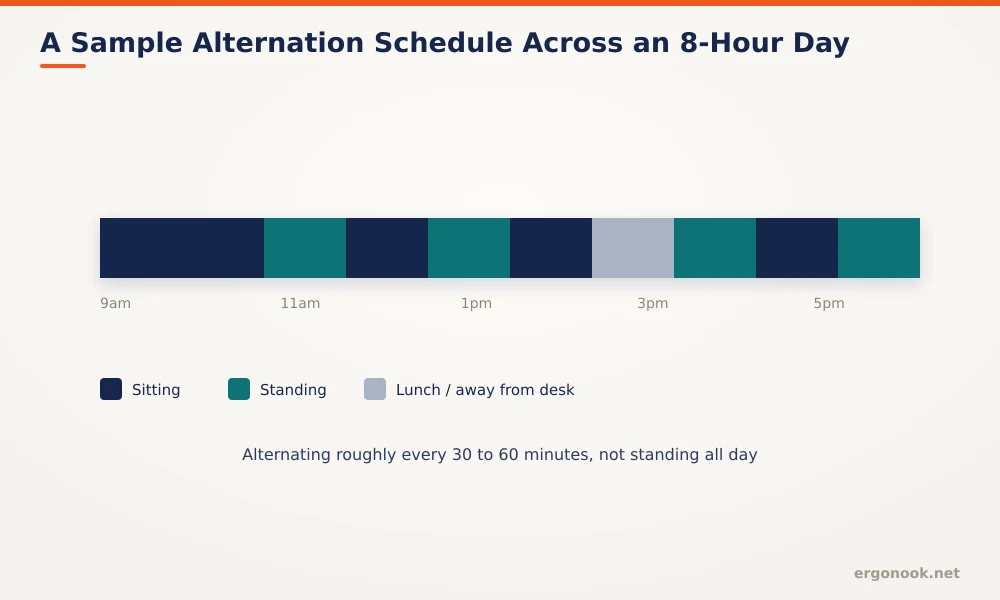
Standing desk vs sitting desk: neither wins alone. A height-adjustable desk that lets you alternate between both, roughly every 30 to 60 minutes, beats committing to either position all day. Mayo Clinic links more than 6 to 8 hours of daily sitting to a 125% to 150% higher risk of cardiovascular events, but standing all day brings its own fatigue.
- Mayo Clinic links sitting more than 6 to 8 hours a day to a 125% to 150% higher risk of cardiovascular events, and more than 8 hours a day to more than double the risk of type 2 diabetes.
- OSHA’s Computer Workstations eTool recommends a five-minute break from computer tasks every hour, on top of alternating desk height.
- A desk converter runs about $100 to $200; a full electric standing desk typically runs $250 to $600 or more.
- Standing all day isn’t the goal. The benefit comes from alternating position, not from how long you stand in one stretch.
This article is for general educational purposes and is not medical advice. If you have persistent back, leg, or foot pain, talk to a doctor or physical therapist before changing your setup or routine.
Standing Desk vs Sitting Desk: Quick Comparison
| Criteria | Sitting Desk (fixed) | Standing Desk (adjustable) |
|---|---|---|
| Cardiovascular risk | Higher with 6 to 8+ hours of continuous sitting | Lower when alternated with sitting through the day |
| Foot and leg fatigue | Not a factor | Real risk if you stand for hours straight instead of alternating |
| Cost | Lowest, most fixed desks are cheap | $100 to $200 for a converter, $250 to $600+ for a full electric desk |
| Multi-user fit | One height only, wrong for anyone a different size | Memory presets fit multiple people at the same desk |
| Desk space | Standard footprint | Converter adds desk depth; full desk replaces it entirely |
| Best for | Tight budgets, short computer sessions | Long computer sessions, shared or hybrid desks |
In this article:
- What is a sitting desk?
- What is a standing desk?
- Standing desk vs sitting desk: health and movement
- Standing desk vs sitting desk: cost and setup
- Standing desk vs sitting desk: shared and multi-user setups
- When a sitting desk is the better choice
- When a standing desk is the better choice
- Common mistakes when switching to a standing desk
- Frequently asked questions
What Is a Sitting Desk?
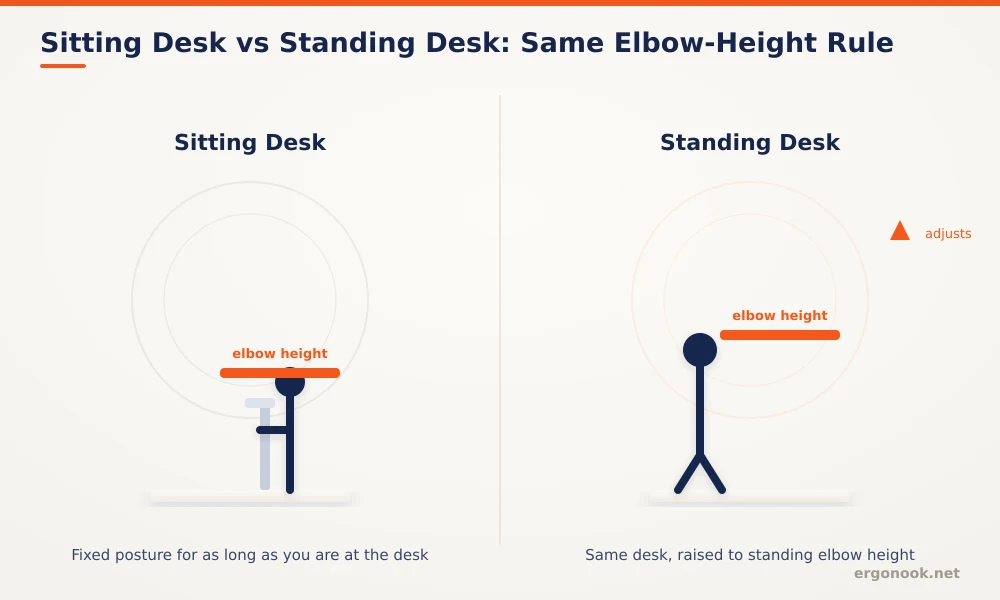
A sitting desk is a fixed-height desk built for one posture. It locks you into sitting for as long as you’re working there, with no built-in way to change that without getting up and leaving the desk entirely. Most desks sold as plain desks, not standing desks, fall into this category, and they’re usually the cheapest option on the market.
What Is a Standing Desk?
A standing desk is height-adjustable, either by an electric motor or a manual crank, and lets you switch between sitting and standing at the same desk. That switching is the actual benefit, not standing itself. A desk converter is the budget version: it sits on top of your existing desk and raises just the keyboard and monitor, rather than replacing the whole desk.
Standing Desk vs Sitting Desk: Health and Movement
Sitting for more than 6 to 8 hours a day is associated with a 125% to 150% increase in cardiovascular event risk, and sitting more than 8 hours a day is linked to more than double the risk of developing type 2 diabetes, according to Mayo Clinic (Mayo Clinic). That doesn’t mean standing all day is the fix. Standing for eight straight hours brings its own problems: foot fatigue, swelling, and lower back strain from staying locked in one stance, just a different stance than sitting.
The real advantage of an adjustable desk is breaking up long stretches of either posture throughout the day. OSHA’s ergonomics guidance separately recommends a five-minute break from computer tasks every hour, enough time to stretch, get up, or walk (OSHA). Raising or lowering the desk is a built-in prompt to reset your posture on top of that break, something a fixed desk gives you no reason to do. For a closer look at whether the investment pays off for your situation, see our guide on whether standing desks are worth it.
Standing Desk vs Sitting Desk: Cost and Setup
Budget and space are the practical tiebreakers once you’ve decided an adjustable desk makes sense. A desk converter costs less and makes sense if you’re not ready to replace furniture you already own, or if you’re renting and don’t want to commit to a full desk swap. A full electric standing desk costs more but gives a cleaner look with no riser taking up desk depth, plus often a wider height range that matters for taller or shorter users who need the extremes of the adjustment.
Within full standing desks, manual crank models are cheaper and have fewer electronic parts to fail, but changing height takes real physical effort, which in practice means people adjust them less often. Electric desks with a motor and memory presets make switching a one-button action, removing the friction that causes people to just stay sitting out of convenience.
Standing Desk vs Sitting Desk: Shared and Multi-User Setups
If more than one person uses the same desk, whether that’s a home office shared between partners or a hot desk at work, a fixed sitting desk built for one person’s height is often wrong for someone several inches taller or shorter. Memory presets on electric standing desks solve this directly: each person saves their own sitting and standing height and switches in seconds instead of eyeballing the adjustment every time. For a single dedicated user, this benefit matters less, since a fixed-height desk built correctly for that one person removes the adjustment question entirely, at the cost of losing the ability to alternate positions during the day.
When a Sitting Desk Is the Better Choice
A fixed sitting desk still makes sense on a tight budget, for short computer sessions spread through the day rather than long unbroken blocks, or for a single user whose chair and desk height are already correctly matched. If your actual complaint is chair comfort or monitor height rather than sitting itself, fixing those first is usually cheaper and more effective than a desk swap.
When a Standing Desk Is the Better Choice
A standing desk earns its cost for anyone doing long, uninterrupted computer sessions, back-to-back video calls, or anyone who’s already noticed stiffness by mid-afternoon. It’s also the better fit for a shared desk, since memory presets remove the friction of readjusting for a different person every time. If desk space is tight, our standing desks for small home offices roundup covers models that fit a compact footprint without giving up height range.
Common Mistakes When Switching to a Standing Desk
These mistakes are why some standing desks end up parked at sitting height permanently within a few months.
- Jumping straight to standing most of the day in week one. This leads to sore feet and legs and often ends with the desk abandoned at sitting height out of frustration. Build up gradually instead, starting with short standing intervals.
- Skipping an anti-fatigue mat. Standing on a hard floor for long stretches is more tiring on the feet and lower back than most people expect going in.
- Setting the standing height wrong, usually too low, which causes hunching, or too high, which raises the shoulders toward the ears.
- Treating it as an all-or-nothing switch. The goal is alternating, not replacing one static posture with another.
Frequently Asked Questions
Is a manual standing desk worth the lower price?
If you’re confident you’ll adjust it regularly, yes. If convenience is what determines whether you’ll actually use it, the extra cost of an electric motor is often worth it.
Do I need both a standing desk and an anti-fatigue mat?
If you plan to stand for more than 20 to 30 minutes at a stretch, a mat noticeably reduces foot and leg fatigue during that time.
Can a desk converter fully replace a standing desk?
For trying the habit or working in a rental, yes. It generally has a shorter height range and takes up more desk depth than a purpose-built standing desk.
How often should I switch between sitting and standing?
Roughly every 30 to 60 minutes is a commonly cited starting point, adjusted to how your feet and back feel rather than a strict timer.
Standing desk vs sitting desk isn’t really an either/or question. The desks that deliver the most benefit are the ones that let you do both, alternating through the day instead of committing to one static posture from 9 to 5.



Write Your Review
No reviews yet. Be the first to share your experience!