

If you spend hours at a desk and feel a familiar ache creeping into your wrists, you understand the frustration. Carpal tunnel syndrome can turn even simple typing into a painful chore. The right keyboard can make a world of difference, and mechanical ergonomic models offer both comfort and durability. This guide evaluates nine of the best ergonomic mechanical keyboards for carpal tunnel relief in 2026, focusing on features like split frames, tenting angles, and palm support. Whether you are a programmer, writer, or remote worker, these picks aim to reduce strain and let you type pain-free.
For a broader look at wrist-friendly options, check out our article on the best ergonomic keyboard for wrist pain. Now, let’s jump into the products themselves.
Tenting and split layout help hand posture, but they do not address nerve compression directly, so persistent numbness or tingling still needs a doctor’s evaluation, not just a new keyboard. This guide is informational and is not a substitute for medical advice; if your pain is severe, persistent, or worsening, consult a physician or physical therapist.
Disclosure: Ergonook is a participant in the Amazon Associates program. Links below are affiliate links, and we may earn a commission from qualifying purchases. This does not affect which products we recommend or how we rank them.

Pros
- Ergonomic split design reduces strain on wrists and shoulders.
- Customizable RGB lighting and macro keys offer personalization.
- Tactile Kailh brown switches provide good feedback without being too loud.
- Sturdy build quality with a comfortable built-in wrist rest.
- Integrated USB pass-through adds convenience for connecting peripherals.
Cons
- Higher price point compared to standard mechanical keyboards.
- May require an adjustment period for users new to split layouts.
- Software for RGB customization could be more intuitive for some users.
The Cloud Nine C989M is an ergonomic split mechanical keyboard designed to reduce wrist and shoulder pain during long typing sessions. It is ideal for professionals who spend hours at a computer, as well as gamers who want comfort without sacrificing performance. The keyboard features Kailh tactile brown switches, which provide a satisfying tactile bump with a low actuation force, making it suitable for both typing and gaming.
Standout features include the split design that can be separated up to eight inches, allowing for a natural arm and wrist alignment. The built-in tenting with a seven-degree angle and cushioned palm support further enhance comfort. The RGB backlighting is per-key customizable via a companion app, offering a wide range of colors and effects to suit any setup.
Build quality is solid, with a durable plastic frame and a full-size layout that includes a number pad and ten programmable macro keys. The USB pass-through is a convenient addition for connecting a mouse or other device. The wrist rests are integrated and provide good support, though they are not detachable.
One potential drawback is the price, which is higher than many standard mechanical keyboards. Additionally, users new to split keyboards may need some time to adapt to the layout. The customization software, while functional, could be more user-friendly for those looking to quickly adjust settings.
Overall, the Cloud Nine C989M is a well-built ergonomic keyboard that delivers on its promise of reducing strain. It is a worthwhile investment for anyone who experiences discomfort from traditional keyboards or wants to prevent future issues. With its combination of comfort, customization, and performance, it earns a strong recommendation for both work and play.

Pros
- Ergonomic split-keyframe with wave-shaped keys promotes natural hand posture and reduces fatigue.
- High-capacity 5000mAh battery lasts a long time between charges, ideal for heavy users.
- Triple connectivity with Bluetooth 5.3 offers stable wireless performance across multiple devices.
- Hot-swappable switches allow easy customization of key feel without soldering.
- Rich RGB customization options with 19 lighting effects and 6 brightness levels.
Cons
- Hot-swap only supports 3-pin low-profile switches, not standard 5-pin high-profile switches.
- Some users may prefer a more traditional straight layout rather than the curved split design.
- Limited to 12 reviews at launch, so long-term reliability is not yet widely reported.
The RAGNOK RK104 is a full-size ergonomic mechanical keyboard designed to reduce wrist and forearm strain during long typing sessions. Its curved split-keyframe and wave-shaped keys fit your fingertips naturally, making it a great choice for professionals, gamers, and anyone who spends hours at a computer. With Bluetooth 5.3, 2.4G wireless, and USB wired connectivity, it pairs with up to three devices seamlessly.
Standout features include hot-swappable red linear switches that are smooth and quiet, rated for 50 million keystrokes. The leather palm rest provides 54% more support than standard rests, and the 5000mAh battery keeps you typing for weeks on a single charge. The RGB backlight offers 9 colors, 19 dynamic effects, and 6 brightness levels, easily adjustable via function keys.
The build quality is solid with a durable plastic frame and a comfortable wrist rest that folds out. The sound-absorbing foams effectively reduce noise and hollow echo, making the keyboard feel more premium. The media control knob adds extra convenience for volume or playback adjustments.
One drawback is that hot-swap compatibility is limited to 3-pin low-profile switches, so popular 5-pin switches won't fit without modification. Also, the curved layout may take some getting used to for those accustomed to flat keyboards. The product is relatively new with only a handful of reviews, so long-term durability is not yet proven.
Overall, the RAGNOK RK104 is a well-rounded ergonomic keyboard that excels in comfort, battery life, and connectivity. It is an excellent investment for users who prioritize wrist health, want a customizable typing experience, and need a versatile keyboard for work and gaming. If you can accept its switch compatibility limitation, it delivers great value at its price point.
Full-size ergonomic layout with curved split-keyframe and wave-shaped keys
Hot-swappable 3-pin low-profile switches (red linear, 50 million keystrokes)
Leather palm rest with foldable stand
9 RGB backlight colors, 19 dynamic effects, 6 brightness levels
Triple connectivity: Bluetooth 5.3, 2.4G wireless, USB wired
5000mAh rechargeable battery with Type-C fast charging
IXPE switch dampener pad, 2 layers of sound-absorbing foam, silicone pad
Compatible with Windows, iOS, Chrome OS, Linux, Android

Pros
- Reduces wrist and shoulder pain for long typing sessions
- Built-in tenting eliminates need for separate accessories
- Kailh Brown switches offer a balanced tactile experience
- Customizable RGB backlighting and programmable controls
- Adjustable tilt adapts to sitting or standing desks
Cons
- Tenkeyless layout may not suit users who rely on a number pad
- Higher price point compared to standard mechanical keyboards
- Learning curve for split keyboard layout for new users
The Cloud Nine ErgoTKL is an ergonomic tenkeyless mechanical keyboard designed for professionals who spend hours typing. Its split design allows each half to be separated up to 6.5 inches, helping to align your shoulders and reduce wrist and shoulder pain. This keyboard is ideal for coders, writers, and anyone who experiences discomfort from traditional straight keyboards.
Standout features include a built-in 7-degree tented palm support that keeps your hands at a natural inward angle, eliminating the need for a separate tenting kit. The Kailh Brown switches provide a tactile bump with a satisfying feel, suitable for both typing and gaming. The aluminum Smart Wheel adds convenience, letting you control volume, switch applications, or scroll pages with a custom function.
Build quality is solid with an aluminum frame and adjustable forward tilt options (0/-4/-7 degrees) that work seamlessly with standing desks. The RGB backlighting is fully customizable, and the programmable hotkeys enhance productivity. The USB pass-through port is a handy addition for connecting peripherals.
Potential drawbacks include the tenkeyless layout, which may not suit users who frequently use a number pad. The price is higher than standard mechanical keyboards, and the split design may require an adjustment period for new users. However, the ergonomic benefits outweigh these concerns for those with chronic pain.
Overall, the Cloud Nine ErgoTKL is a well-built, ergonomic keyboard that delivers on its promise of pain-free typing. It is a worthwhile investment for anyone seeking long-term comfort and efficiency in their daily workflow.

Pros
- Widely reviewed with a strong track record
- Distinct tactile feedback for typists who prefer a firmer keystroke
- Straightforward wired setup
Cons
- Manufacturer notes a one to two week adjustment period is typical
- Wired only, no wireless option
The PERIBOARD-512 uses a one-piece split layout with curved, stepped key rows, aiming to reduce wrist bending during long typing sessions.
Its extended key travel gives a tactile, audible response similar to a mechanical keyboard, and the curved keycaps are shaped to fit fingertip contours.
It's rated for up to 20 million keystrokes and has one of the most widely reviewed track records in this comparison.
Perixx notes most users adapt within one to two weeks, which is worth expecting going in.
It suits anyone who wants a proven, wired split keyboard with distinct tactile feedback.
Dimensions: 19.09 inches long by 9.29 inches wide by 1.73 inches high.
Connectivity: Wired USB.
Switch type: Tactile membrane, rated for up to 20 million keystrokes.
Weight: 2.3 pounds.
Who should buy this keyboard? Anyone who wants a proven, wired split keyboard with distinct tactile feedback.
Who might want to look elsewhere? Anyone who wants a wireless connection should consider the Logitech Wave Keys or Nulea keyboard instead.
Setup tip: Give yourself the one to two week adjustment period Perixx notes rather than judging comfort in the first few days.
Pros
- Dramatically reduces wrist and forearm strain compared to traditional keyboard and mouse setups.
- Generous battery life with easy recharging via USB-C, perfect for office or home use.
- Pillowed wrist rest is comfortable and stays in place during typing.
- Vertical mouse offers smooth, silent clicks and side scrolling for added convenience.
- Affordable price point for a complete ergonomic combo with solid build quality.
Cons
- USB-C port is an adapter for the receiver, not a direct connection, which may confuse some users.
- Split keyboard takes time to adjust to for those used to standard layouts.
- Vertical mouse may feel large for users with smaller hands.
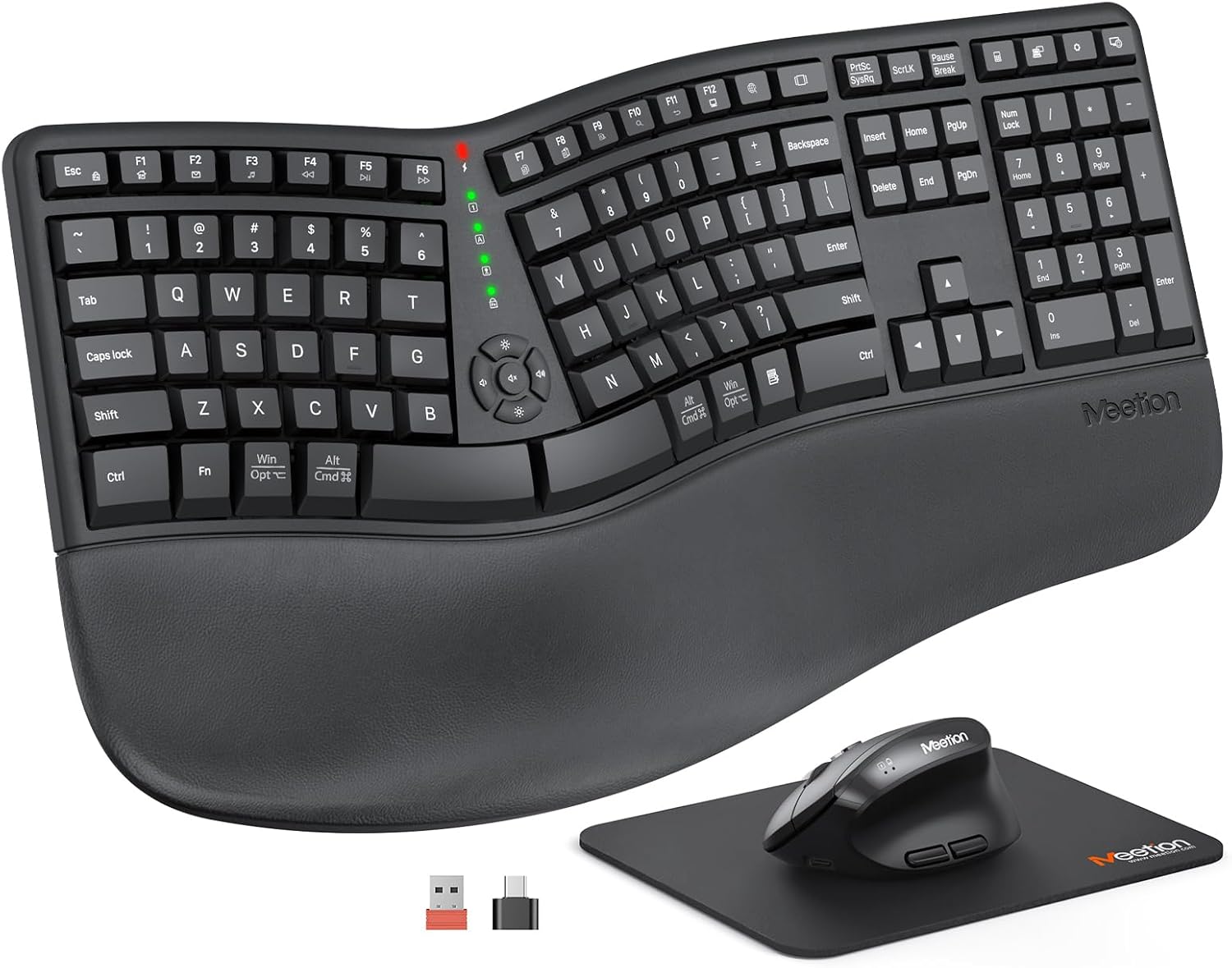
The MEETION Ergonomic Keyboard and Mouse Combo is designed for users who spend long hours at a computer and want to reduce discomfort. The split keyboard and vertical mouse work together to keep your wrists and arms in a neutral position, making it a great choice for office workers, writers, and anyone prone to repetitive strain injuries.
The standout feature is the Director-C split keyboard, which separates into two halves. This allows each hand to type at a more natural angle and distance, eliminating the twisting and reaching that cause fatigue. The concave key well and angled keys further enhance comfort by following the natural contours of your fingers. The included pillowed wrist rest adds a layer of soft, non-slip support that keeps your wrists comfortable even during marathon typing sessions.
The vertical mouse is equally impressive, offering a handshake grip that relieves pressure on the wrist and forearm. With adjustable DPI (800 to 2400), silent clicks, and a side-scrolling wheel, it handles everything from precise editing to casual browsing. Both devices are rechargeable with 500mAh batteries that last up to two months, so you seldom need to think about charging. The single USB-A receiver connects both devices reliably within 33 feet, keeping your desk free of dongles.
One potential drawback is the USB-C adapter, which must be plugged into the USB-A receiver to work. This can cause confusion if you expect the USB-C port to act as a direct connection. Additionally, the split layout demands a learning curve, and the vertical mouse may feel large for users with smaller hands. These are common trade-offs with ergonomic gear, but they are worth considering before purchase.
Overall, the MEETION combo delivers excellent ergonomic value at a reasonable price. It effectively reduces strain and improves posture without sacrificing functionality. If you want to upgrade your workstation to prevent discomfort, this set is a practical and affordable solution.

Pros
- Certified by an independent ergonomics organization
- Full-size layout keeps a familiar typing experience
- Quiet keys suited to shared workspaces
Cons
- Fixed split angle rather than fully separable key modules like the Kinesis models here
- Larger footprint than a standard compact keyboard
The Ergo K860 uses a curved, split keyframe that slopes outward, aiming to keep your wrists and forearms in a more natural position without fully separating the two halves.
Its memory foam wrist rest and three tilt angles let you fine-tune the typing posture whether you're sitting or standing, and it's certified by United States Ergonomics.
It connects over Bluetooth or the included USB receiver, and keeps a full-size layout with quiet keys, so the transition from a standard keyboard is relatively gentle.
Compared with the fully split Kinesis models in this comparison, its fixed curve is less adjustable but easier to adapt to.
It suits anyone who wants proven ergonomic credentials in a familiar, full-size keyboard shape.
Dimensions: 17.95 inches long by 9.17 inches wide by 1.89 inches high.
Connectivity: Bluetooth or included USB receiver.
Tilt options: 0, negative 4, or negative 7 degrees.
Layout: Full-size, 105 keys.
Weight: 2.6 pounds.
Who should buy this keyboard? Anyone who wants a certified ergonomic keyboard that still feels close to a standard full-size layout.
Who might want to look elsewhere? Anyone who wants fully separable key modules for maximum shoulder-width typing should look at the Kinesis Freestyle2 or Advantage360 instead.
Setup tip: Start at the flat 0 degree tilt and only add negative tilt once you're comfortable with the split shape.

Pros
- Rechargeable battery with a long rated life per charge
- Simple plug-and-play setup, no Bluetooth pairing required
- One of the more affordable split keyboards in this comparison
Cons
- Fixed split angle rather than fully separable modules
- USB receiver only, no Bluetooth option
The Arteck split keyboard uses a fixed split layout with a soft cushioned wrist and palm rest, aimed at a more natural hand position than a flat keyboard.
It connects through a nano USB receiver stored in the keyboard itself, and its rechargeable battery is rated for about six months per charge based on typical daily use.
It's backed by a 24 month warranty, and is one of the more affordable split keyboards in this comparison.
It doesn't offer Bluetooth or fully separable key modules, so it's a more modest step up from a standard keyboard than the Kinesis models here.
It suits anyone who wants an affordable, low-effort introduction to a split keyboard layout.
Dimensions: 16.5 inches long by 9.6 inches wide by 1.02 inches high.
Connectivity: 2.4G USB wireless receiver.
Battery: Rechargeable, rated around six months per charge.
Warranty: 24 months.
Who should buy this keyboard? Anyone who wants an affordable, simple introduction to a split ergonomic layout.
Who might want to look elsewhere? Anyone who wants Bluetooth or fully separable key modules should consider the Logitech K860 or Kinesis models instead.
Setup tip: The nano receiver stores inside the keyboard when not in use, so check there first if you misplace it.

Pros
- Split-key design reduces wrist strain and promotes a natural typing angle
- Low-profile brown switches offer tactile feedback with a quieter operation than traditional clicky switches
- Full NKRO anti-ghosting ensures no missed keystrokes during fast typing or gaming
- Customizable key mapping via web tool without installing additional software
- Broad compatibility with Windows, macOS, and Linux out of the box
Cons
- Ergonomic shape may require an adjustment period of 1-2 weeks for new users
- No wireless connectivity; requires a wired USB connection
- Limited onboard customization without using the Perixx website for reprogramming
The Perixx PERIBOARD-535BR is a wired ergonomic mechanical keyboard designed for professionals who spend long hours typing, coding, or writing. Its one-piece split layout separates the keys into left and right zones, encouraging a more natural hand and wrist position that can help reduce strain and fatigue. This keyboard is ideal for users transitioning from standard flat keyboards who want the benefits of ergonomics without the complexity of a fully split design.
At the heart of the PERIBOARD-535BR are low-profile brown tactile switches, which provide a noticeable bump at the actuation point for precise feedback. These switches are quieter than traditional clicky alternatives, making them suitable for shared workspaces. The stepped, curved key rows and contoured keycaps further enhance comfort by promoting a relaxed typing posture, while the full N-key rollover ensures every keystroke registers accurately even during rapid typing.
Build quality is solid, with a one-piece frame that feels sturdy on the desk. The keyboard measures 18.66 by 7.95 by 1.73 inches and weighs about 1.92 pounds, offering a stable typing platform. Custom key programming is available through the Perixx website without the need for additional software, giving users flexibility to assign macros or shortcuts. Compatibility extends across Windows, macOS, and Linux, making it a versatile choice for multi-platform users.
One potential drawback is the learning curve: the ergonomic shape may take one to two weeks to get used to, especially for those accustomed to standard keyboards. Additionally, the keyboard is wired only, which might be a limitation for users seeking a clutter-free wireless setup. Some users may also find the lack of on-the-fly customization without visiting the website slightly inconvenient.
Overall, the Perixx PERIBOARD-535BR offers a compelling blend of ergonomic design, tactile mechanical switches, and thoughtful features like NKRO and programmability. It is a strong choice for anyone looking to improve typing comfort and accuracy during long work sessions, provided they are willing to adapt to its split layout. For the price, it delivers solid value for ergonomic enthusiasts and professionals alike.

Pros
- Excellent ergonomic design reduces wrist and hand strain during extended typing.
- Customizable tilt with removable elevator for personalized comfort.
- Strong data security with AES 128-bit encryption for every keystroke.
- Convenient dedicated Windows key and back button for efficient navigation.
- Flexible number pad placement allows you to optimize your desktop layout.
Cons
- Split layout may require an adjustment period for users accustomed to traditional keyboards.
- Integrated palm rest cannot be detached for cleaning or replacement.
- No backlighting, which can be a drawback in low-light environments.
The Incase Sculpt Ergonomic Keyboard, designed by Microsoft, is a wireless split-layout keyboard aimed at professionals and heavy typists seeking to reduce wrist strain and improve posture. Its domed geometry and cushioned palm rest promote a natural typing position, making it ideal for long work sessions or anyone with repetitive strain concerns.
Key features include a removable elevator for adjusting tilt, AES 128-bit encryption for secure data entry, and a dedicated Windows key for quick navigation. The standalone numeric keypad adds flexibility, allowing you to place it where it suits your workflow. Users report a noticeable reduction in wrist fatigue after extended use.
The keyboard has a sleek black finish with a split layout that encourages a shoulder-width hand position. The palm rest is plush and supportive, though it is integrated and not removable. The keys have a comfortable scissor-switch feel, and wireless connectivity is reliable with a secure encrypted link.
The split layout may require a brief adjustment period for those used to standard keyboards, and the lack of backlighting can be a drawback in dim environments. Additionally, the integrated palm rest may not suit users who prefer a detachable option for cleaning.
Overall, the Incase Sculpt Ergonomic Keyboard offers excellent ergonomic support and security features for productivity-focused users. While it has a few limitations, its comfort and thoughtful design make it a strong choice for anyone looking to upgrade their typing experience.
Buying Guide: What to Look for in an Ergonomic Mechanical Keyboard for Carpal Tunnel
Choosing the right keyboard involves more than picking a familiar brand. Focus on these four criteria to zero in on a model that will help ease carpal tunnel discomfort.
Split or One-Piece Design
A split design lets you position each hand at shoulder width, keeping wrists straight and reducing ulnar deviation. Some models are fully separated (like the Cloud Nine C989M), while others are one-piece with a split keyframe (like the Perixx PERIBOARD-512B). Both approaches encourage a natural arm angle, which can significantly lower pressure on the median nerve. If you are new to ergonomic keyboards, a one-piece split may be easier to adopt.
Tenting and Palm Support
Tenting angles the keyboard halves upward, like an open book, so your palms face inward rather than flat on the desk. This reduces forearm pronation and nerve compression. Many models, including the Cloud Nine ErgoTKL and C989M, include built-in tenting. A supportive wrist rest is equally important; look for pillowed or memory foam padding that keeps your wrists level with the keys. The Logitech Ergo K860 offers 54% more wrist support than a standard keyboard, according to the manufacturer.
Key Switch Type
Mechanical switches provide tactile feedback that can reduce bottoming out, which may lessen finger and wrist fatigue. Brown switches (tactile) are a popular middle ground, offering a bump without being too loud. Linear switches (red) are smooth and quiet, ideal for those who prefer a lighter keystroke. The Perixx PERIBOARD-535BR uses low-profile brown tactile switches, while the RAGNOK RK104 features hot-swappable red switches. Choose a switch that matches your typing style and sensitivity.
Adjustability and Connectivity
Being able to adjust tilt anglers or add a tenting kit makes a big difference over time. Look for keyboards with adjustable legs (0, -4, -7 degrees) like the Logitech Ergo K860. Wireless connectivity via Bluetooth or 2.4 GHz reduces cable clutter, but wired models avoid battery lag. Split keyboards that separate up to 8 inches, such as the Cloud Nine C989M, allow you to customize placement on a standing desk. For more setup tips, read our guide on how to position keyboard and mouse ergonomically.
Final Thoughts
After evaluating these nine models, the Logitech Ergo K860 stands out as the best all-rounder for carpal tunnel sufferers who want a refined, ready-to-use design with exceptional wrist rest comfort. For those who prefer a fully split mechanical experience with tenting and macro keys, the Cloud Nine C989M offers unmatched adjustability and tactile feedback. Whichever you choose, pairing your keyboard with proper posture and breaks will multiply the benefits.
Frequently Asked Questions
What features help reduce carpal tunnel pain in a keyboard?
A split or tented design that keeps wrists straight, a supportive palm rest, and mechanical switches with light actuation force can all lower pressure on the median nerve. Look for adjustable tilt and enough separation to let you type with elbows at 90 degrees.
Is a split keyboard better than a contoured one-piece for carpal tunnel?
Both have merit. A fully split keyboard allows independent positioning, which may be ideal for severe symptoms. A contoured one-piece split, like the Logitech Ergo K860, offers a simpler transition and still promotes a natural hand angle. Choose based on your desk space and willingness to adjust.
How long does it take to get used to an ergonomic mechanical keyboard?
Most users adapt within one to two weeks of regular use. During this period, you might type slower at first, but wrist comfort typically improves quickly. Stick with it and consider lowering your desk height to avoid shoulder hunching.
Can a mechanical keyboard help with carpal tunnel syndrome if I already use a wrist brace?
Yes. A mechanical keyboard with a light switch and good ergonomics can reduce the force required to type, which complements a brace’s support. However, you should also consult a healthcare professional for a comprehensive treatment plan. For more tips on reducing wrist pain, read how to reduce wrist pain from typing.


Write Your Review
No reviews yet. Be the first to share your experience!