

This article covers general seating features, not medical treatment. A high back chair can support the shoulders and upper spine in a way a mid-back or low-back chair cannot, but it is not a medical device. If back pain is severe, persistent, or radiating into the arms or legs, talk to a doctor or physical therapist rather than relying on a chair alone.
Not every office chair marketed for back pain actually has a high backrest. Plenty of budget task chairs stop supporting the spine below the shoulder blades, which leaves the upper back and neck to fend for themselves during long stretches of typing or reading. This list is limited to chairs where the backrest genuinely extends up to shoulder height or higher, since that height difference is what separates a true high back chair from a mid-back chair with generous marketing copy.
If mesh breathability matters more to you than the leather executive styling several of these picks use, our high back mesh office chair picks cover the same backrest-height requirement with an all-mesh lineup instead.
We pulled six chairs currently sold on Amazon with a documented high backrest and some form of lumbar support, ranging from a simple fixed-curve design to a two-direction adjustable system. For a comparison of what lumbar support actually does independent of backrest height, see our guide on what lumbar support means before choosing between the picks below.
Disclosure: Ergonook is a participant in the Amazon Associates program. Links below are affiliate links, and we may earn a commission from qualifying purchases. This does not affect which chairs we recommend or how we rank them.

Pros
- Molded foam seat cushion holds up well over long, uninterrupted sitting sessions
- Adjustable lumbar cushion is independent of the backrest shape
- High rating relative to price point
Cons
- No independent headrest
- Fewer armrest adjustment points than the pricier picks on this list

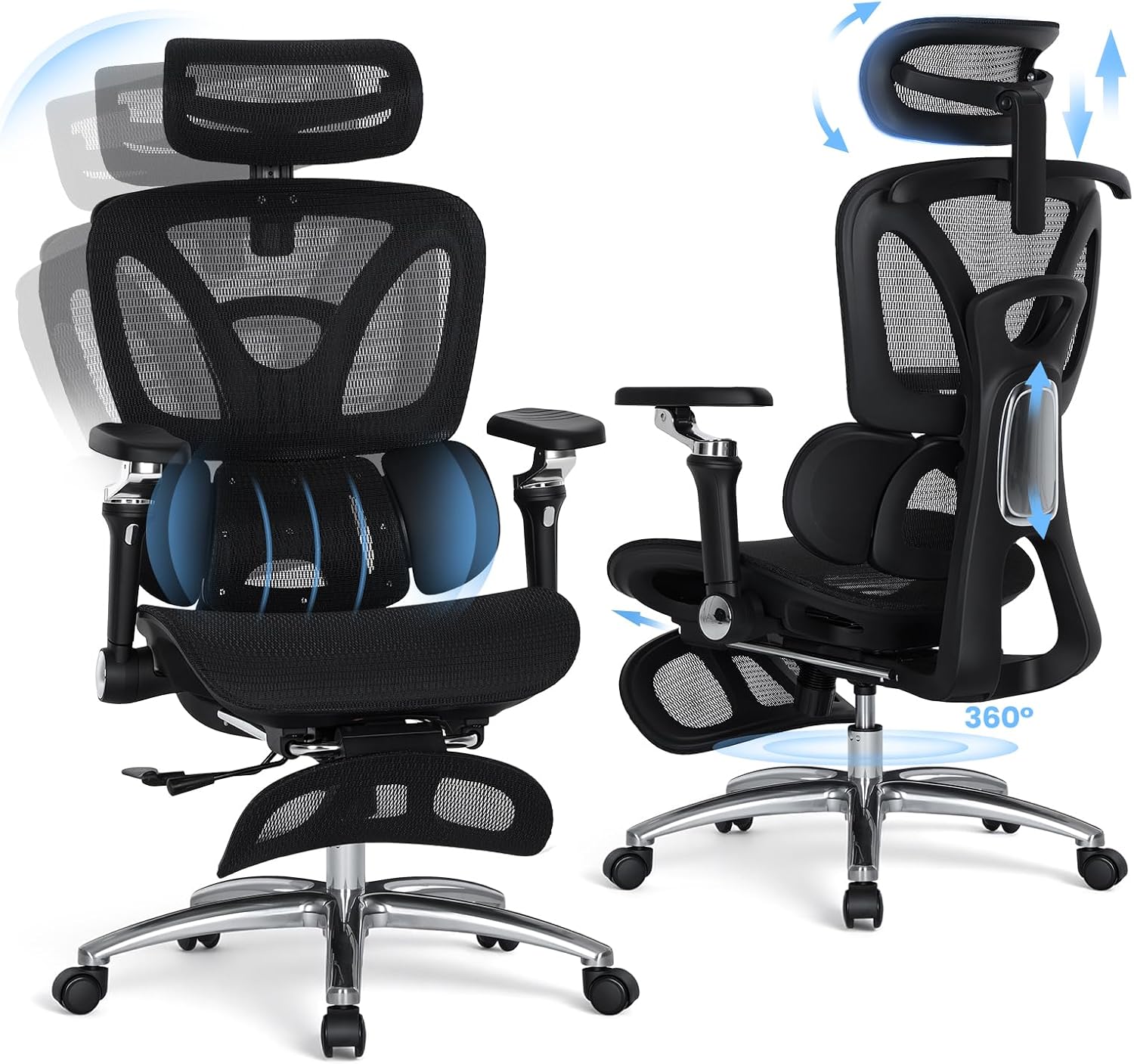
Pros
- Lumbar adjusts in two directions for a closer match to individual body shape
- Breathable mesh backrest is cooler than leather over a full workday
- 3D armrests support more posture variety than fixed arms
Cons
- Recline range is more limited than the dedicated reclining picks in this roundup
- Mesh backrest offers less cushioning at the shoulders than a padded high back

Pros
- Lumbar layer adapts to posture changes rather than staying in one fixed position
- High backrest gives shoulder and upper-back support that mid-back chairs skip
- Flip-up arms make the chair easier to fit into a tight desk setup
Cons
- Leather runs warmer than mesh over a full workday
- No independent headrest, so neck support depends on the height of the backrest itself

Pros
- Push-button lumbar adjustment is faster to use than a knob or lever mechanism
- Adjustable headrest adds neck support that some executive-style chairs skip
- Upgraded casters roll more smoothly than basic hard-plastic wheels
Cons
- Rating on this pick runs lower than the mesh options on this list
- Leather traps more heat than a mesh backrest over a full day

Pros
- Memory foam seat cushion holds shape well over repeated daily use
- Metal base and heavy-duty cylinder are built for durability under regular use
- Simple, fixed lumbar design needs no setup or adjustment
Cons
- Lumbar support is fixed rather than independently adjustable
- No headrest included

Pros
- Lumbar adjusts in two directions rather than height alone
- Independently rated to BIFMA and SGS structural standards, not just a seller claim
- Recline function adds versatility beyond a fixed upright chair
Cons
- Highest price on this list
- 300 lb capacity is lower than several other picks here
What Makes a Chair Genuinely High Back
Backrest Height, Not Just the Word “High Back”
A true high back chair supports the shoulder blades and, on some designs, the base of the neck, not just the lower and middle spine. Sit in the chair, if possible, or check the listed backrest height against your own torso length before assuming a chair labeled “high back” actually reaches that far. Chairs that stop mid-shoulder blade are closer to a mid-back design regardless of how they are marketed.
Product photos can be misleading here, since a camera angle can make a mid-back chair look taller than it is. Where available, compare the listed backrest height in inches against a chair you already own or have sat in, rather than relying on the product photo or the words “high back” in the title alone.
Fixed Versus Adjustable Lumbar Support
Some of the chairs on this list use a simple, fixed lumbar curve built into the backrest, which works well if you already know a standard curve suits your posture. Others use an independently adjustable pad, or a two-direction system that moves both vertically and horizontally, which takes a bit more setup but can match a wider range of body shapes. Neither is inherently better, a fixed curve is simpler to use correctly out of the box, while an adjustable system rewards the extra time spent dialing it in. Readers who need a higher weight rating than the picks here provide should compare our big and tall executive chair picks instead, several of which pair a high backrest with a higher-capacity frame.
Headrest as a Separate Consideration
A high backrest is not the same as a headrest. Some chairs on this list extend high enough for shoulder support but stop short of the neck, while others add a separate, adjustable headrest on top of the high back. If neck support matters as much as upper-back support, confirm the chair has both features rather than assuming a tall backrest automatically includes one.
Material and Certification
High back chairs on this list split between leather executive styling and breathable mesh, which is mostly a comfort and climate tradeoff rather than a back support difference. Where a chair lists an independent structural certification such as BIFMA or SGS, that is a more reliable signal of build quality than a seller’s own marketing claims, particularly for a chair that will see daily use for years. For general guidance on evaluating any ergonomic chair beyond back-pain specifics, see our ergonomic office chair buying guide.
Leather also tends to concentrate heat across a wider surface area than mesh, since a high backrest covers more of your back than a mid-back design. If you already run warm during the day or work in a room without strong air conditioning, that difference is worth weighing more heavily for a high back chair than it would be for a smaller mid-back model.
Final Thoughts
For a straightforward, budget-friendly option that prioritizes seat comfort alongside a genuine high back, the Molded Foam Cushion High Back Chair pairs a 4 inch molded foam cushion with an adjustable lumbar cushion at a lower price than most of the field here. For a shopper who wants the most configurable chair on this list and is willing to pay for independent structural certification, the GABRYLLY 2-Way Adjustable Lumbar High Back Chair combines two-direction lumbar adjustment with a 135 degree recline and BIFMA and SGS ratings. Both are reasonable starting points before comparing the executive leather picks further down the list.
FAQ
Is a high back chair automatically better for back pain than a mid-back chair?
Not automatically. A high back adds support for the shoulders and upper spine, which helps if that is where discomfort shows up, but it does not replace the need for good lumbar support in the lower back. Someone whose pain is limited to the lower back may get equal benefit from a well-designed mid-back chair with strong lumbar support, and may find a high back chair unnecessarily bulky for a smaller desk setup.
Does a high back chair need to include a headrest?
No, the two are separate features. Some high back chairs stop at shoulder height without a headrest, which is fine if neck support is not a priority. If it is, confirm the chair has an adjustable headrest in addition to the high backrest rather than assuming one feature implies the other is included.
How do I know if a fixed lumbar curve will work for me?
The only reliable way is to sit in the chair, if possible, or compare the manufacturer’s stated lumbar curve position against a chair you already find comfortable. If you have had trouble with fixed-curve chairs before, an independently adjustable lumbar pad gives more room to correct for that, though it does require spending a few minutes setting it correctly rather than sitting down and expecting it to fit immediately.
When should I see a doctor instead of just changing chairs?
If back pain is severe, does not improve with a better chair and regular movement, or radiates into the arms or legs, that is a signal to see a doctor or physical therapist. A high back chair is a comfort and posture-support tool, not a diagnosis or a treatment plan.
It is also worth tracking whether the pain changes with posture at all. Discomfort that improves noticeably with a better-supported upright position is more likely to respond to a seating change, while pain that stays constant regardless of position is a stronger signal to seek a professional evaluation rather than continuing to try different chairs.




Write Your Review
No reviews yet. Be the first to share your experience!